
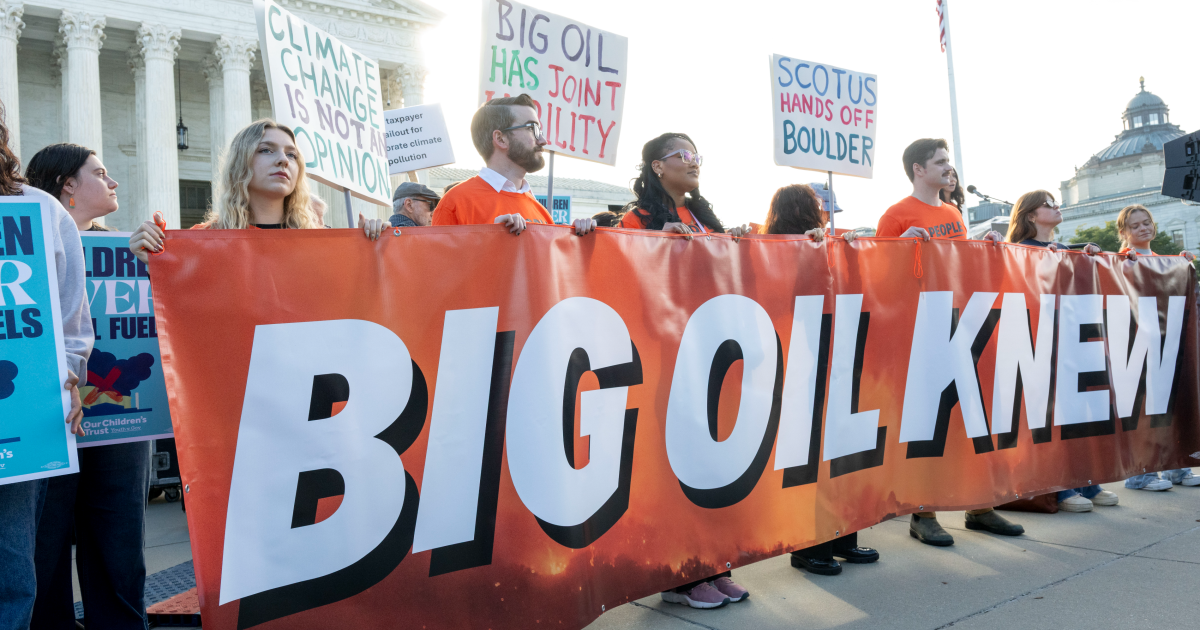
Climate disaster survivors, Colorado ranchers, Boulder County youth and climate accountability advocates rally outside the U.S. Supreme Court in Washington, Monday, Oct. 5, 2026.Kevin Wolf/AP Get your news from a source that’s not owned and controlled by oligarchs. Sign up for the free Mother Jones Daily. On Monday morning outside the Supreme Court, as Justices heard arguments concerning a landmark climate liability lawsuit, a rally organized by the Center for Climate Integrity and Fossil Free Media drew a crowd of roughly one hundred people. Many carried signs with messages like “Climate Change is No Accident,” “SCOTUS Hands Off Boulder,” and “Warning: Burning Fossil Fuels Can Destroy Civilization.” At several points, The People v. Big Oil gathering chanted “They knew, they lied” in a call-and-response, referencing fossil fuel scientists and executives who knew more than 50 years ago that burning fossil fuels would raise global temperatures, and instead sowed doubt to undermine scientific evidence. As Louie Delaware, a survivor of the 2021 Marshall Fire told the crowd, “No company or industry should gain an advantage by hiding facts that people need to protect their health, their communities, and their future. The bottom line is that they knew, they lied, and they must be accountable for their actions.” Delaware lost his home along with roughly 50 others on his street when the fire devastated Boulder, Colorado. His family was displaced for more than two and a half years. Other survivors of the Marshall Fire spoke at the rally, as well as survivors of the 2025 Eaton fire in Altadena, California. Meanwhile, inside the courtroom, the justices heard arguments in Suncor Energy v. Boulder, widely regarded as a seminal case concerning the issue of whether or not local governments can demand damages from fossil fuel companies for their contributions to climate change. The fossil fuel companies are arguing that a state court can’t hold multinational companies accountable for global harm. As I reported last week: The case revolves around a dispute between the City and County of Boulder, which first sued the energy companies in 2018. They are arguing that Suncor and Exxon deceived the public about the dangers of climate change and should be forced to pay damages for climate-induced heat waves, wildfires, droughts, and floods. “The damages will only multiply as climate change worsens,” Boulder stated in its lawsuit. Suncor and Exxon, meanwhile, are asking the justices to kill the case before it makes it to trial—and with it a host of other state-level climate cases. Depending on how the eight justices rule—Justice Samuel Alito announced what some considered to be an 11th hour recusal earlier this week—the case could have far-reaching consequences for people [in Colorado]. But its implications extend beyond the state’s borders: dozens of other climate-related lawsuits hang in the balance of how Suncor v. Boulder is decided. “The Eaton Fire took my sister and eighteen other people. My family lost five homes, including my childhood home,” said Zaire Calvin, who lost his sister, Evelyn McClendon to the disaster. “From Altadena to Boulder, we carry different stories. Today, we stand together in one demand: let the evidence be heard. Let responsibility be determined.” California’s own climate liability lawsuit against major oil companies is currently on hold while the Supreme Court weighs in on the Boulder case. “From Altadena to Boulder, we carry different stories. Today, we stand together in one demand: let the evidence be heard. Let responsibility be determined.” Former Washington state Gov. Jay Inslee was also present on Monday outside the courtroom. “The fossil fuel industry malignantly and maliciously lied to the American people, and I’ll be damned if I let them take away an American right to hold industries accountable and have their day in court,” he said. “They knew for decades what the consequences of their products were, and they chose to lie.” In 2021, Inslee signed Washington’s Climate Commitment Act, a market-based cap-and-invest program to reduce greenhouse gas emissions, and has emerged as a leading voice against industry pushing against sweeping immunity laws against climate liability lawsuits. Neighborhood home during the Marshall Fire in Boulder, Colorado on December 30, 2021. Louie Delaware When the speeches ended, I spoke with Deirdre Macnab and Dr. Kathryn Bedell, two regenerative cattle ranchers from Rio Blanco County who had traveled to Washington for the event. After interviewing Macnab last week, I asked her what it felt like to be in front of the Supreme Court. “I’m glad it’s coming to the Supreme Court. Now we need to come together. We can solve this,” she said. “But we’ve got to bring the big boys to the table, and that’s the oil companies.” Fellow rancher Bedell echoed her call to action, and underscored the devastating effects of wildfires, drought, and extreme heat. “I think there isn’t anybody here who should be able to deny the impacts of climate change. It’s going to be obvious in our food supply pretty soon if we don’t change,” she told me. “If you can’t grow food, we have to import it, and we won’t have any food security or control over the price. People should be terrified. It terrifies me.” Bedell, a sixth-generation farmer who has been a rancher for over three decades, has been forced to sell her cattle. “I’ve had these same cattle for generations, so I know them all personally. They’re moving to the sale yard on December 19.” As oral arguments drew to a close, I spoke with Louie Delaware and another Marshall Fire survivor, Jenny Singer-Rupp. “One of the tenets of a free democracy is ‘the David’ can go after ‘the Goliath’. Everybody deserves their day in court to be able to prove their case,” Delaware told me. He pointed to settlements by the tobacco industries and pharmaceutical companies over opioid addiction, adding, “They’re huge entities, but there are a lot of huge entities that have been taken down in court.” Singer-Rupp is simply fighting for her children. “My kids talk to me about climate change and natural disasters, and they’re worried about their future,” she said. “I never thought I’d be standing in front of the Supreme Court. But I’m doing everything I can to protect that future for them.”
“They Knew, They Lied”: Fire Survivors Bring Their Fight to the Supreme Court’s Steps
Full Article
Original Source
Read the full article at Motherjones →KhanList aggregates and links to publicly available news content. We do not host full articles from third-party sources. Always verify important information with original sources.