
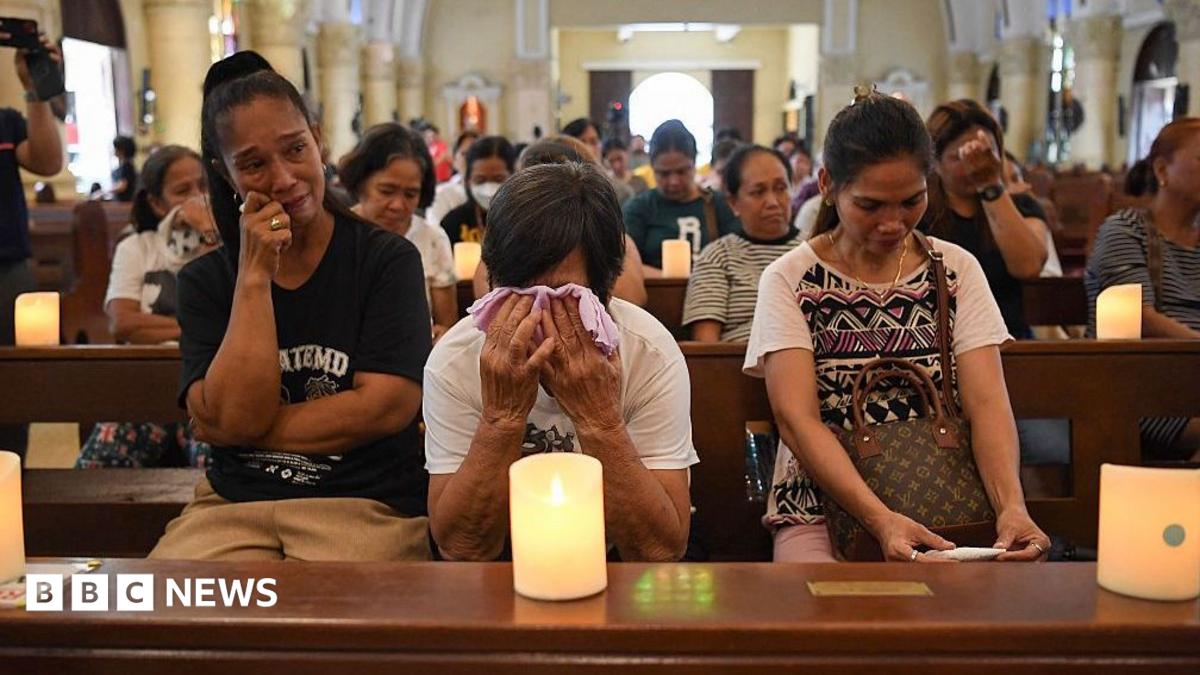
When the International Criminal Court opens the trial of former Philippines president Rodrigo Duterte on Monday for crimes against humanity, it will also open the lid on one of the most violent and divisive episodes in the country's history.Duterte's supporters – and he is still popular – argue that he should not even be at The Hague, accusing the current government of President Ferdinand Marcos of selling out national sovereignty by sending him to a foreign court. But for the families of the thousands of victims of Duterte's anti-drug campaign, the trial brings the comfort of accountability and public acknowledgement of their suffering, which they have been denied in the Philippines in the 10 years since the killings began.Duterte, 81, is charged with three counts of murder and attempted murder during his anti-drugs campaign, in which thousands of alleged dealers were shot and killed. Many families say their relatives were innocent.The tears stream down Leonila Ignacio's face as she recalls the day her 15-year-old daughter Princess disappeared seven years ago. She had agreed to meet us in the chapel of a church foundation in Manila, because she does not feel safe talking about it near her home. In the bitterly polarised political climate of the Philippines victims' families have often been attacked and threatened on social media.Princess had gone to meet a group of boys, and was seen on a CCTV video being rounded up and bundled into a police vehicle. When she checked with the police they denied taking her. She says she got no help at all."It was so hard back then. You feel you are going crazy, you just want to give up, but you can't because there's a life you're fighting for. Even if they showed just the body of my child… it is so hard. I still carry it with me, it still hurts. Even if I want to, I cannot hold back the tears."She is accompanied by Randy Delos Santos, whose 17-year-old nephew Kian was shot dead by police in August 2017. His was one of the very few cases of killings in the drug war which was properly investigated, thanks to overwhelming evidence that the police had shot him while he was unarmed and in their custody. Three police officers were convicted of his murder. Yet his uncle is still grateful to see Duterte on trial at The Hague."Thank goodness there is a court that paid attention. Thank goodness there are people willing to help, to see that widespread killings happened here in the Philippines. That someone in power abused their authority and used it to violate the human rights of their citizens."He said he too had to investigate Kian's murder by himself, with little help from the police.For those of us who reported the drug war, it was one of the most distressing stories we had ever covered. The bodies started turning up pretty much from the day Duterte was sworn in as president in 2016.On the campaign trail he had made a series of blood-curdling pledges, saying he would kill 100,000 criminals and fatten the fish in Manila Bay with their bodies.But many people assumed this was just his tough-man image talking, that he would not try to scale up the brutal anti-crime policies he had implemented as mayor of the southern city of Davao, earning him the nickname "The Punisher".The killings were carried out by police officers on so-called tokhang, or door-knocking operations, against those suspected of using or dealing narcotics.Invariably these would result in the targets being shot dead, the police claiming they had resisted arrest, or fought back. Then there were the hit squads, ununiformed assassins usually on motorbikes, hired either by the police or drug syndicates, who would shoot victims as they drove past.In 2016 I interviewed a young woman who had been recruited as an assassin by a corrupt police officer who was involved in the drug trade. She said she had killed five people in the three months since Duterte's election.She was clearly distressed by what she was doing – she had been forced into doing it to get her husband out of jail, she said. At the time she was going into hiding in fear for her life. We have never been able to find out what happened to her after that.At times it seemed the killing was getting out of control. The police appeared to be trying to meet quotas. The president, far from restraining them, urged them to carry on, and not to worry about legal repercussions. I will be the one who will go to jail for you, he told them.When 32 were killed in a single night in Bulacan, a province north of Manila, in August 2017, Duterte said he would like to see 32 killed every night. At one point he compared himself to Adolf Hitler.The ICC has charged him in relation to the deaths of 76 people, though prosecutors say these should be seen as examples from a much wider pattern of killings. The cases date back to before his election as president, to his time in office in Davao where he is alleged to have run death squads.As president, Duterte withdrew the Philippines from the ICC in March 2019. But the court says it still has jurisdiction over alleged crimes committed before that date, and that the failure of the Philippines to investigate and prosecute those responsible for the mass killings during the drug war gives it the authority, as a "court of last resort", to try them at The Hague.Duterte has denied the charges, his lawyers arguing the death toll during the drug campaign was caused by excessive police enforcement, not an official policy of killing drug users and dealers.He is the first Asian leader to be tried at the ICC, and if found guilty, would be the first former head of state or government to be convicted there. Yet the case remains very controversial in the Philippines.The way he was taken to The Hague outraged his supporters. He was whisked by police officers onto a private jet at Manila airport in March last year, after returning from a trip to Hong Kong, right after the ICC indictment was made public.The Duterte family had formed an alliance with the Marcoses to fight the 2022 election, winning Ferdinand Marcos Jr the presidency and Sara Duterte, Rodrigo's daughter, the vice-presidency.But by last year the partnership had broken down, each side trading scathing attacks on the other. The Dutertes believe that the extradition was a purely political manoeuvre by the Marcos administration to weaken them.This argument, tapping into public sympathy for the ageing ex-president, probably helped pro-Duterte candidates in the mid-term election for the Philippines Congress last year, and is still used by Sara Duterte, who is widely considered a front-runner for the next presidential election in 2028.Even though they exacted a shockingly high human toll, Duterte's drug policies remain popular in much of the country. That makes accountability for the thousands of deaths difficult."When we post something about a mother whose child was killed, most of the reactions on Facebook are laughing emojis. It drives me crazy just looking at it," says former journalist and human rights campaigner Carlos Conde. Speaking to us at the office of the newly created Truth Commission, he described how much online hostility the families of the victims received."There's not a lot of remorse expressed over what Duterte did. In fact, if you just look at social media and how people talk about the drug war comparing then and now, you still see that."The Truth Commission is trying to document every killing. So far they have listed 8,320 between 2016 and 2022, when Duterte left office. But they believe there are many thousands more. The records were bad, Conde says. Even some of the death certificates are fraudulent.I returned to a neighbourhood in central Manila I had visited in 2016. Back then I found wide support for Duterte and his drug campaign among the residents, but also some unease.The local administrator had told me that most of the users and dealers were local pedicab drivers, and that he had tried to save their lives by getting them to register as addicts. But he also worried that once they were on an official list, this could make them even more of a target.I asked his replacement, Rosauro Almario, whether the drug war had worked in her district. It did reduce the drug problem, she said, though as a Christian she felt there were more humane ways of dealing with addicts.Sentiment among residents had not changed much either. Most people we spoke to believed Duterte's approach had helped clean up the neighbourhood, but among the pedicab drivers there was a different feeling. It was bad, said one man – if you were rich, you lived, if you were poor, you died.That is one of the strongest indictments of Duterte's drug campaign, that it was in effect a war on the poor.In a riverside community of tiny dwellings made from discarded plywood and cardboard I met Jesusa, a 68-year-old woman whose son Frederick was detained by police in December 2016 in front of the church. When his body was found later, it was tied up with wire. He had been shot dead. There was no investigation."They wanted everyone dead," she said, "because they got promoted. We even heard that from the police. Their rank goes up, and there's extra money. So they just kept killing and killing. Many were even thrown into the river. Even those who were still alive, thrashing in the water, they wouldn't survive because they put weights on them. And right there by the bridge, we'd hear the gunshots."On 30 November Jesusa plans to watch the start of the trial when it is broadcast live. She does not have a television, so she will watch on a neighbour's set."What I pray is that he gets punished too. That's my prayer to God – that whatever debt he has, he pays for it."
'They just kept killing': Ex-president's murder trial to re-open memories of violent drug war
Full Article
Original Source
Read the full article at Bbc →KhanList aggregates and links to publicly available news content. We do not host full articles from third-party sources. Always verify important information with original sources.