
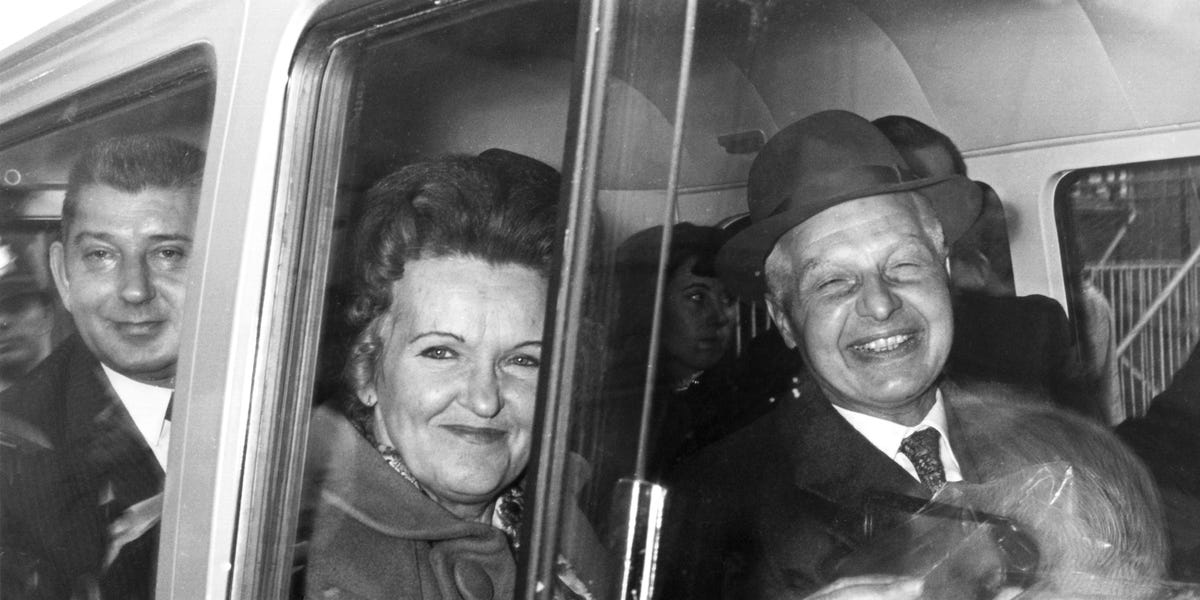
6 min readMorris and Lona Cohen escaped arrest in 1950 after Lona delivered a complete atomic bomb diagram from Los Alamos to Soviet handlers, fleeing America before the FBI could apprehend them.The Cohens reinvented themselves as British booksellers Peter and Helen Kroger in London, operating a Soviet spy ring that transmitted naval secrets to Moscow until their arrest in 1961.After serving less than a decade of their sentences, the Cohens were exchanged for a British prisoner in 1969 and became decorated Soviet heroes.In the fall of 1950, while America was still reeling from the summer arrests of Julius and later Ethel Rosenberg, who were accused of passing along nuclear secrets to the Soviet Union, another New York City couple received an ominous warning from a friend: “Go now. Leave the lights on, walk out, don’t look back.”That couple was Morris and Lona Cohen. And if hell had come for the Rosenbergs, then what could come for the Cohens was unfathomable.Because the Rosenbergs had only facilitated the smuggling of some nuclear secrets. Lona Cohen had given the USSR a complete working diagram of the atomic bomb, straight from Los Alamos.But in lieu of a high profile arrest and headline grabbing trial, the Cohens were able to slip out into the night undetected. They would never set foot in America again, and the spying career of Morris and Lona Cohen had come to an end. The spying career of British booksellers Peter and Helen Kroger, however, was only a few years away.The Cohens of New York CityMorris Cohen had been a true believer in the Communist cause for years before he met Lona, having been radicalized in the wake of the Great Depression. By 1935, he was a card-carrying member of the Communist Party, and in 1937 he travelled with the Abraham Lincoln Brigade, a volunteer group that joined the fight against Francisco Franco’s nationalist forces in the Spanish Civil War.Lona, born Leontine Theresa Petka, had left her Polish immigrant parents behind in Massachusetts when she was just 15 years old. She moved to New York City, became an avowed socialist, and then became an equally avowed Communist.When Morris suffered a leg injury in combat, he was sent to Barcelona to recover. There, Soviet spy Amadeo Sabatini swooped in and recruited Morris, not for his demonstrated spy skill so much as for his absolute unwavering devotion to the cause. Morris returned to the United States in November of 1938, now with the code name “Luis,” and began his work as part of the “резиденту́ра” (pronounced “rezidentura”)—the Soviet term for a base of espionage operations in a foreign country.Morris met Lona as a matter of course, since they both travelled in the same Communist circles. They fell in love, and in 1941, they got married. Yet, what Lona did not know before tying the knot was that her marriage gave her more than just a new surname, it gave her a place in the “резиденту́ра.”Before her marriage to Morris, Lona had not been a Soviet spy. Now, not only would she join her husband in acts of espionage, but she would have to pick up the slack when U.S. government machinations accidentally interrupted Morris’ spy career.Morris at War, Lona at Los AlamosIn 1942, Morris Cohen, secret Soviet spy, was called back to the battlefield; only this time, he hadn’t volunteered. Morris was drafted into the U.S. Army just a few months after the attack on Pearl Harbor thrust the United States into World War II, and like many men sent to fight on the European front, Morris’ wife was left to hold down his responsibilities on the home front. Though, unlike many of those men, those duties also included the workload “Luis” had to handle as part of the “резиденту́ра.”Lona picked up her husband’s slack in the endeavor the Soviets had named Line X—a network of American sources and Soviet handlers who collected intel on America’s technical and industrial secrets, including weapons development. Lona would work at two different defense factories, gathering secrets, until “the big one” appeared on the Soviet Union’s radar.After that, Lona Cohen had one singular mission: obtain the secrets of the weapon to end all weapons—the atomic bomb.Relocating to New Mexico under the guise of “health concerns,” Lona Cohen was sent to obtain information from Los Alamos physicist Theodore Hall. What he eventually delivered to her outside an Albuquerque church in August 1945 (they had been meant to rendezvous on July, but Hall had gotten the dates wrong, so the atheist Lona endured a month of Sunday mass for the cause) was the complete diagram of “Fat Man,” the nuclear weapon that was dropped on Nagasaki on August 9th.Lona Cohen hid the documents inside a Kleenex box, shepherding them back to New York and her Soviet handlers without detection. A few months later, Morris would return home from the war, and the couple’s espionage efforts became more muted—though they would, in 1949, find themselves working with Rudolf Abel (later part of the infamous Gary Powers exchange).Then came the arrest of Klaus Fuchs in 1950, followed by the arrests of Julius and Ethel Rosenberg, the knock on the door, the note reading “Go now. Leave the lights on, walk out, don’t look back,” and the fleeing into the night. The couple spent a few years in Poland, teaching English and undertaking foreign missions for the USSR.Finally, in 1954, came the London assignment, and the new identities of Peter and Helen Kroger.The Krogers of the U.K.Carying forged New Zealand passports, the now-named Peter and Helen Kroger moved to Ruislip in west London. Their purported work as antiquarian booksellers gave them an alibi for what might have otherwise looked like suspicious behavior; the couple were seen as more quirky than conniving, even when locals overheard them listening to broadcasts from Radio Moscow when they paid social calls.They had also arrived in London just two months after Gordon Lonsdale, a Canadian who operated a business selling jukeboxes and bubble gum machines. From the outside, the booksellers and the jukebox dealer appeared to be linked only by a shared love of capitalism. In reality, Gordon Lonsdale was Konon Molody, head of the Portland spy ring. Molody would obtain secret information from actual British nationals Harry Houghton and Ethel Gee, and then bring that information to the “Krogers,” who then used a radio transmitter they had hidden in their basement to transmit the information to Moscow.In 1957, the Cohens would become known to US intelligence by their original name, when photographs of them were found in the possession of the recently arrested Rudolf Abel. Had the Cohens not heeded that late-night note, they may well have been arrested shortly thereafter, but by escaping to Europe, they bought themselves a few more years of freedom. Unfortunately for the Cohens (now the Krogers), their new spy network wasn’t entirely safe either.In his memoir, MI5 officer Peter Wright recounted that Harry Houghton landed on the agency’s radar after a Polish spy under the moniker “Sniper” identified a traitor within the British Navy. “Sniper” could only identify the man as “Horton,” and that he had incidents of drunkeness in Warsaw, but that was enough for MI5 to identify the inebriate undercover operative as Houghton.The 1961 arrest of Houghton became the first domino that led to the downfall of the Portland spy ring, which included the arrests of the Cohens under their new names. Lona (or Helen) was sentenced to 20 years in prison, Morris (or Peter) was sentenced to 25 years. But neither would serve their full sentence.In 1969, the couple were part of a prisoner exchange, and were relocated to the USSR in exchange for a British teacher who had been arrested by the KGB for “distributinganti-Communist propaganda.” The Cohens were given a heroes welcome in the USSR, being awarded the Order of the Red Banner and later the title of Heroes of the Russian Federation.A single note on an autumn night turned the Cohens into medal-wearing heroes of the Communist cause. Eventually, they died of old age, rather than as another pair of occupants for Sing Sing’s electric chair alongside Julius and Ethel Rosenberg.Michale Natale is a News Editor for the Hearst Enthusiast Group. As a writer and researcher, he has produced written and audio-visual content for more than fifteen years, spanning historical periods from the dawn of early man to the Golden Age of Hollywood. His stories for the Enthusiast Group have involved coordinating with organizations like the National Parks Service and the Secret Service, and travelling to notable historical sites and archaeological digs, from excavations of America’ earliest colonies to the former homes of Edgar Allan Poe.
They Handed the Soviets the Blueprint for the Atomic Bomb—and Remained At Large for 10 More Years
Full Article
Original Source
Read the full article at Popularmechanics →KhanList aggregates and links to publicly available news content. We do not host full articles from third-party sources. Always verify important information with original sources.