
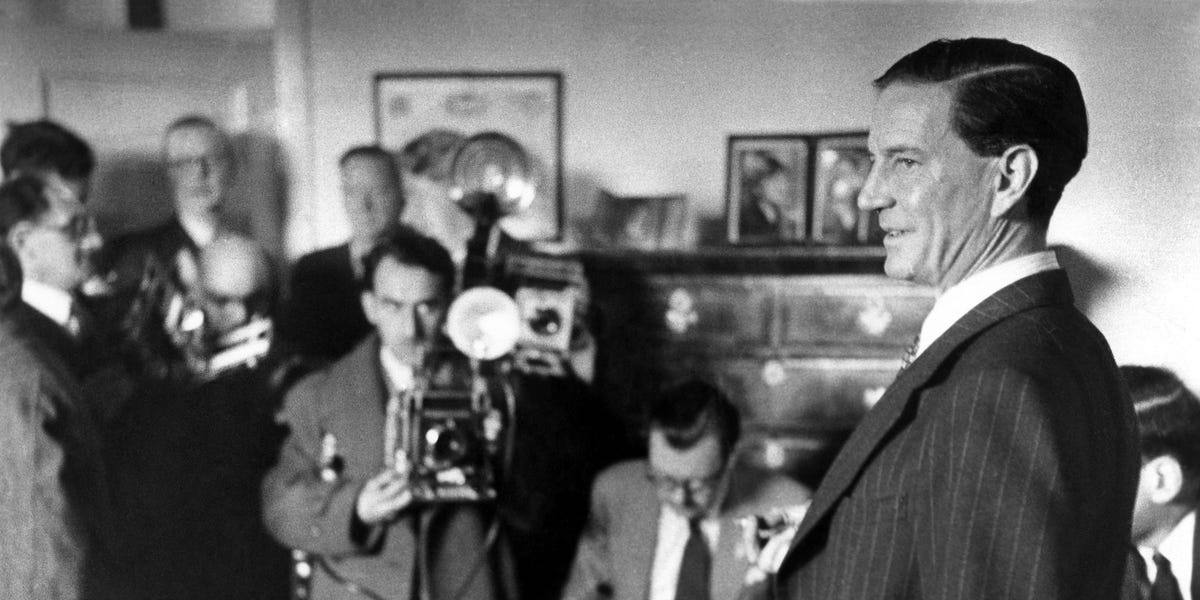
5 min readHere’s what you’ll learn when you read this story:After the Depression took a heavy toll, five University of Cambridge students became disenchanted with capitalism. The young men were recruited by Soviet forces to join what they were told was a fight against capitalism to promote a communist utopia, and they soon became double agents.Though they all eventually confessed, the infamous Cambridge Five are remembered as traitors to the British cause during the Cold War. They were supposed to be shining beacons of society. Donald MacLean was the son of a Cabinet minister. Anthony Blunt was a math whiz who became an art historian. John Cairncross was a language scholar and something of a savant. Kim Philby was the son of an intelligence officer. Guy Burgess was Philby’s outlandish but brilliant friend. Nepotism aside, these five men who all graduated from Cambridge University, one of Britain’s most prestigious institutions, were all involved in a treasonous double-agent spy ring, letting the KGB in on British intelligence secrets.Cambridge was seething with political debate when the five men were students in the 1930s. As the working class suffered during the Depression, and Nazi Germany spread like a stain over what remained of democracy, they began to believe that capitalism was slowly but inevitably poisoning itself. What they were completely unaware of is that one of their own—Anthony Blunt, a Trinity don—was already working with Soviet intelligence, feeding names of promising recruits to a mysterious handler in London. The group that would come to be known as the Cambridge Five or the Magnificent Five were arrogant, flagrantly iconoclastic rebels, the product of an era when the prosperity and hope once fueled by capitalism had faded. That’s exactly what the Soviets preyed on.Philby, MacLean, and the others earnestly believed that they were being recruited by the KGB as potential heroes rather than traitors. They were all burning to fight fascism. Soviet recruiters took advantage, asking young Brits whether they were committed to toppling the Nazi regime without betraying Stalin’s totalitarianism. Philby, who started out as an investigative journalist but was bent on being a government agent, was intrigued. After he traveled to Spain on what may have been a mission to assassinate Franco—which apparently failed when his car was taken out by an enemy shell—Philby emerged a Soviet hero. He and the other four wormed their way into positions of power in Britain that allowed them to exchange classified information with the KGB. Burgess had access to political leaders through his radio career, and was even praised by an unwitting Winston Churchill.Everything was turned on its head in 1939. When Stalin abandoned the utopian cause and made a pact with Hitler, many supporters turned against him, but not the Cambridge Five. They were called upon when the domestic and foreign arms of Britain’s intelligence services, MI5 and MI6, were understaffed at the outset of the war. Maclean, who was already working in the Foreign Office as a career diplomat, used his diplomatic postings to funnel classified communications to Moscow. Burgess, meanwhile, parlayed his charisma and gift for propaganda into a post with MI6’s Section D, later moving into the Foreign Office’s News Department. It was Burgess who recommended Philby for a role in Section D as well. Philby led a two-faced existence, training recruits in propaganda by day and transferring classified files to the KGB after dark. Cairncross, for his part, worked at Bletchley Park decrypting German Enigma codes before later transferring to MI6, and he turned some of the war’s most sensitive secrets over to the Soviets along the way.These men were somehow able to elude the scrutiny of British authorities when handing information to KGB agents. Under cover of night, they liaised in secret locations, and sometimes even that carried too much risk, so they would leave stacks of files waiting for pickup in discreet places. Sometimes they met in broad daylight, choosing crowded areas where nothing suspicious would stand out. Once, Burgess was almost caught in a pub when he accidentally knocked over his drink and papers dangerously close to an off-duty police officer. The Five also supplied the Soviets with German intelligence when Hitler broke his pact with Stalin. By the end of the war, the Soviet Union had obtained information from them about Britain’s atomic bomb development, which came on the heels of America’s covert Trinity experiment (the prototype of the bombs detonated over Hiroshima and Nagasaki).Philby ended up being the only member of the Cambridge Five who stayed with the British Secret Intelligence Service as the others moved on to different government positions. He was now Britain’s head of anti-Soviet counterintelligence, officially tasked with spying on the Soviets, but secretly reporting everything he knew straight back to them. By 1951, Philby had spent roughly 17 years as an undercover Soviet operative, using his senior post in British intelligence to sabotage missions aimed at the USSR. Some of his most devastating betrayals targeted Ukrainian resistance agents, dozens of whom were recruited by MI6 to parachute into Soviet Ukraine and organize an uprising. Philby revealed the missions’ dates, drop zones, and even the names of the participants to his KGB handlers. Group after group vanished without a trace after landing, captured or killed by Stalin’s secret police, who were waiting for them all along.It took until 1963 for consequences to catch up with Philby, though clues about his activities surfaced much earlier. After Burgess and Maclean’s defection in 1951 cast suspicion his way, Philby was quietly forced out of MI6. He talked his way through a public inquiry in 1955, emerging officially cleared, and resumed intelligence work under a cover as a Middle East correspondent for the London Observer in Beirut. It was only when a Soviet defector’s testimony reopened the case that MI6 sent an old friend, Nicholas Elliott, to confront him—and this time, Philby couldn't talk his way out. British authorities almost had him in their grasp. Yet while Philby’s confession (which was partially released to the National Archives in 2019) was enough to warrant prosecution, he managed to get away. Offered immunity in exchange for full cooperation, he instead used the delay to slip away, defecting to Moscow before British authorities could act. He would spend the rest of his life there, dying in 1988 and buried with full Soviet military honors, having evaded justice to the very end.“It was a slow and brain-racking process; my transition from a Socialist viewpoint to a Communist one took two years,” Philby said in his 1968 book My Silent War. “It was not until my last term at Cambridge, in the summer of 1933, that I threw off my last doubts. I left the University with a degree and with the conviction that my life must be devoted to Communism.”In the end, not one member of the Cambridge Five was ever convicted of espionage in a British court. Burgess and Maclean escaped justice by fleeing to Moscow before they could be tried. Blunt confessed but was granted immunity in exchange for his cooperation. Cairncross admitted his own role, but evidentiary hurdles kept prosecutors from ever bringing him to trial. The world learned the details of their betrayal through their defections and confessions, but the full scope of their lives as double agents only emerged very gradually, through the slow drip of official disclosures.Elizabeth Rayne is a creature who writes. Her work has appeared in Popular Mechanics, Ars Technica, SYFY WIRE, Space.com, Live Science, Den of Geek, Forbidden Futures and Collective Tales. She lurks right outside New York City with her parrot, Lestat. When not writing, she can be found drawing, playing the piano or shapeshifting.
They Graduated from Britain’s Best University—Then Spent Years Working as Soviet Spies
Full Article
Original Source
Read the full article at Popularmechanics →KhanList aggregates and links to publicly available news content. We do not host full articles from third-party sources. Always verify important information with original sources.