
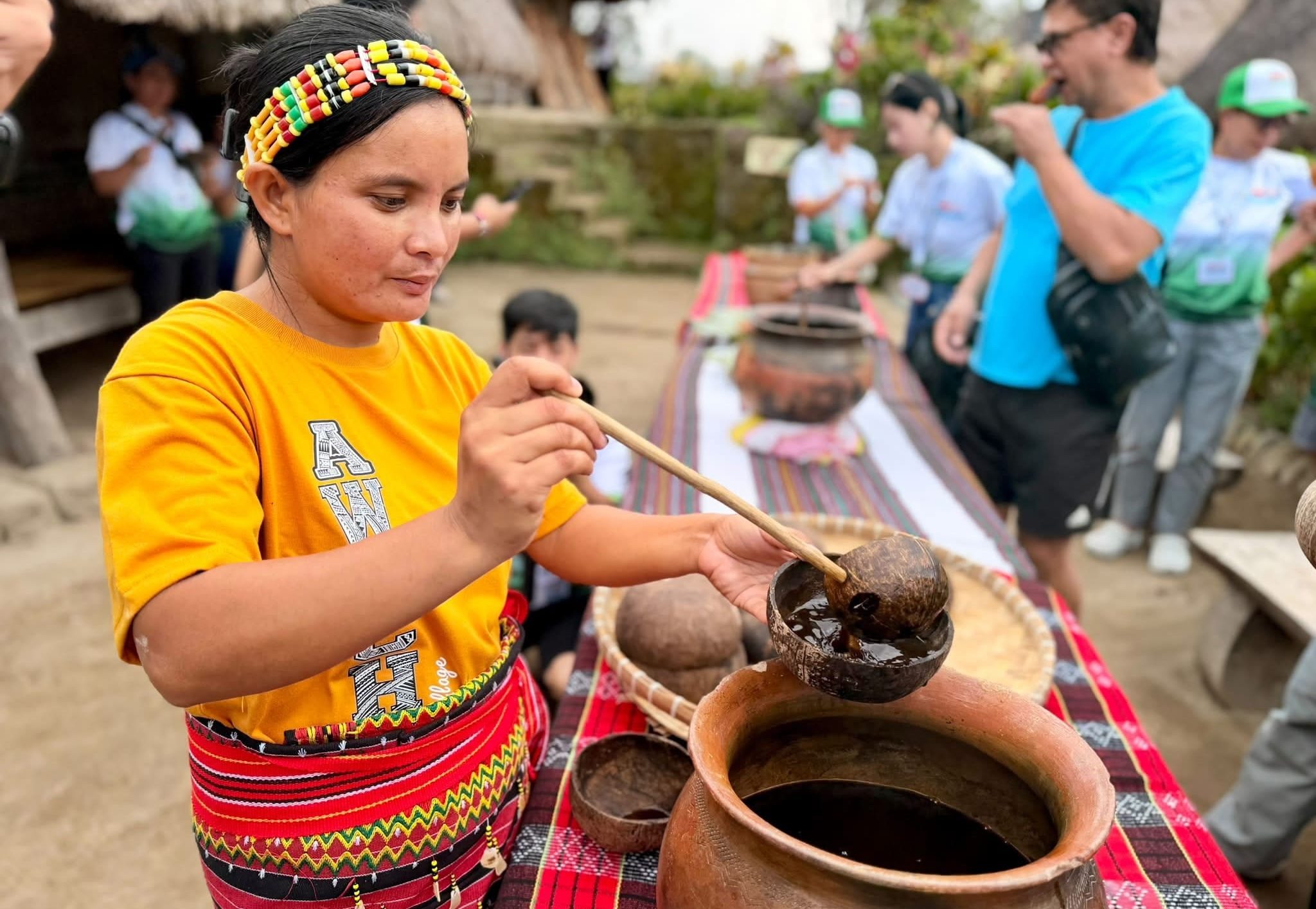
BAGUIO CITY, Philippines – At 27, Izadee Nabunat has spent much of her life in Australia knowing she is Cordilleran. But she still has questions about the ancestral homeland she calls home. Three days into a journey across the Cordillera, she stood before fellow travelers, tourism officials, and cultural performers at Mount Data Hotel, struggling to put the experience into words. “Being a Cordilleran who grew up overseas, there has always been curiosity within me in regards to our culture and history,” she said. The journey had answered some of those questions, she explained, but had also made her want to learn more. Then she turned to the Department of Tourism (DOT) officials who had organized the trip. “DOT, if your target was our hearts, I can confirm you’ve captured ours completely.” Izadee Nabunat, a Cordilleran from Sydney, Australia, treks through the UNESCO-listed Nagacadan Rice Terraces in Kiangan, Ifugao, on October 18, 2026, reconnecting with her heritage during the Discover More to Love Homecoming Caravan. All photos by Mia Magdalena Fokno/Rappler Nabunat was among the overseas Cordillerans who joined the Discover More to Love Homecoming Caravan from October 17 to 20. The four-day journey brought balikbayans, tourism stakeholders, and media partners through Ifugao, Kalinga, Mountain Province, and Benguet, beginning with a festival in Baguio City and ending at a flower farm in Atok. For participants returning from overseas, it was an opportunity to reconnect with their heritage. For the communities hosting them, it was also a chance to show what tourism could contribute to local livelihoods and the considerable work involved in preserving cultural traditions. Beyond the festival performances The journey opened on October 17 with the fifth Cordillera Festival of Festivals, when more than 500 performers representing the region’s six provinces and two cities brought their respective celebrations to Baguio’s Session Road. From the thanksgiving traditions of Apayao’s Say-am and Benguet’s Bindiyan to the cultural presentations of Ifugao, Kalinga, Mountain Province, Abra, Baguio, and Tabuk City, the performances introduced visitors to the region’s diverse communities. It was a lively beginning, with the rhythms of gongs, colorful traditional clothing, and stories expressed through music and dance. But the following days would take the participants beyond staged performances and into the communities where many of those traditions continue to be practiced. Their first provincial destination was Kiangan, Ifugao. On October 18, the caravan visited the Nagacadan Rice Terraces, one of the five terrace clusters inscribed on the UNESCO World Heritage List as the Rice Terraces of the Philippine Cordilleras. The terraces were in their post-harvest period, far from the lush green landscape often featured in travel advertisements. Community guides explained the agricultural cycle, irrigation, heirloom rice, and the work required to maintain the fields. Among them was Johntrey “Dandan” Dinamling, a young resident who had put his schooling on hold to help his family farm and was gaining experience as a tourism guide. It was one of his first experiences guiding visitors. His story offered a glimpse of the choices facing young people in farming communities. Maintaining the terraces requires labor and traditional knowledge, while families must also find ways to earn enough to meet their needs. Tourism presents another source of income, particularly when visitors engage local guides, purchase community products, and spend time learning from residents. The caravan also encountered traditional Ifugao houses, weaving, and local food, including binakle, a rice cake wrapped in banana leaves. At one traditional house, visitors joined their guides in singing the Tuwali folk song “Itetem ta humgopak,” meaning “Put the ladder down so I can enter.” Threads of tradition take shape on a loom at Mabilong Weavers Village in Lubuagan, Kalinga. For Nabunat, the experience in Kiangan proved especially memorable. She recalled how the group’s guide later asked participants to identify their favorite part of the journey. They could not choose. “Simply there was no way to choose a single moment,” she said. The families keeping traditions alive From Ifugao, the caravan traveled to Tabuk City on October 18, before continuing to Lubuagan, Kalinga, the following morning. At Mabilong Weavers Village, visitors watched artisans create traditional Kalinga textiles, observing the intricate work behind patterns that carry cultural meaning. The group later visited Awichon Cultural Village, established by the late National Living Treasure Alonzo Saclag and his wife, Rebecca Saclag. Recognized in 2000 for his contributions to Kalinga performing arts and dance traditions, Saclag devoted much of his life to promoting the culture of his people. His wife continues to share that work with visitors. A craftswoman demonstrates traditional beadmaking at Awichon Cultural Village in Lubuagan, Kalinga. Rebecca Saclag personally guided the caravan through traditional houses, weaving and beadmaking activities, and other features of Kalinga community life. She explained that their family had helped recreate traditional houses so younger generations could see the forms of architecture that have become less common as households build modern homes. “Ginawa namin para makita ninyo (We did it for you to see),” she told the visitors. She also showed the group wild fruit trees she had planted during the COVID-19 pandemic, recalling the difficulty of finding fruits rich in vitamin C. Her stories brought an intimate dimension to Awichon. Cultural preservation involves the efforts of families who spend years building, collecting, teaching, and sharing what they know. The visitors also enjoyed local dishes prepared by the Pasil Slow Food Community, accompanied by cultural performances. Later that afternoon, the caravan reached Bontoc, Mountain Province, where the Bontoc Museum offered another encounter with the region’s history. A cultural welcome preceded the visit, which included traditional houses, rice granaries, and displays explaining Bontoc customs and community institutions such as the ato, historically a gathering place for elders and community affairs. Traditional stone-and-thatch structures and a sculpted figure are among the outdoor displays at the Bontoc Museum. By evening, the group arrived at Mount Data Hotel in Bauko. It was there that Nabunat, representing a Philippine Cordillera organization based in Sydney, expressed her gratitude for the journey. “We truly felt at home in every city and barangay across the provinces,” she said. She also spoke of responsible tourism and the possibility of helping promote the Cordillera to overseas communities. Her enthusiasm was evident. But beyond the warm welcomes and cultural experiences was a question that tourism destinations across the region continue to confront. How can growing visitor numbers translate into lasting benefits for residents while protecting the resources, traditions, and everyday life that make these places worth visiting? The caravan’s final stop offered a practical example. From stopover to destination On October 20, the participants arrived at Northern Blossom Flower Farm in Atok, Benguet. The farm’s sweeping mountain views were familiar to many visitors through photographs and social media, although its famous flower displays were not yet at their peak. Owner Mellany Ganayan explained that the main blooming season generally runs from December to June. The farm grows more than 30 varieties of flowers, including hydrangeas, carnations, snapdragons, and calla lilies. Before becoming a tourist attraction, Northern Blossom was primarily a commercial flower farm. That changed after photographs circulated online and television programs featured the property in 2018, attracting visitors eager to experience Atok’s landscape. “We were known as a stopover before,” Ganayan said, referring to Atok’s former role as a place travelers passed through on their way to Bontoc or Sagada. “But now we’re not just a stopover. We are a destination.” The growth in tourism has brought employment and business opportunities. Even between peak blooming seasons, Northern Blossom Flower Farm in Atok, Benguet, offers sweeping views of the Cordillera mountains. Ganayan said the farm once had around seven workers, but now employs more than 30. It also provides seasonal opportunities for student guides and workers. She recalled that Atok had about 11 lodging establishments and homestays in 2023, compared with approximately 47 at the time of the visit. As more tourists began arriving, she said, residents saw opportunities to improve their houses and offer accommodation. The figures reflect Ganayan’s account of local tourism growth. Yet increased visitor numbers also mean greater demands on resources, particularly water. Ganayan said warmer daytime temperatures and dry periods have increased the farm’s irrigation needs, while tourists add to water consumption. She illustrated the problem with a simple calculation. If 1,000 visitors each used three liters of water for a toilet flush, that would mean 3,000 liters consumed. Two flushes per visitor would require 6,000 liters. For a farm whose primary business still depends on growing flowers, that is a considerable amount of water. Ganayan said they are exploring additional water tanks, water-saving toilets, and the reuse of wastewater for irrigation. Northern Blossom also closes on Sundays, partly to give workers and the surrounding community time for church and other personal activities. The farm’s experience shows both sides of tourism growth. More visitors can mean more jobs, homestays, and income. But sustaining those benefits requires planning, investment, and consideration for the community’s needs. Coming home, and wanting to return By the time the caravan ended in Benguet, the participants had spent four days meeting people whose daily work sustains the places that attract visitors. They had walked through rice terraces maintained by farmers, watched weavers at their looms, listened to cultural workers share their knowledge, and learned how a flower-growing community was adapting to increasing tourism. For Nabunat and the other overseas Cordillerans, the journey was particularly personal. They had returned to familiar mountains but encountered stories and traditions they had not fully known. Traditional Kalinga dishes prepared by the Pasil Slow Food Community are served in clay pots lined with banana leaves at Awichon Cultural Village in Lubuagan, Kalinga. At Mount Data, Nabunat said the experience had deepened their interest in their heritage and strengthened their desire to help promote the region overseas. She also expressed hope that tourism could create opportunities while respecting the culture and way of life of host communities. The enthusiasm of returning Cordillerans is an opportunity for the region, although turning it into lasting benefits will depend on how communities are supported and how tourism develops. Back in Atok, Ganayan and her workers were preparing for another flowering season, with irrigation, maintenance, and water conservation among their concerns. The next blooms were still weeks away. For the balikbayans, meanwhile, the journey had ended with new memories, more questions about their heritage, and reasons to come home again. – Rappler.com
They came home to the Cordillera and found more than they expected
Full Article
Original Source
Read the full article at Rappler →KhanList aggregates and links to publicly available news content. We do not host full articles from third-party sources. Always verify important information with original sources.