
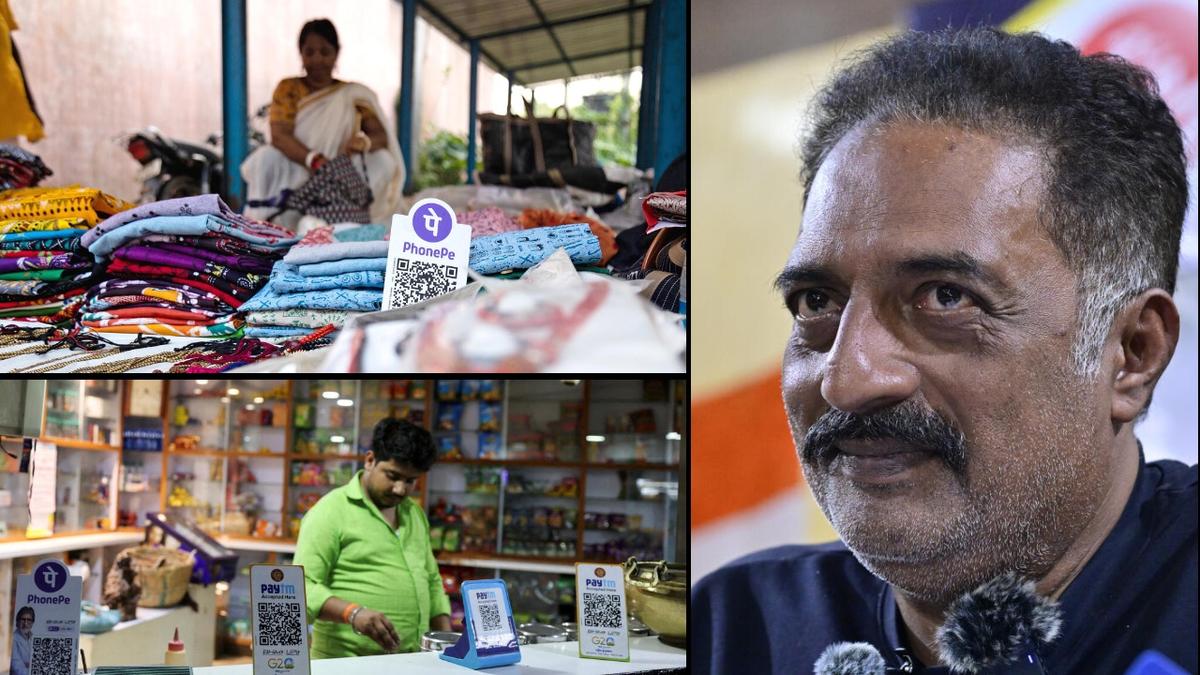
Fraandz.I keep getting the same forward. ‘The government has saved you. UPI till ₹2,000 is free. Sleep well.’Before the slogans start, I want a simple answer. On an ordinary day, how much do you actually scan (to pay)? For tea? An auto? The vegetables? Or the school fee, the hospital bill, the petrol that never stays under ₹2,000 once you fill the tank?The gift is real. The cut-off is also real. Both can be true at the same time. That is what they are counting on. You will remember only the first sentence.What the paper actually saysOn September 14, the Finance Ministry issued Gazette S.O. 5067(E). (I am writing the number here so nobody tells me later that I imagined it.) Under Section 10A of the Payment and Settlement Systems Act, two things stay free: RuPay debit-card payments of any amount and UPI up to ₹2,000. Banks cannot charge the person sending or the person receiving on those two.The next day, NPCI (National Payments Corporation of India) put out the rest. From October 15, if you pay a merchant more than ₹2,000 on UPI, the shop pays a 0.4% fee. On ₹3,000 it is ₹12. On ₹50,000, it is ₹200. After ₹75,000 they cap it at ₹300, so even a payment of ₹1 lakh costs the merchant ₹300, not ₹400.Money sent to your brother remains free. Even a lakh sent to a friend remains free (because transfers between people, which are about 70% of total UPI value, will stay free at every amount). Small vendors who take under a lakh a month on a QR code, if they are tagged correctly as P2PM (person to person merchant), also stay out. Rail, petrol, insurance, telecom and farm inputs get a flat ₹5 if the ticket is above ₹2,000. Mutual funds and the capital-market crowd get 0.02%.Your app will not cut 0.4% from your account. They have said that many times. I believe the circular. But I do not believe the shopkeeper will swallow ₹12 with a smile every time someone pays for the groceries. Actor Prakash Raj | Photo Credit: Allen Egenuse J. Why ₹2,000 sounds like kindnessIn August, UPI processed 24.51 billion transactions. That is NPCI’s number. The value was ₹29.82 lakh crore. For the full year of 2025-26, it was 24,162 crore transactions and ₹314 lakh crore. Here is the line that sounds good on television. More than 95% of merchant tickets are ₹2,000 or less. Only about 4% of merchant tickets sit above ₹2,000, but those tickets carry about two-thirds of merchant value.They protected the number of scans, and opened the value. Milk, a cutting chai, an auto fare stay free. A sack from the mandi, a quarterly school fee, a hospital bill, a month’s petrol, that crosses ₹2,000: that is where the meter sits.In August, Reuters and India Today used a rougher cut: about 5% of transactions and 65% of value. That was the proposal stage. After September, NPCI spoke only of person-to merchant payments. I am keeping both figures so nobody says the numbers were moved in the dark. Five questions for the Prime Minister and the Finance Minister 1. Why are the kirana and the middle-class shopping trolley the places you chose to squeeze?2. RBI sent you about ₹2.87 lakh crore last year. At ₹2,000 crore a year, that surplus alone could have kept the UPI incentive running for about 143 years. Why start a meter on small trade?3. Banks wrote off ₹16.35 lakh crore in 10 years (₹9.27 lakh crore of that under large industry and services). That write-off pile is more than 800 years of the ₹2,000-crore UPI line you say you will save. Who was rescued, and who is being billed now?4. Corporate tax incentives from 2019-20 to 2023-24 are about ₹4.53 lakh crore in the Receipt Budget papers. That is over 200 years of free low-value UPI.5. Ladli Behna in Madhya Pradesh is about ₹23,883 crore this year. Ladki Bahin in Maharashtra paid about ₹78,700 crore in two years. Uttar Pradesh has put a ₹50,000 offer on the table. For 1 crore women, it is ₹50,000 crore. If money can be found at that scale before a vote, why tell a tea-shop the republic cannot afford a free QR above ₹2,000?First, they built the habitOn November 8, 2016, at 8 p.m., 86% of the cash in circulation in India was declared scrap. After that night, the wallet left the pocket — slowly. In 2019, Section 10A arrived. On this track, a bank would not take even one extra rupee from you. For seven years, that was true.In the same years, cash itself was made expensive. An annual ATM fee; ₹21 to ₹23 at another bank’s machine after the free limit; ₹100 to ₹600 if the minimum balance slipped or the cheque bounced; for an SMS pack; extra pages in the cheque book; branch NEFT; to close an account.That is the sequence. Bring the people in, make the old road costly, then nail a board on the main gate.Who actually pays?On paper, the shop. The circular is polite: the customer app will not cut 0.4%. Banks are told not to let the merchant pass it on. Write that on a wall in a mandi and see how long it lasts. Kirana profit margins in this country are often 8% to 12%. That ₹12 has to come from somewhere. MRP rises a little; a cardboard sign goes up; UPI is refused on a large bill. That is pass-through. The meter is on the merchant, the bill is on you.This is how the government wants the arithmetic to look clean. And save ₹2,000 crore a year on the incentive.The road is public. Who owns the cars?NPCI built the rail, but the apps are another story. July’s NPCI figures: PhonePe, about 46% of volume and 48% of value. Google Pay, about 32% and 34%. Together, 78% of volume and 82% of value. Paytm, around 8%. BHIM, still under 1%.Walmart sits behind PhonePe. Alphabet sits behind Google Pay. That is shareholding, not a conspiracy. After 0.4%, market estimates put the yearly pool at around ₹16,000 to ₹21,000 crore. Apps may take about a quarter. Banks still take the larger slice.The sentence designed to melt a patriotShould the system not stand on its own feet? It sounds beautiful, but open the other file as well. The UPI-RuPay incentive was ₹2,196.21 crore in 2025-26. This year’s Budget allocates ₹2,000 crore. The Standing Committee and the Department of Financial Services have put the yearly cost of running person-to-merchant UPI near ₹20,000 to ₹20,700 crore. The gap is real. The question is whether the honest way to close it is a meter on a kirana bill of ₹2,500, while a lakh sent to a friend for imported shoes stays at zero.RBI transferred about ₹2.87 lakh crore surplus to the Centre for 2025-26. NPCI is not sitting in a loss. Operating revenue was ₹4,240 crore, and it is still in surplus. Banks wrote off ₹16.35 lakh crore of bad loans from 2014-15 to 2023-24 (Parliament was told that in March 2025). There is room for corporate default at that scale. Breath runs short at a ₹2,000-crore incentive!This is all I am askingOn October 15, your phone will not deduct 0.4%. That is true. But watch the board above the counter. Watch the MRP. That is where the fee will try to hide. If you run a small shop and your UPI receipts stay under a lakh a month, get the P2PM tag in writing. The circular will not save you on its own.I am not a banker. I am not an economist on a panel. I am a citizen watching this country being trained, ticket by ticket. If a number here is wrong, correct it in public. If the numbers are right, do not hide behind a free packet of milk.The gazette number is S.O. 5067(E). The meter switches on October 15, 2026. If you want to ask, ask.The writer is an actor and political activist.
‘They called it a gift, then I sat with the gazette’: Prakash Raj on UPI fee
Full Article
Original Source
Read the full article at Thehindu →KhanList aggregates and links to publicly available news content. We do not host full articles from third-party sources. Always verify important information with original sources.