
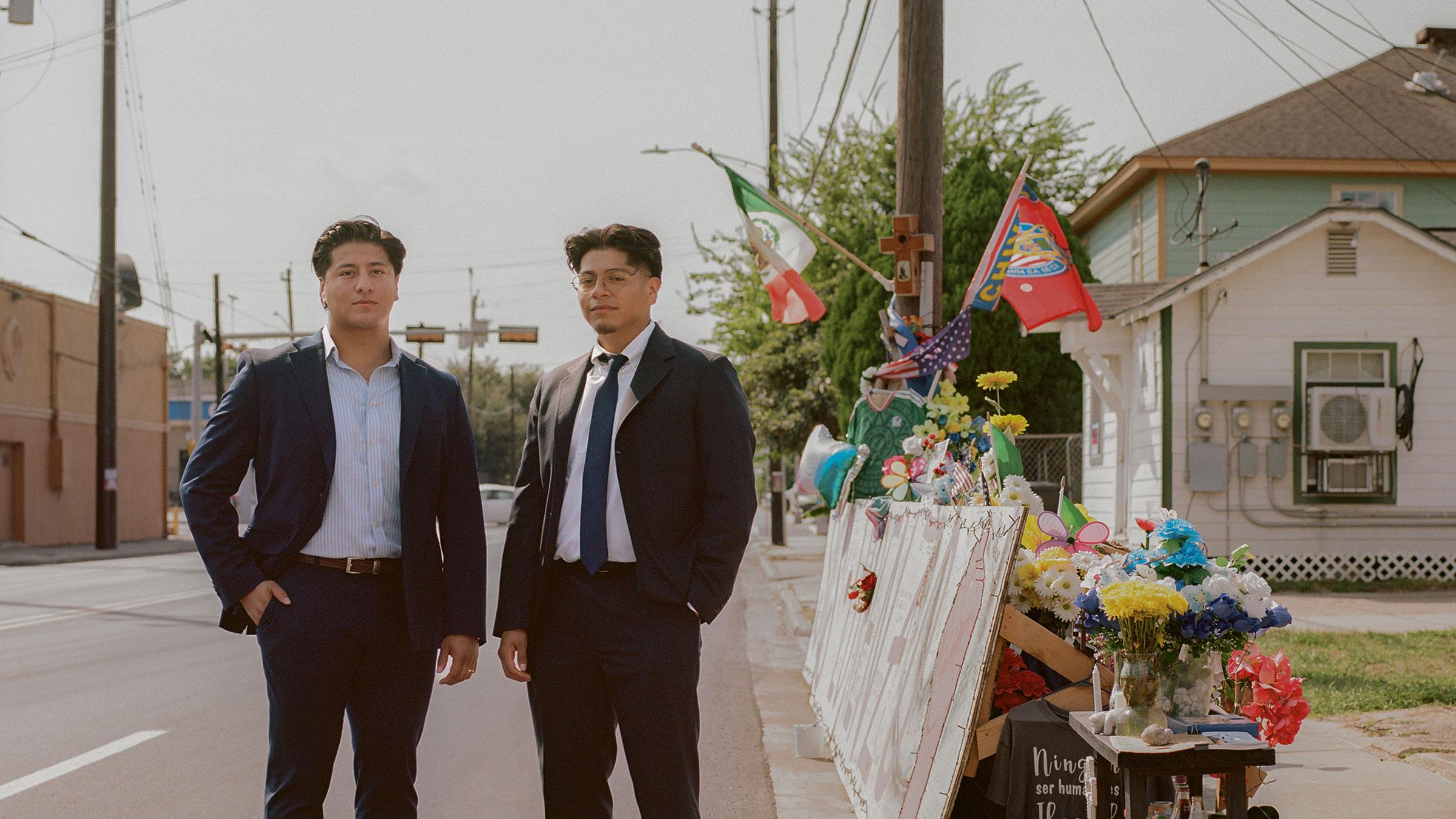
For years, the Salgado house in Houston has been the place where the family gathers—for birthdays, holidays, and especially for New Year’s. “It's a house that my dad built for all of us,” says Ronaldo Salgado, 29. His father, Lorenzo Salgado Araujo, moved to the U.S. from Mexico more than 30 years ago with his wife and began working in construction, saving up for a home large enough to host future generations: their three sons and any grandchildren they might one day welcome. This summer, the house was full again. Not for a celebration, but to mourn the death of Salgado Araujo. On the morning of July 7, the 52-year-old small-business owner was shot and killed by an Immigration and Customs Enforcement agent while driving his crew to work. In the aftermath of the shooting, Ronaldo and his brother Lorenzo Jr., 27, estimate that 14 relatives from across Texas, Mexico, Alabama, and North Carolina convened at their family house. Now, it’s quiet. Salgado Araujo’s wife spends long hours at the altar the family created, sitting in silent mourning.In their grief, the family is also awaiting answers. What they do know is that Salgado Araujo had breakfast and left to pick up his brother and other members of his crew. They know that two unmarked SUVs approached and pursued Salgado Araujo’s van, and that, eventually, an agent shot through the passenger-side window, striking him in the abdomen. Video footage shows him lying on the ground beside the van, surrounded by officers and calling for help. He died in the hospital.There are critical questions that still need to be answered. ICE’s version of events conflicts with statements from the witnesses who were in the van that morning. An ICE spokesperson told TIME that Salgado Araujo refused directives from agents, rammed one of their cars, and attempted to run over an officer, who fired in self-defense. The passengers, all of whom were detained by ICE and have since been released, have said that no officers were in front of the vehicle or in any danger when he was shot. The agents were not wearing body cams. A department spokesperson stated that Salgado Araujo was not the person agents were looking for that day. The FBI, the Texas Rangers, the Harris County District Attorney’s office, and the ACLU, in partnership with the family, are all investigating the events of July 7. Harris County DA Sean Teare has said a grand jury will determine any charges. In an interview with TIME, Houston ACLU attorney David Donatti says the organization intends to file a claim.“The lack of answers is an indignity in of itself,” Lorenzo Jr. says.He and his brother don’t believe their father would have driven away if he’d been able to tell the SUVs were government vehicles. The family had a plan in place, on the off-chance Lorenzo Sr., who was undocumented, encountered ICE agents. He was supposed to call Ronaldo or his wife at the first opportunity. He kept paperwork in his van from his lawyers, meant to show he was pursuing the ability to work legally in the U.S. “It’s that fear that people go to work with every day, that they’re going to be detained and won’t be able to see their family that evening,” Lorenzo Jr. says. “That used to be our biggest fear: my dad would get picked up, and we’d have no idea where he was for a few days.” He hangs his head for a moment and exhales. The family’s reality is so much worse than they ever thought to fear. “Everyone has the inalienable rights of life, liberty, and the pursuit of happiness. For immigrants trying to achieve the American dream, regardless of status, they're entitled to that. Also, they’re entitled to due process,” Ronaldo says. “Unfortunately, the Department of Homeland Security, specifically ICE, isn’t following through on that promise.” A spokesperson for DHS says, “All illegal aliens receive due process. We are applying the law as written by Congress. If a judge finds an illegal alien has no right to be in this country, we are going to remove them.”Often, family members of those detained, injured, or killed by ICE are limited in how much they can speak out, for fear of having their own immigration status examined. Ronaldo and Lorenzo Jr. were born U.S. citizens, and feel a sense of responsibility to use their voices to call for change. Ronaldo has spoken at press conferences beside politicians; he and Lorenzo Jr. have appeared on broadcast news and testified at a congressional forum. Ronaldo wants to work on state legislation that will protect immigrant communities. “I’m trying to use that anger and channel it in a more positive way,” says Ronaldo. “I feel right now that I can’t slow down, that I have to continue taking on these meetings, doing these interviews, doing anything I can just to get my dad's name out there, to shine a light as to what happened, to who my dad was, and the injustices that my dad experienced—that we're still experiencing to this day.” Salgado Araujo had the equivalent of a middle school education when he came to the U.S. His sons say his greatest pride was their commitment to education. Ronaldo, a high school geography and history teacher, was set to move to Dallas for a “dream job” on Aug. 1. He was the last son still living at home with his parents, and he looked to the examples of his brothers—Lorenzo working as an engineer in D.C., their younger brother in college in Pennsylvania—and wanted to start a life in a new city like they did. The timing made sense: his father was talking about slowing down at work, and his parents were going to enjoy more time together, to enter the next phase of life. “I always had that fear: What if they need me? But it got to a point where I was like, You know what? My mom and dad, they’re fine. They have each other, and they’ll always have each other,” Ronaldo says, voice breaking. He resigned from the job he was set to begin so he can focus full-time on the work he’s doing in his father’s memory.“This is not anything that any of us ever imagined happening, especially to us, especially to my dad, who was a decent citizen, regardless of status,” he says. “He loved this country, regardless of how much it discriminated against him.” Ronaldo visits the site where his father was killed at least once a day, and every day he finds someone there who wants to talk. Sometimes it’s a neighbor, but often it’s a traveler from other parts of Texas, from Arizona, from New Mexico, from Minnesota. They tell Ronaldo their immigration stories and about the loved ones they’ve lost, they say that he and his brothers remind them of their own kids, or that Lorenzo Sr. reminds them of their own fathers. A few community members have dedicated themselves to tending to the makeshift memorial, watering the flowers, bringing their dinners outside to watch over things as the day winds down. “This is all just to try to remember a man who worked all his life to give his family a better life,” Ronaldo says, “and to give his kids something to be proud of.”
These Two Brothers Are Fighting to Protect Immigrant Families After a Tragedy
Full Article
Original Source
Read the full article at Time →KhanList aggregates and links to publicly available news content. We do not host full articles from third-party sources. Always verify important information with original sources.