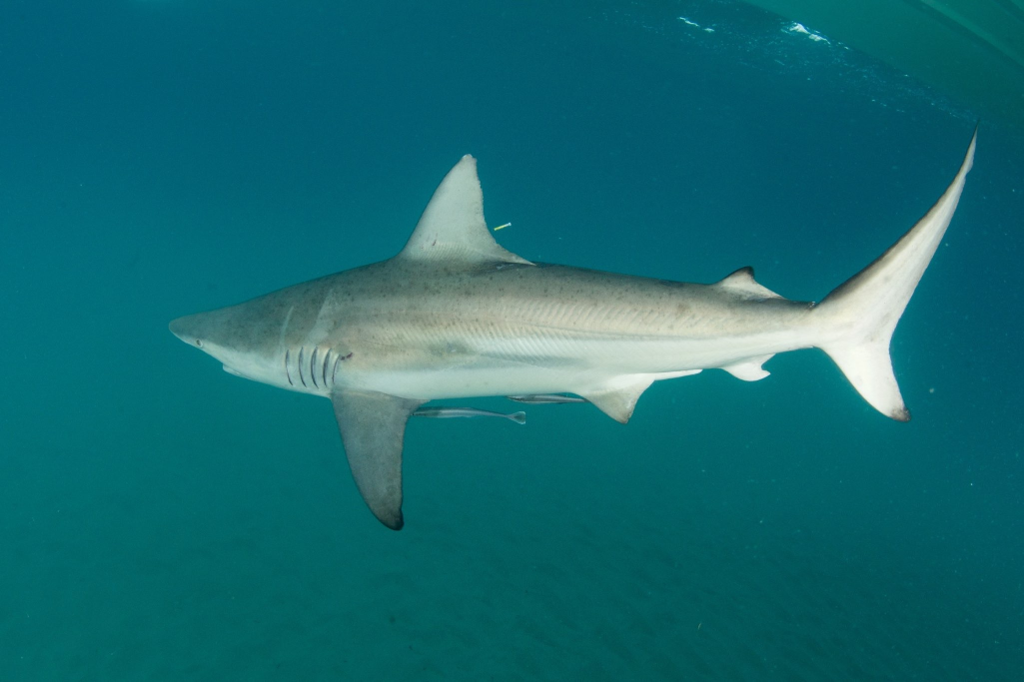
These Shark Look-Alikes Have Long Confounded Fishers and Scientists on the East Coast. Tracking Where They Migrate Could Help Clear the Confusion Researchers are tagging and tracking spinner sharks to map out their geographic distribution, because they’ve seen that the range of the very similar blacktip shark has shifted A blacktip shark, above, looks and behaves like a spinner shark. Scientists are tracking spinner sharks to get a clearer idea of the species' whereabouts. Stephen Kajiura Jaws had a different effect on Beth Bowers than it did on other kids. Instead of being terrified by the movie’s man-eating shark, Bowers’ reaction was, “Wow, this is so cool!” “I thought that these were really amazing predators,” she says. And she wanted to study them. Now, Bowers is a marine ecologist with the Smithsonian Environmental Research Center. Some days, her work consists of collecting data on the Atlantic Ocean, surrounded by the fishy smell of shark bait and the salty splash of waves. We board a fishing boat together on a Friday afternoon in September not far from Maryland’s Ocean City inlet. Accompanied by a small crew of researchers, the first mate and the captain, we travel about six miles off the coast for a shark-tagging expedition. The team tags sharks from a fishing boat in Ocean City, Maryland. Carlyn Kranking On the boat, the team goes about six miles off the coast to fish for sharks. Carlyn Kranking Rob Aguilar and Gabe Stephenson of the Smithsonian Environmental Research Center prepare to capture and tag sharks. Carlyn Kranking Bowers is leading a project to map the migration and distribution of spinner sharks, a slender species that hasn’t been very well described in research. The uncertainty comes, in part, from spinners’ similar appearance to the blacktip shark. Spinners and blacktips “look like your generic shark,” Bowers says. “If you think of a shark, you might think of one of them.” Both species are typically gray or brown on top with white on the bottom, and they have similarly sleek body shapes. It gets more muddled: Blacktip sharks are named for the black tips on their fins, and spinner sharks are named for their proclivity to jump out of the water and spin around in the air. But the spinner shark has black tips, too, and the blacktip shark also jumps out of the water. With such strong similarities, scientists can’t always trust reports they get from fishers. “We might have a call from somebody saying, ‘Hey … I saw a group of blacktip sharks today,” says Jon Dodd, executive director of the Atlantic Shark Institute. “The problem is that it’s not uncommon to then go out with these folks and have them catch a spinner and say, ‘There it is, a blacktip.’” Did you know? Why some sharks spin in the air Scientists suggest that the sharks might jump out of the water and spin when chasing prey, avoiding predators or dislodging parasites. In the mid-20th century, the blacktip shark was called the small black-tipped shark, and the spinner shark was called the large black-tipped shark. Before that, Bowers notes, taxonomists sometimes considered them the same species. “There’s always been this confusion,” says Stephen Kajiura, a biologist and shark expert at Florida Atlantic University. “Because they’re so often confused with one another, their distribution along the Atlantic Coast has been misinterpreted throughout the years,” Bowers says. Both sharks make seasonal migrations to reach breeding grounds, follow food and stay within waters that are warm enough for their cold-blooded bodies. In previous research, Bowers and Kajiura tagged blacktip sharks off the coast of Florida and tracked where they moved. Their results, published last year, revealed that the animals travel 50 percent farther than scientists had thought, with some individuals trekking between Palm Beach, Florida, and Long Island, New York. A 1948 publication had suggested that blacktips were rare north of Cape Hatteras, North Carolina, and the modern scientific consensus had been that the creatures don’t typically go north of Delaware. The widely accepted northern limit for the blacktip shark is Delaware, but Bowers and Kajiura previously discovered that the species travels up to Long Island, New York. Carlyn Kranking Now, Bowers and the SERC scientists want to do the same thing for spinner sharks and directly compare their range with that of the blacktips. Kajiura says he’s interested to learn about the spinner sharks’ distribution. Only blacktips are present around him in Florida, so he wants to understand the reason for the discrepancy. “Where are the spinners? Why are they not here at the same place as the blacktips?” Kajiura says. If the two species “are so similar in so many ways, you know, what are they doing?” He speculates that “the spinners may be farther offshore, or in deeper water or farther north.” Bowers’ study, he adds, will find the answer. Off Ocean City, the researchers anchor the boat and deploy shark bait, which they attach to kites that hold the bait near the surface of the water, where spinners and blacktips tend to hunt. Then, they cast some lines. Captain Mark Sampson sends out a kite, attached to floating shark bait, to attract spinner and blacktip sharks. Carlyn Kranking When a shark bites, SERC research technician Rob Aguilar reels it in and first mate Jake Konka unhooks the creature. It is a juvenile spinner shark, approximately 40 inches long. The researchers put a hose pumping salt water into the shark’s mouth, which allows it to breathe while it sits on the deck of the boat. As they do for each shark, the team records demographic information, such as its species, sex and measurements. Researchers from other institutions are tagging sharks for the project off the coasts of New York, South Carolina and Florida. First mate Jake Konka holds a juvenile spinner shark. Carlyn Kranking Konka and Stephenson measure a spinner shark. Carlyn Kranking For this juvenile, the team attaches a small, external identification tag that anchors under the cartilage at the back of the dorsal fin. If scientists recapture the shark, checking its tag could help with other research, such as determining how long the sharks live. But in general, for adults, the team flips them upside-down and conducts a surgery to insert a cylindrical tracker into their abdominal cavity. “We try to do this as quickly as possible, because the handling time seems to be the most important factor in decreasing mortality after releasing the animal,” Bowers says, adding that the sharks should recover immediately. “As soon as they go into the water, you want to see them swimming away, unscathed, with a fascinating story to tell about how aliens just abducted them and put something in their stomach that is now tracking them.” Beth Bowers holds a tracking device, which her team inserts into a shark's abdominal cavity via surgery. They must put it internally, she says, because if it were outside the animal's body, it could get covered in barnacles and debris and stop transmitting. Carlyn Kranking Once released, the tagged sharks carry on with their typical movements and migrations. But the transmitter continually sends signals out with a unique identification code. When the shark passes near one of almost 8,600 receivers up and down the East Coast, its ID gets stored on that receiver, along with the date and time. Scientists periodically retrieve these receivers to access their data, and if any of them has picked up one of these sharks, Bowers’ research team will be notified. The life of a tracker is about a decade, and it will take several years to get robust data on the tagged sharks. But in the meantime, the information gathered is contributing to biodiversity databases, and some students are using it to research artificial reefs and the diets of spinner and blacktip sharks, Bowers says. Konka holds a juvenile dusky shark. Carlyn Kranking Konka measures a juvenile dusky shark. Carlyn Kranking Spinner sharks have already given some clues that their range may be shifting. When Tobey Curtis, a fishery management specialist with the National Oceanic and Atmospheric Administration, went to college on Long Island around 30 years ago, he had never heard about spinner sharks or blacktip sharks being seen that far north. “They were certainly around, but they were kind of rare, and I never personally saw any,” Curtis says. But in just the last eight to ten years, he notes, spinner sharks have become abundant off the south shore of Long Island each summer. “It’s almost weird if you don’t see them now.” He acknowledges that the evidence is merely anecdotal, but other hints of change have appeared. In 2022, Dodd, Kajiura and ecologist Joshua K. Moyer of Yale University described an unusual sighting of a newborn spinner shark off the coast of Rhode Island, young enough that it still had an umbilical scar. “That was a big surprise,” Dodd says. “That size spinner shark being up here in southern New England is something that we had not seen before.” It signals the potential of a nursery habitat in the area. Scientists haven’t recorded a similar sighting since, so Dodd tentatively classifies this young shark as a “rare stray” rather than a sign of breeding. But the water temperatures in the region likely wouldn’t have been able to support a sighting like this decades ago, he adds. “It’s just another indicator of how these water temperatures, particularly along the East Coast and up into the Gulf of Maine, are changing and increasing over time.” In unpublished research that’s currently under peer-review, Kajiura is documenting temperature-related shifts in the range of blacktip sharks, too. With aerial surveys, he has seen the annual winter gatherings of blacktip sharks move to the north along Florida’s coast in recent years. “Thanks to warming oceans, that water temperature that they prefer is actually found at higher and higher latitudes,” Kajiura says. An aerial view of a massive shark aggregation off the coast of Palm Beach County, Florida. Each dark speck is a shark. Bowers and Kajiura, Marine Ecology Progress Series, 2025, under CC BY 4.0 Winter water temperatures recorded at a NOAA weather station in Florida, off Lake Worth Pier, have shown an increase of one degree Celsius over the past decade, Kajiura adds. “That’s what’s both fascinating and terrifying.” And the blacktip sharks have adjusted along with the environment. “They don’t have to come to a certain place,” he says. “They come to a certain environmental condition, wherever that happens to be along the seaboard.” Understanding where the sharks live and how that might be shifting is important for conserving both species and establishing meaningful fisheries management plans, since blacktip sharks and spinner sharks are fished for meat along the East Coast. NOAA hasn’t done a stock assessment specifically for spinner sharks to inform management on how they’re fished, but Curtis says they plan to have one in the coming years. “The tagging and the biological research, that’s really going to help improve the data going into a stock assessment,” he says. Even though spinners and blacktips are so similar, Kajiura says, scientists can’t assume their range will also be the same. “That’s why it’s so important to get the spinner data as well, to make sure that the management for that species matches their actual behavior and distribution.” You Might Also Like Get the latest on what's happening At the Smithsonian in your inbox. More about: Animals Atlantic Ocean Biology Ecology Fish Fishing Florida Maryland Nature New Research New York City Rhode Island Shark Week Sharks Smithsonian Smithsonian Environmental Research Center Smithsonian Institution
These Shark Look-Alikes Have Long Confounded Fishers and Scientists on the East Coast. Tracking Where They Migrate Could Help Clear the Confusion
Full Article
Original Source
Read the full article at Smithsonianmag →KhanList aggregates and links to publicly available news content. We do not host full articles from third-party sources. Always verify important information with original sources.