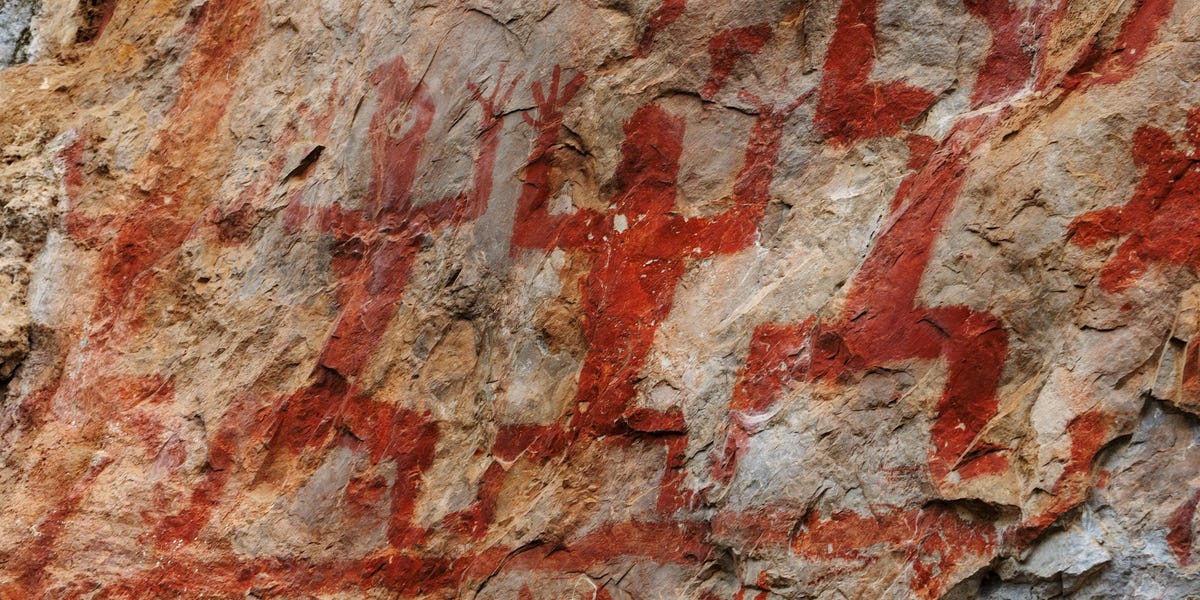
3 min readHere’s what you’ll learn when you read this story:Known as the Huashan Rock Art Cultural Landscape, cliffs along the Zuojiang River Valley in China have preserved murals of red figures that have not faded much in thousands of years.How the pigment managed to survive countless monsoon seasons was a mystery until recently, when researchers analyzed its chemical composition and found it contained human blood.While it might sound macabre, the blood in these murals was found to have most likely come from childbirth or menstruation.The limestone cliffs rising from China’s Zuojiang River Valley in Guangxi tell silent stories. Human figures, painted entirely in red and depicting sacred rituals, dance across the cliff faces in ancient murals known collectively as the Huashan Rock Art Cultural Landscape. For nearly 2,000 years, they have resisted fading in the heat and humidity of a region known to be a tropical monsoon zone. How they managed such a feat has been an enduring mystery.Rock fragments from several sites in the valley showed that the paint was bonded so tightly to the cliff that it never peeled. Where details are missing from the murals, it’s because the stone beneath them broke away, not because the pigment eroded. This intrigued Shandong University chemist Meng Wu, who wanted to know why this pigment persisted for millennia while rock art in other parts of China succumbed to the weather. After collecting some of those fallen fragments, Wu and her research team analyzed them with three types of spectroscopy to determine their molecular structure. Looking further into their structure and composition with proteomics, they found something remarkable.“Our study indicates that red clay rich in nano-hematite was used as the pigment, and a composite mortar made from lime and blood served as the binder in the rock art,” Wu said in a study recently published in Journal of Archaeological Science. “Biomineralized calcium carbonate induced by blood proteins tightly encapsulates nano-hematite and strongly bonds to the limestone.”Human blood had been incorporated into the paint, and though one’s thoughts may instinctively turn to bloodletting or even human sacrifice, Wu wondered whether the blood could have been obtained without violence. The murals were left behind by the Luoyue people, ancient hunter-gatherers of Southern China who maintained a matriarchal (and matrilineal, meaning they traced their family lines from the maternal side) society. Mural scenes of pregnant women and childbirth strengthened Wu’s growing hypothesis: the pigment could have been made with menstrual blood or blood from childbirth.Prehistoric rock art was long thought to have been created with paints made from mineral pigments mixed with organic binders such as resins, plant gums, or animal fat, but blood has similar binding properties. Wu found that the Huashan paint started as a mortar emulsion. Powdered lime was slaked (mixed with water to produce calcium hydroxide) and combined with calcium phosphate and blood, and the mixture was then painted onto the limestone cliffs, later to be topped with a red clay pigment that contained hematite. When the base mortar reacted with atmospheric carbon dioxide, it formed calcium carbonate that was biomineralized into a dense crystal structure by blood proteins—a process that bonded the pigments to the limestone.When proteins found only in blood—such as hemoglobin and immunoglobulins—were detected in the samples, Wu was able to confirm that mostly human and some bovine blood (possibly from hunted animals) had been used, though relatively little blood was required to create mortar for large stretches of the rock paintings. She also identified traces of two other proteins: prolactin-inducible protein and lactoferrin. These proteins occur at high levels in pregnant females, but are also present at much lower levels in the blood of females who are not pregnant, which could mean some of the blood was menstrual or childbirth blood. It may have even been used in the same fertility rituals illustrated on the cliffs.“These findings provide new insights into the creation of prehistoric rock art,” Wu said, “showing that it was a technically intensive project rather than a labor-intensive one, and that organic-inorganic composite systems were more likely to be used for rock art that survived for long periods or in harsh environments.”Elizabeth Rayne is a creature who writes. Her work has appeared in Popular Mechanics, Ars Technica, SYFY WIRE, Space.com, Live Science, Den of Geek, Forbidden Futures and Collective Tales. She lurks right outside New York City with her parrot, Lestat. When not writing, she can be found drawing, playing the piano or shapeshifting.
These Rock Paintings Survived for 2,000 Years. The Secret May Be Human Blood.
Full Article
Original Source
Read the full article at Popularmechanics →KhanList aggregates and links to publicly available news content. We do not host full articles from third-party sources. Always verify important information with original sources.