
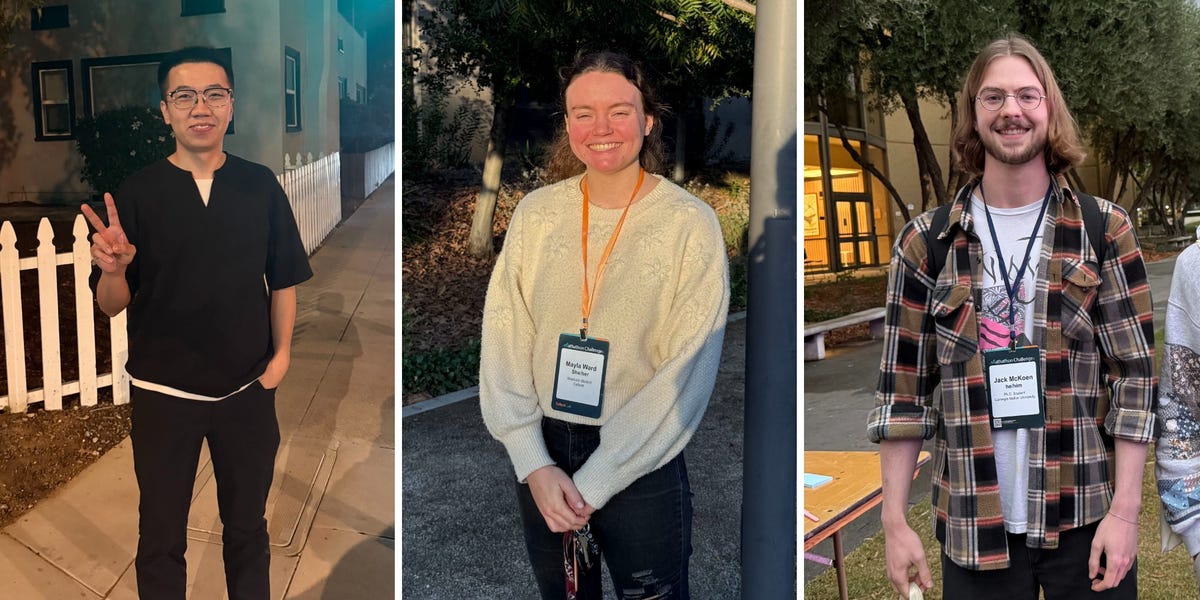
These math students aren't running from AI. They're learning to use it. Truman Dickerson Some math students are going all in on AI to save their careers. Jack McKoen knew about AI, but he didn't take it seriously until one day, when "everything changed," he said.That day was September 5.At 1:20 p.m., OpenAI announced on X that its agents had cracked one of math's most famous quandaries: the Navier-Stokes Millennium Prize Problem.When McKoen got home that night, he was upset.He wondered if his mathematical niche, the specialty he had sunk four years and thousands of dollars into studying, was becoming irrelevant."I was hoping to get a job in industry," the 26-year-old Ph.D. hopeful told Business Insider. "But now, is there any demand?"McKoen specializes in Lean, a programming language into which mathematical conjectures are translated before they're checked by a computer. He said that now, "an amateur with no experience" can do portions of his job using AI.That night, in his house near Carnegie Mellon University, McKoen weighed his options. He could "sell out" and seek employment at an AI startup. He could stick his head in the sand and pretend AI wasn't happening. Or, he could try to adapt.So far, McKoen's gone with the latter option. And in doing so, he isn't alone. While some students are indeed giving up on academic math, another group is boldly charging ahead, adding AI models to their toolkits and loudly asserting that math still needs its human scholars.Business Insider spoke to three such students earlier this month at Caltech's mathathon, an event where participants used AI to solve math problems.Each had varying motivations, but they shared in common a tenacity in the face of unprecedented turmoil.Here are their stories.Shaowu Zhang Shaowu Zhang is no stranger to upheaval. Truman Dickerson Shaowu Zhang is no stranger to upheaval.Now a Ph.D. student in his final year at Caltech, Zhang grew up in China and spent the last decade attending mathematical lectures around the world. He had stints in Boston, Zurich, Hong Kong, and Paris before landing in California.When OpenAI published solutions to hundreds of unsolved problems in October, Zhang's reaction moved swiftly from sadness to skepticism."I was very suspicious," he said, walking across Caltech's campus. "I mean, we should at least see if it makes sense."So a few days after the OpenAI dump, Zhang fired up his X account and took a microscope to a few of OpenAI's proposed solutions. Sometimes he offered praise and identified areas for further research. Other times he spoke caustically about AI's failures."Mathematicians, no need to update your CVs just yet," he posted on October 11 about one manuscript. "OpenAI's internal model still has a looong way to go before it replaces you."In an interview, Zhang criticized people for taking OpenAI's word at face value, adding that the AI colossus later retracted some of its solutions. "I kind of only trust mathematicians," he said.Back in 2022, when OpenAI first released the first version of ChatGPT, one of Zhang's mentors at Caltech immediately put it through a gridiron of mathematical tests.Though Zhang said he didn't realize its potential right away, he was exposed to AI early on and eventually began using it to help write code to prove conjectures.Now, Zhang is a teaching assistant at Caltech, overseeing many students. He said he knows all the "gossip" and respects the anti-AI crowd, even if he doesn't completely agree with them."I think we should use AI to do more math," he said. "But we should use it responsibly."Mayla Ward Mayla Ward at first denounced the mathathon but later became an organizer. Truman Dickerson At first, Mayla Ward, a grad student studying mathematics at Caltech, signed an open letter calling for the cancellation of the mathathon.In its initial iteration, which included sponsorships from OpenAI and Anthropic, Ward took the view that the undergrad students at Caltech who proposed it were contributing to a "commercialization" of mathematics."These companies were probably profiting," she said in an interview. "That just didn't really sit right with me."But Ward also had sympathy for the undergrads' motivations. AI was indeed ripping through the math field, and save for this small cohort of Caltech students, few people were proposing any concrete solutions.So instead of repudiating the event or sitting on the sidelines, Ward entered a period of intense negotiations with its organizers.She, along with some other grad students, pushed to reframe the event to use AI to enhance human understanding — rather than to pump out reams of near-unintelligible, AI-generated proofs."I saw this as an opportunity for both sides to come together and improve on it," she said.And ultimately, Ward's intervention worked. Both sides made concessions, and the mathathon earned the blessing of prominent scholars in the math community.Ward, in her second year at Caltech, said she hopes to develop AI models specifically engineered for solving math problems alongside Caltech professor Sergei Gukov."This is certainly the type of math that interests me the most," she said.Jack McKoen Jack McKoen said a lot of mathematics is "masturbatory." Truman Dickerson McKoen said he was drawn to mathematics because he felt like it exposed him to "strange occult secrets.""It sounds corny," he said during a late-night chat in Caltech's math department building. "It's like you're picking apart the secrets of the universe."The Canadian got his master's degree in mathematics from the University of Alberta before transferring to Carnegie Mellon for his Ph.D. this year.Like other students, McKoen said he wasn't a believer in AI until recently. He recalled telling his mentor he wasn't using AI in his workflow."He just kind of looked at me and said, 'Then you need to rethink your workflow,'" McKoen said.McKoen said he was thankful. He said he knows other math professors who advise their students not to learn AI."It's possible for a Ph.D. student to kind of get led astray," he said.Still, McKoen said he hasn't fully adapted to AI, noting that his specialty is highly exposed to being overtaken by AI. He left the door open to jumping ship to an AI startup one day."Some of my pals would be mad, but they'd get it," he said. Read next Business Insider tells the innovative stories you want to know Business Insider tells the innovative stories you want to know Business Insider tells the innovative stories you want to know Business Insider tells the innovative stories you want to know Truman Dickerson is a reporter at Business Insider, based in New York City. He covers trending tech and business news, with a focus on how AI is affecting higher education. He previously reported for The Boston Globe. He graduated from Boston University, where he served as editor in chief of The Daily Free Press, BU's student-run newspaper.Contact him at Tdickerson@insider.com or on Signal at trumaninsider.75 OpenAI ChatGPT Sam Altman More Anthropic
These math students aren't running from AI. They're learning to use it.
Full Article
Original Source
Read the full article at Businessinsider →KhanList aggregates and links to publicly available news content. We do not host full articles from third-party sources. Always verify important information with original sources.