
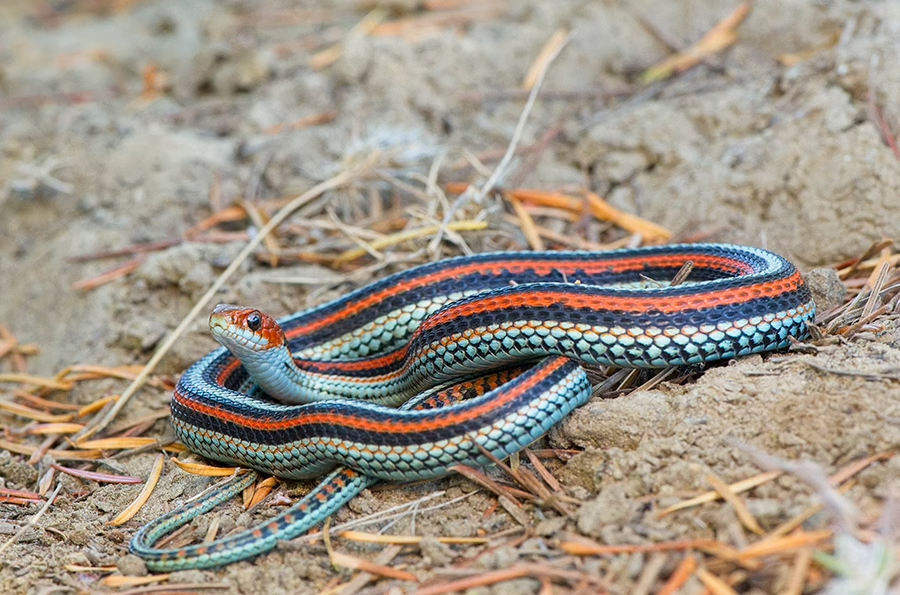
Fewer than 2,000 San Francisco garter snakes are estimated to live in their native home of two California counties. So, experts are raising some babies at the San Francisco Zoo to give them a head start before releasing the creatures into the wild November 23, 2026 10:00 a.m. San Francisco garter snakes have distinctive blue, red and black stripes. Vishal Subramanyan / Midpeninsula Regional Open Space Covered in vibrant blue, red and black stripes, the San Francisco garter snake is considered one of the most beautiful snakes in North America. But the nonvenomous species’ good looks have also made it a target for illegal collectors, and other threats—including habitat loss and invasive species—have further reduced its population. Fewer than 2,000 individuals are estimated to remain in two Northern California counties, and the species has been on the federal endangered species list since it was created in 1967. Now, conservationists are hoping to give the population a boost by releasing 62 captive-raised young snakes into the wild. It’s the first time they’ve attempted such an effort, according to a November 10 announcement from the San Francisco Zoo & Gardens. “This is an extraordinary accomplishment for everyone who has worked for generations to protect this remarkable species,” says Karine Tokatlian, a biologist with the Midpeninsula Regional Open Space District (Midpen), one of the organizations collaborating on the project, in the statement. “This first release is an important step toward building healthy, resilient populations that can sustain themselves over the long term.” The baby snakes spent about a year growing and eating earthworms. Courtesy of San Francisco Zoo & Gardens Planning for the project has been underway for at least a decade, reports the Washington Post’s Kyle Melnick. But on-the-ground efforts kicked off last year, when biologists carefully captured ten pregnant females in a Midpen preserve and brought them to the San Francisco Zoo. There, the females gave birth to slender babies, which spent about a year growing and feeding on earthworms. The mothers, meanwhile, were returned to the wild. “We tried to release them at the exact points we caught them,” Elliot Schoenig, a biologist with the U.S. Geological Survey’s Western Ecological Research Center, another project partner, told the San Francisco Chronicle’s Kurtis Alexander last year. “For the most part, they just cruised back in. Some skirted the edges of the pond, which is their typical foraging behavior. Hopefully, they’ll encounter a frog and settle back in.” Once the youngsters were about a foot long, experts conducted genetic testing and used the results to determine where best to release them. Roughly a third of the juveniles were returned to the area where their mothers lived, while the others were released in areas of San Mateo County that needed a population boost and greater genetic diversity. Conservationists are not revealing the specific locations over concerns that illegal collectors will seek them out. “Even for a whole bunch of biologists who are typically not the most emotional people in their work, [the releases were] impactful,” Ariel Starr, a wildlife ecologist with Midpen, tells the Washington Post.Scientists call this process head-starting, meaning they raise young animals in captivity when they’re considered the most vulnerable to threats like predation and competition for prey. Once they’re deemed large enough to tackle some of these challenges, the creatures are released into the wild. This technique is intended to boost the juveniles’ chances of survival, hopefully allowing them to reach sexual maturity and reproduce. Zooming out, conservationists hope to one day get the species off the federal endangered list, which would mean establishing at least ten self-sustaining breeding populations with at least 200 snakes each. To do that, they’re also improving the snakes’ habitat, monitoring wild populations, educating the public and supporting populations of the threatened California red-legged frog, one of the snakes’ primary prey species. “By protecting and restoring the landscapes that the San Francisco garter snake depends on, we’re also investing in the long-term health and resilience of the region’s environment,” Tokatlian tells KQED’s Sarah Mohamad. In the meantime, biologists have already captured a new round of pregnant females, which have birthed more than 130 babies at the zoo. If all goes as planned, they’ll be released into the wild next year. The recent conservation efforts have given conservationists reason for optimism. But challenges remain. “If we don’t have more snakes out there, they could disappear in our lifetime,” Rochelle Stiles, director of field conservation at the San Francisco Zoo & Gardens, told the San Francisco Chronicle. You Might Also Like Get the latest stories in your inbox every weekday. More about: Animals California Endangered Species Reptiles Snakes Wildlife
These Endangered Snakes Are Some of the Most Beautiful in North America. Here's How Conservationists Are Trying to Save Them
Full Article
Original Source
Read the full article at Smithsonianmag →KhanList aggregates and links to publicly available news content. We do not host full articles from third-party sources. Always verify important information with original sources.