
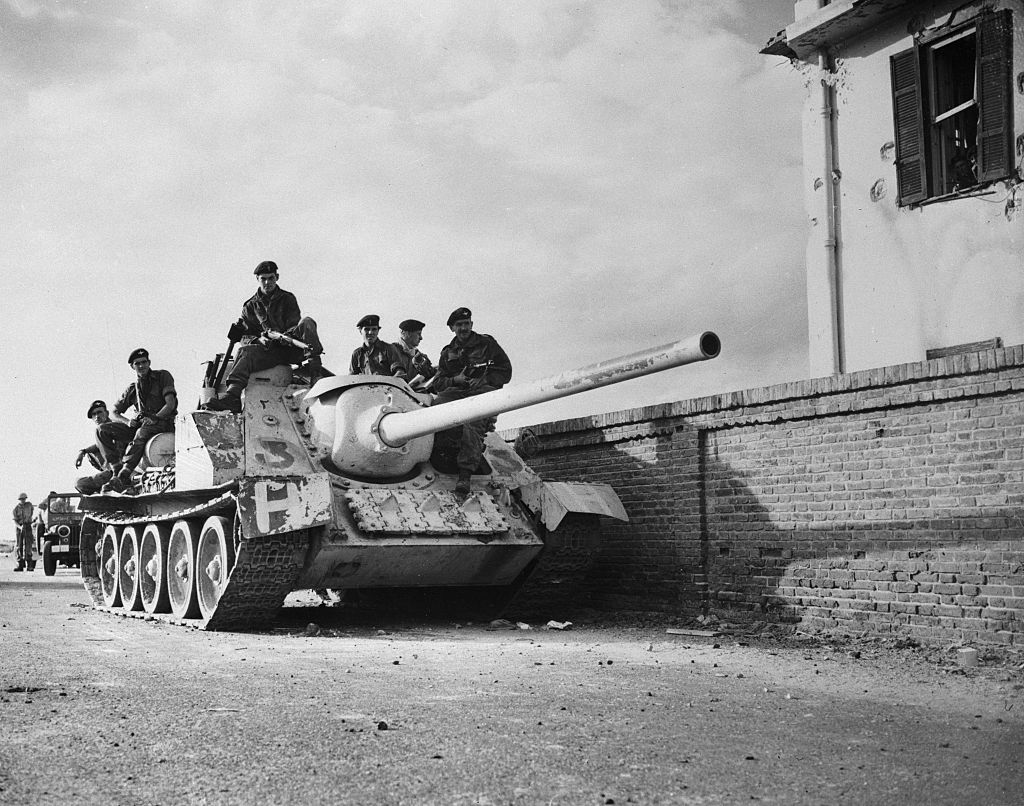
Foreign Affairs J.D. Vance could learn a thing or two from Harold Macmillan. The Anglo leader looked across the globe and saw a Muslim nation, which had already been stirring things up, potentially threatening a vital waterway. At the same time, Israel had its own beef against that country, and was pushing for a joint first-strike. So together, the two governments launched a military attack. But things did not go well. Casualties were low, but the political blowback was shattering. Is this a sketch of the ongoing conflict between the United States and Iran? Some might so assert, and that can’t be helped. Yet these are the outlines of the Suez Crisis of 1956. Back then, Britain, Israel, and also France joined together to “safeguard” the Suez Canal and to take the anti-colonialist Egyptian leader, Gamal Abdel Nasser, down a peg. Not many celebrate that conflict, but for those who do, 70th anniversaries are coming up, starting with October 29, when Israel commenced Operation Kadesh, followed a few days later by the Anglo-French Operation Musketeer. The attacks were a military success, but a political failure. Amid international uproar, a ceasefire was declared, and the foreign forces were soon withdrawn, leaving Nasser to declare victory. Many cheered his willingness to stand up for the liberationist aspirations of not only Arabs, but also the entire Third World (then a fresh phrase, coined four years earlier). So yes, history rhymes, and yet each historical moment sounds its discordant notes. For instance, back in 1956, the U.S. strongly opposed the Suez operation. President Dwight Eisenhower, a retired general, had seen enough of fighting; in fact, when he came into the White House in 1953, his top priority was to settle the Korean War, which he did. The 34th president was, for sure, a determined Cold Warrior against the Soviet Union, but he wanted to keep the focus on opposing communism, not snuffing out the various nationalisms then springing up, including in Egypt. As they say in the Army, the main thing is to keep the main thing the main thing—and for Eisenhower, that meant containing Moscow, not Cairo. Moreover, Ike’s secretary of state, John Foster Dulles, epitomized an earlier era in U.S. diplomacy, when the State Department strove to be even-handed—critics said, pro-Arab—in the Middle East. Eisenhower and Dulles worried that the Suez invasion would inflame the Egyptians and others, driving them toward the Soviets, who were encouraging movements of “national liberation.” So as the crisis unspooled, Washington and Moscow found themselves on the same side, telling the invaders to get out. Suez is generally reckoned as the last hurrah of British imperialism. Yes, there’d still be overseas missions to come, but, with the glaring exception of Tony Blair’s invasion of Iraq, the United Kingdom’s appetite for wars of choice had basically abated. (The story of France is similar; as for Israel, well—it’s different.) Yet there’s another aspect to the Suez saga that should be heartening to conservatives, if not neoconservatives: Parties of the right might make a geopolitical mistake, but if they can fix it, changing their errant ways, they can recover their political standing. Indeed, they can win even bigger in the next general election. That’s what happened in the UK back in the 1950s, and the precedent is worth a ponder. In the meantime, here’s an American precedent to consider: When U.S. presidents launched wars of choice that didn’t turn out well, their instinct was often to double down—and it was costly for them and their party (as well as, of course, for the country). For instance, as the Vietnam War started to look quagmire-y in the mid-1960s, President Lyndon B. Johnson sent more troops. The results were huge defeats for Johnson’s Democrats in the 1966 and 1968 elections (including the loss of the presidency). Similarly, as the Iraq War turned into a disaster in the mid-2000s, President George W. Bush hung tough on the “moral clarity” of the mission and then “surged” more troops. For their part, the voters didn’t approve: Bush’s Republicans were walloped in the 2006 and 2008 elections, including again the loss of the White House. The lesson is clear: If you make a mistake, get out as quickly as you can. The British prime minister who ordered the Suez attack was Anthony Eden, a capital “C” Conservative. The revulsion against him was severe; his health suffered a collapse that was described, publicly but unconvincingly, as a purely physical ailment. In search of relief, Eden traveled not to a hospital, but to the Caribbean, spending nearly a month at the Jamaican estate of the James Bond novelist Ian Fleming. Upon his return to London, Eden agonized for another month before announcing his resignation on January 9, 1957. Doctors’ orders, he claimed. (Wags said Eden had committed Suez-cide.) Interestingly, once freed from the stresses of office, Eden lived another 20 years, unrepentant about his military misadventure. (The idea that a leader wouldn’t wish to admit a mistake is unsurprising—it’s certainly familiar to American Republicans, surveying their party’s presidents over the last few decades.) Yet now the Suez saga starts to get decidedly cheerier for the party of the right—and offers hope to conservatives on this side of the Atlantic. Eden’s successor at 10 Downing Street was Harold Macmillan, who had been serving in the cabinet as chancellor of the exchequer. So Macmillan’s portfolio was finance, not foreign policy. As a member of the team, he had supported Operation Musketeer, albeit while harboring private concerns; his own preferred solution was a peaceful and international economic consortium to subsume the Canal controversy in foreign investment. That was, of course, a road not traveled, but when the fog of war was lifted, Macmillan had no clear fingerprints on the Suez stinker. That fuzziness served him well in the byzantine succession process that followed Eden’s withdrawal: Macmillan was acceptable to the Edenite dead-enders in the Conservative Party, as well as to more dovish members. One of the most acute studies of the man captures his essence. Macmillan: A Study in Ambiguity was the title of Anthony Sampson’s 1967 analysis. Sampson quotes Macmillan’s assessment of the situation, given to his son-in-law: “I think Anthony’s going to have a rough ride for the next few weeks. In fact, I shouldn’t be surprised if he lost his seat.” Mindful that Macmillan was more positive in public, Sampson raised, and then dismissed, the theory that Macmillan had actually encouraged Eden to launch the war, so that he, Macmillan, who was three years older, could get the younger man out of the way. (For what it’s worth—probably more for theatricality than veracity—this sneaky scenario was included in the Netflix miniseries The Crown.) The new premier’s most urgent task was repairing Britain’s relationship with the United States; as Randolph Churchill would write: Among the most serious consequences of the Suez debacle was that it nearly destroyed the Anglo-American alliance. It was one of Mr Harold Macmillan’s greatest acts of statesmanship that he was able to heal the breach so very soon after he became Prime Minister. Macmillan’s great strength was measured deliberation. He was, after all, a chess player and a reader who preferred novels to newspapers. Born in 1894 to bourgeois wealth—the family business, Macmillan & Co., was even then a publishing powerhouse—young Harold would seem to have had it easy. Yet he had to overcome adversities, from a bullied childhood to a cuckolded marriage. And, most profoundly, the experience of the First World War. Macmillan volunteered for the army, where he met men very different from those he had known at Oxford. As he told his family in a letter from the front: A company has just passed my house, back from a long route march, singing wonderfully the dear soldier songs, with silly words and silly tunes, but which somehow seem, sung by their great childish voices, from the depths of their very lovable hearts, the most delicate music and the most sublime poetry. Indeed, of all the war, I think the most interesting (and humbling too) experience is the knowledge one gets of the poorer classes. In 1915, he was shot through his right hand; for the rest of his life, he could never manage a firm handshake. Macmillan recovered well enough to be sent back to the front, where, at Ginchy, France, on September 15, 1916, he sustained his most grievous wound. Macmillan biographer D.R. Thorpe sets the scene, incorporating Macmillan’s own words of recollection: Caught by machine-gunners from the left flank, Macmillan was hit in the left thigh and in the pelvis, and “rolled down into a large shell-hole, where I lay dazed, but not—at first at least—unconscious.” For the next ten hours he intermittently dozed, treated himself with morphine, feigned death as Germans skirted round the shell hole. He was rescued from no man’s land by Company Sergeant Major Norton and a team of stretcher bearers. These experiences left him with both only a lifelong shuffling gait and a deeper social outlook: He developed an empathy for those who suffered with him, and for the first time an understanding of those who had not had the advantages of his upbringing and education... and resolved after the war to pursue the Disraelian political ideal of “One Nation.” So while Macmillan was always a Conservative in politics, he was also always a moderate, rejecting both laissez-faire and socialism. In 1938, by then a rising figure in Parliament, he published a book that defined his corporatist worldview. Its title: The Middle Way. Fast-forward to 1957. As recalled by yet another Macmillan biographer, Alistair Horne, one Tory member of Parliament wrote at the time that “everybody feels such a load of depression, because an ill man was led by illness into folly.” The MP was referring, of course, to Eden. Horne continues: The country at large had never felt flatter, more discouraged, more bewildered or more uncertain of the future. The picture was of a Britain thoroughly menaced, at odds with America, all her alliances shaken after Suez. The nation too had become infected by Eden’s disordered bile duct. Yet while the psychological impact of Suez was seismic, by a cold numerical reckoning, it was something of a blip. In a week of fighting, just 16 British soldiers were killed (add to that 10 French soldiers and 177 Israelis; Egyptian losses, meanwhile, were closer to 1,000). So here we can pause over a parallel on Iran today. While the political backlash against the Iran war has been enormous, nevertheless, a utilitarian calculus might count this conflict as small in the scheme of things. As this author observed in these pages nearly three months ago, American deaths in the Iran conflict total fewer than two dozen; even after an upward revision in October, the figure remains small. For purposes of comparison, in 2025, a total of 828 American service personnel died of various causes while on active duty. The point here is not to minimize the carnage of the Iran war. Rather, a look at actual numbers can help put matters into proportion. Indeed, perspective helps make clear the possible analogy to that earlier misfired Mideast war, seven decades ago, which hurt the responsible political party, but not for long—once that party made the right repairs. The beginning of the Conservative recovery after 1956 could be seen in the way the war was framed by opponents, who attributed it to Eden personally. During the fighting, Aneurin Bevan—a longtime Labour mainstay, soon to be the party’s spokesman on foreign affairs—roared to an anti-war rally at Trafalgar Square: Sir Anthony Eden has been pretending that he is now invading Egypt to strengthen the United Nations. Every burglar of course could say the same thing; he could argue that he was entering the house to train the police. So, if Sir Anthony Eden is sincere in what he is saying, and he may be, then he is too stupid to be a prime minister. Echoing Bevan, The Daily Mirror, then the largest-circulation newspaper in Britain, headlined “Eden’s War.” The opposition’s focus on Eden was, in fact, a gift to the Conservatives, because once the singular bogeyman was gone, the Tories didn’t look so bad; neither Macmillan nor anyone else in his government talked about “finishing the job” in Egypt. As for imperialism in general, some 14 British colonies gained their independence during Macmillan’s tenure; in 1960, his “wind of change” speech in South Africa received worldwide attention. With their fears of endless war allayed, and with Macmillan’s charming of Eisenhower and Dulles, Britons could return to domestic concerns, and were free to recall the privation suffered under six years of Labour rule, 1945–51, when the socialist regimen was price controls and queues. (The National Health Service, enacted under Labour, was, of course, enduringly popular; Macmillan’s Conservatives wisely made their peace with the NHS, even as they tweaked it.) Macmillan’s truly was the Middle Way, tilting only slightly to starboard. Margaret Thatcher recalled in her memoirs, with a tincture of right-wing disdain, “The natural path to promotion and success at this time lay in the centre of politics and on the left of the Conservative Party.” As Macmillan said of his governing philosophy, “Our first objective must be to keep the party together, at all costs united.” With that in mind, in a 1957 address to his fellow Tory MPs, he paddled toward platitudes, while keeping his partisan pointedness: I hear a lot of silly talk about the Left and the Right. To the broad stream of our philosophy there are many tributaries. Indeed we are always adding to this flow as the Parties of the Left break up into a kind of delta of confusion. And so our great river flows on triumphantly to the sea. Macmillan posted a sign on the door to the Cabinet room: “Quiet calm deliberation disentangles every knot.” Thorpe adds that the new PM was eager to disentangle one knot in particular: “He made sure that this coded distancing of himself from the frenetic atmosphere of the Suez crisis became widely known.” Indeed, writing from the vantage point of 2011, Thorpe detailed Macmillan’s irenic activities and added his own tart comment: “Unfortunately, the lesson was not heeded at the time of the Iraq invasion in 2003.” Providentially, the British electoral calendar gave Macmillan time to breathe, and he made the most of it, focusing on peace and prosperity. “Let’s be frank about it,” he said in 1957, “most of our people have never had it so good.” Then, in his 1959 re-election campaign, Macmillan’s party operatives sharpened the contrast with the socialists: “Life’s better with the Conservatives. Don’t let Labour ruin it.” Voters agreed: The Tories were returned with an increased majority in Parliament. Even Thatcher, first elected to Parliament that year and well to the right of her leader, recalled, “On top of the sense of prosperity, there was an awareness that in Harold Macmillan Britain had a statesman capable of acting a distinguished role on the international stage.” (In fact, Macmillan’s big-tent governance made room for Thatcher: She would later accept a junior ministerial position.) For a time, he was so popular that he was dubbed “Supermac,” and the moniker was only semi-ironic. Yet by 1963, Macmillan was almost 70 years old; four decades in public life had worn him down, and so he left office. His was a worthy career in service to his country. Amid all the terrors and radicalisms of the 20th century, Macmillan had steered the ship of state on a safe and steady course. To be sure, other successful politicians on the right have had the same idea: In the 1920s, Republicans won on “normalcy” and “Keep Cool with Coolidge.” In the 1950s, Konrad Adenauer’s Christian Democrats won West German elections using the slogan Keine Experimente! (“No experiments!”). And in 1984, the Reaganite GOP reminded voters, “It’s morning again in America… Why would we ever want to return to where we were less than four short years ago?” This is the obvious winning formula for parties of the right: We’re careful, we won’t do risky or dumb things. Most conservatives think they think that way—the challenge is to prove it. And so if a conservative leader veers off track, well, the conservative party had better get back on track, for the sake of the country, as well as itself. In America today, the electorate does not seem pleased with its leadership. The incumbent party faces severe challenges, and yet the opposition party, too, is mistrusted. Still, somebody has to win in November, and the auguries bode better for blue than for red. Yet whatever happens in 2026, the more consequential election comes in 2028. In the meantime, if we listen carefully, we can hear the historical rhyme of Vice President J.D. Vance with Macmillan. To be sure, Vance was not born rich, and yet he, too, is a book-reading war veteran, well placed in the succession order. Still, there’s a rip in the rhyme: It’s known that Vance privately opposed the Iran war, whereas Macmillan supported the folly of Suez. But, just like Macmillan in the 1950s, Vance is a team player and a party-builder—for better or worse, he’s no Thomas Massie. The VP keeps his focus on the other party. In September, Vance said, “I’m not asking anybody to agree on every single policy of the administration. What I am asking you to do is to recognize the contrast with the radicals.” Continuing in that vein, he added, “Do not throw the baby out with the bath water. Don’t give the country over to a bunch of crazy people because you happen to disagree with us on a policy issue here or there.” These points are now, in fact, a feature of his stump speech. Whatever happens in the 2026 elections, we can look ahead to 2028 and anticipate that the Democrats—including their ascendant hard left—will be emboldened. This will put their foibles more fully on display, and so make them more vulnerable, as Vance already suggests, to a thorough comparing-and-contrasting. If Republicans can get back to being the normal party of peace and prosperity, they can say in 2028, in the spirit of Macmillan’s successful campaign of 1959, “Life’s better with Republicans. Don’t let Democrats ruin it.” Subscribe Today Get daily emails in your inbox Of course, the preceding paragraph starts off with a big “if.” Can the GOP put foreign war in the rearview mirror, as did Macmillan? Some are already comparing the Iran war to Suez, and yet some had earlier compared the Iraq War to Suez—and yet obviously that lesson then didn’t stick. So in 2028, a victory-minded Republican will have to work extra hard to convince voters that this time, the GOP president will stick to a vision of prudent restraint. Be a normal conservative, pushing peace and prosperity, not regime change somewhere in the Middle East. If so, the same Republican can then put the onus on Democrats for their abnormal ideas and impoverishing agendas (and yes, point to the riots in France as a warning of what happens when progressive open-border policies meet the engorged welfare state). We can’t yet know whether such messaging will win in 2028. Yet the British version won in 1959. And we know that history rhymes.
These Conservatives Fought an Ill-Fated War, but Recovered and Won the Next Election
Full Article
Original Source
Read the full article at Theamericanconservative →KhanList aggregates and links to publicly available news content. We do not host full articles from third-party sources. Always verify important information with original sources.