
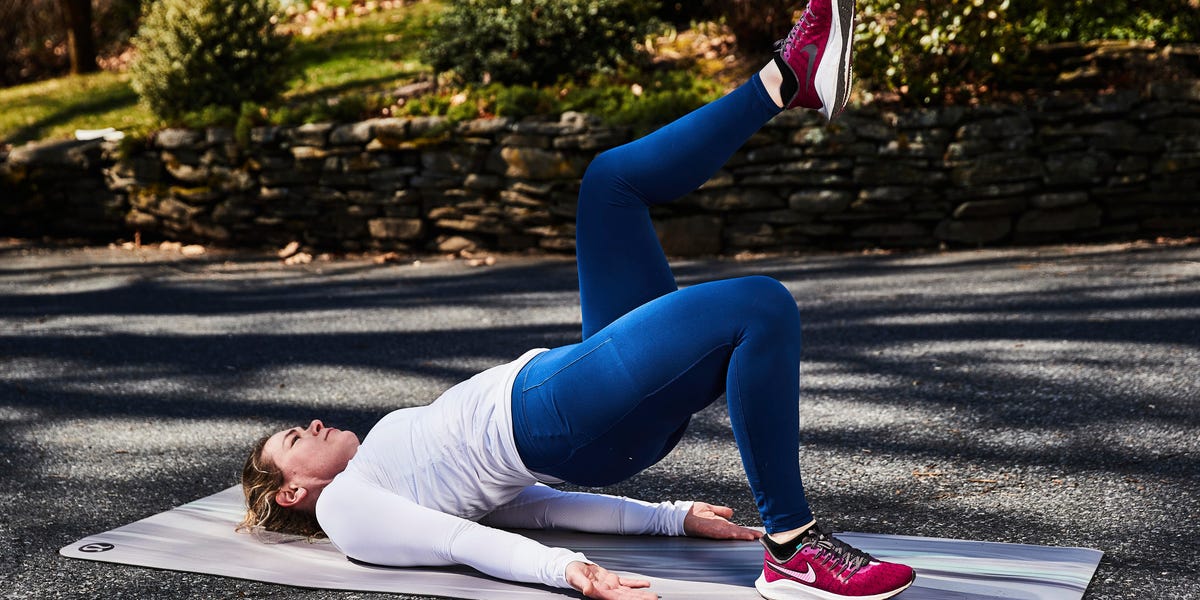
While our hip flexors (on the front of the body) often get a lot of our attention (because, tightness and aches!), the hip extensors can always use more love.Hip extension exercises build up our often-neglected posterior chain—the muscles on the back of the body that add power to your stride.“Hip extension exercises are integrally important for runners,” says Samantha Rothberg, CSCS, certified strength coach and triathlete. “This movement pattern strengthens the muscles—the glutes and hamstrings—we need strong to ensure a safe and efficient gait on the run.”A few key exercises added to your strength workouts will target these crucial running muscles.Benefits of Hip Extension ExercisesAs Rothberg mentioned, the big power players that drive hip extension include your glute (butt) muscles and your hamstrings (on the back of the upper thighs).More specifically, the gluteus maximus (the biggest muscle of the backside) drives the push-off phase of the running gait. “It also stabilizes the hips on the run to keep the lower back, knees, and ankles safe,” Rothberg explains. Meanwhile, the hamstrings extend the hip, flex the knee, and add stabilization and force behind your stride.“These large posterior chain muscles are often undertrained in favor of anterior muscles, such as the quadriceps and hip flexors, upon which we are overreliant because of poor posture and a sedentary lifestyle,” Rothberg adds. “Utilizing these large muscles [on the back of the body] is more efficient, will produce more power, and could help to prevent an overuse injury.”Balancing out your lower body with hip extension exercises creates that efficiency in your stride by allowing all muscle groups to work at their best. This also means you work better rather than harder to reach faster speeds, Rothberg adds.The Best Moves to Strengthen the Hip ExtensorsDo each exercise below for 4 sets of 8 to 10 reps. If it’s a single-sided exercise, go for 8 to 10 reps per side.You will need a kettlebell or a heavy dumbbell for this workout. You’ll also need a barbell, but you can use a kettlebell or dumbbell in place of that, as well. An exercise mat is optional.Rothberg demonstrates the exercises in the video above so you can learn proper form.1. Single-Leg Glute BridgeWhy it works: Running is a single-leg sport, and strengthening the legs one at a time prevents imbalances and helps you sidestep injury, Rothberg says. “Driving the elbow into the [lifted] quad also ensures that the core is engaged and that you are driving through the down heel, and not kicking up to the sky with the elevated leg,” she adds.How to do it: Lie faceup, knees bent and feet planted. Place left arm down by side. Lift right knee and bend right elbow. Touch right knee to right elbow, driving them into each other. This is your starting position. Drive through left heel to lift hips up. Engage glutes to lift hips; avoid lifting with lower back. Slowly lower back down to starting position. Repeat for 8-10 reps. Then switch sides. 2. Deadlift Why it works: “This exercise targets the entire posterior chain, teaches you to push off the ground effectively, which is important for running, and can be loaded and scaled as appropriate for your lifting level,” Rothberg says.How to do it: Stand with feet hip-width apart, holding a kettlebell or dumbbell with both hands in front of hips. Hinge at hips by sending glutes straight back, keeping back flat and core engaged. Keep weight close to body, reaching toward feet.Drive through feet and engage glutes to stand back up, extending hips. Repeat for 8-10 reps. 3. Kickstand DeadliftWhy it works: This deadlift variation also brings in a unilateral element, helping you strengthen one leg at a time. This helps keep your muscles symmetrical, Rothberg says, while providing the same benefits as a regular deadlift.How to do it: Stand with feet hip-width apart, holding a kettlebell or dumbbell with both hands in front of hips. Step right foot back, so toe is in line with left heel, and keep right heel lifted. All weight should be on left leg. Hinge at hips by sending glutes straight back, keeping back flat and core engaged. Keep weight close to body. Drive through left foot and engage glutes to stand back up, extending hips. Repeat for 8-10 reps.Then switch sides. 4. Glute Bridge WalkoutWhy it works: Adding a walkout to the glute bridge strengthens the hamstrings eccentrically, in the lengthening (or lowering) phase, Rothberg explains. It also makes your glutes work isometrically, meaning they have to maintain contraction as you extend the legs. This helps to stabilize the hips, which can keep them from dipping on the run.“Many people get injured from not training the eccentric load—that’s often when they pull something,” she adds, which is why eccentric movements are so important.How to do it: Lie faceup, arms down by sides, with knees bent and feet planted hip-width apart. Drive through heels to lift hips, engaging glutes and core. Avoid lifting with lower back. Hold here.Step left foot forward. Then right. Continue alternating until legs are straight. Then pause and walk them back in, underneath knees. Lower hips. Repeat for 8-10 reps. 5. Barbell Romanian DeadliftWhy it works: Focus on the eccentric action of this exercise—that means slowing down the lowering phase, aiming for a five-count as you go—to gain the most benefit. This helps you strengthen the posterior muscles in the lengthening phase, which increases your strength gains, Rothberg says.How to do it: Stand with feet hip-width apart, holding a barbell (or two heavy dumbbells) with both hands in front of you. Hinge at hips by sending glutes straight back, keeping back flat and core engaged. Move slowly, on a count of 5. Keep weight close to body.Drive through feet and engage glutes to stand back up, extending hips. Repeat for 8-10 reps.Mallory Creveling is an ACE-certified personal trainer and RRCA-certified run coach, who also holds certifications in kettlebell training, sports performance, and more. She has more than 15 years of experience covering fitness, health, and nutrition for a wide range of publications, and nearly 10 years of experience as a trainer and fitness instructor. Mallory stays on top of her continuing education in fitness, as well as the latest science in wellness. She has worked with some of the best experts in their medical fields, and regularly interviews researchers, trainers, athletes, and more to find the best advice for readers looking to improve their performance and well-being. As a freelance writer, Mallory's work appeared in Women's Health, Self, Men's Journal, Reader's Digest, and more. She has also held staff editorial positions at Family Circle and Shape magazines, as well as DailyBurn.com. A former New Yorker/Brooklynite, she's now based in Easton, Pennsylvania.
These 5 Hip Extension Exercises Help You Strengthen the Right Muscles for a Powerful, More Efficient Stride
Full Article
Original Source
Read the full article at Runnersworld →KhanList aggregates and links to publicly available news content. We do not host full articles from third-party sources. Always verify important information with original sources.