
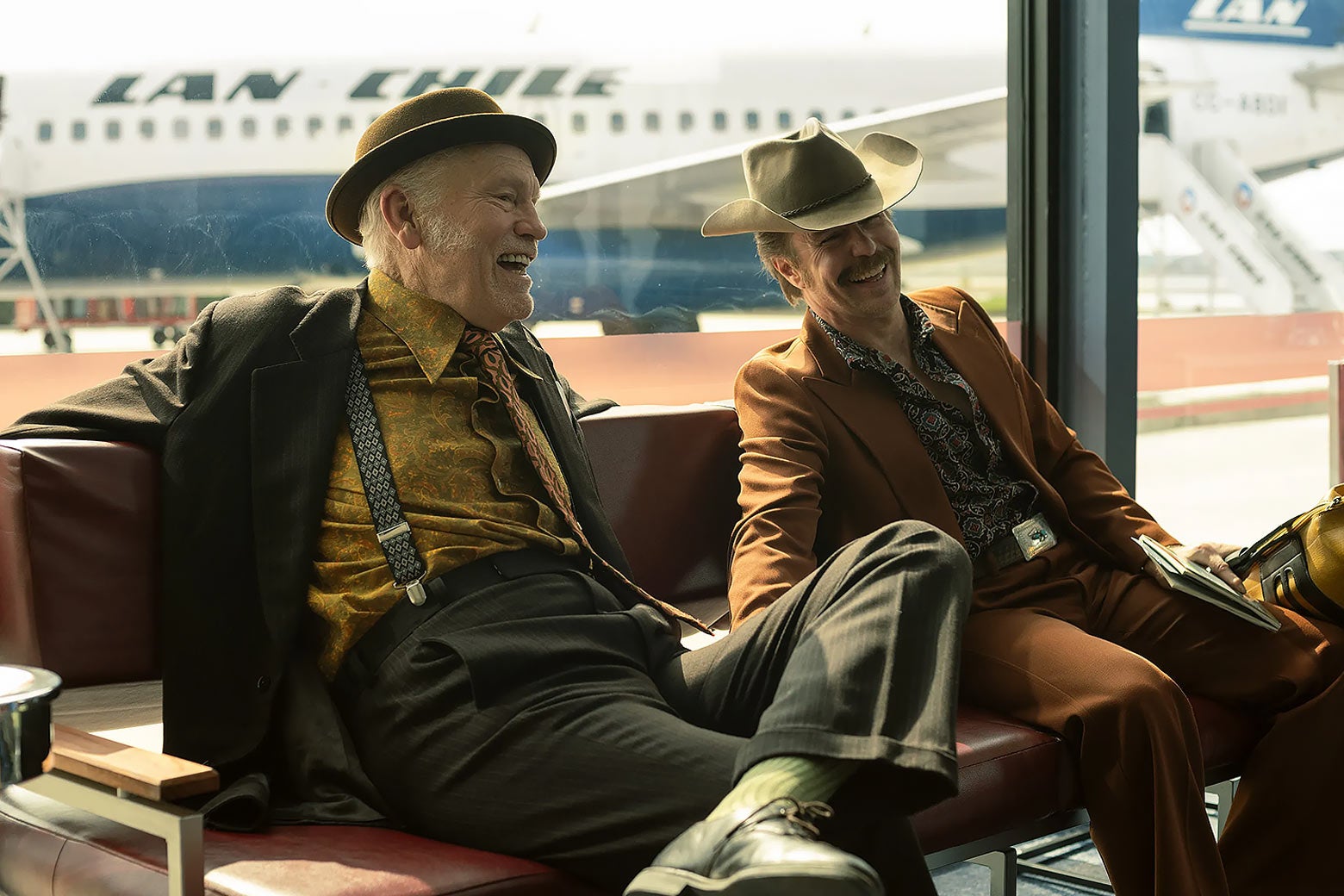
Movies John Malkovich Has Finally Been Given the Role of His Career With Wild Horse Nine, Martin McDonagh returns with another pitch-black comedy that could win its lead an Oscar. I hope it does. By Enter your email to receive alerts for this author. Sign in or create an account to better manage your email preferences. Unsubscribe from email alerts Are you sure you want to unsubscribe from email alerts for Dana Stevens? Nov 05, 20261:00 PM Searchlight Pictures Sign up for the Slatest to get the most insightful analysis, criticism, and advice out there, delivered to your inbox daily. The Irish playwright-turned-filmmaker Martin McDonagh returns to a familiar well in Wild Horse Nine, but that well is deep enough to contain more than one good movie. As in McDonagh’s 2008 directorial debut In Bruges, Wild Horse Nine follows two men whose partnership in a dangerous profession finds them stuck in a picturesque location, awaiting an act of violence that could come at any time. And like both In Bruges and 2022’s The Banshees of Inisherin, this new film is a black-humored exploration of the intricacies of male friendship. It’s too bad that, like the 2017 semi-misfire Three Billboards Outside Ebbing, Missouri, McDonagh’s latest is at times guilty of using other people’s tragedies as a backdrop for the redemption of messed-up white guys. But since Wild Horse Nine is largely about that very phenomenon—specifically, the colonization of global politics and culture by America in all its pigheaded glory—McDonagh’s barbed dialogue at least punctures the right targets this time around. It’s 1973, and CIA agents Chris Carlisle (John Malkovich) and Lee Chesterfield (Sam Rockwell) have spent a year stationed in Santiago, Chile, preparing for the U.S.-backed overthrow of the democratically elected Marxist president, Salvador Allende. Just weeks before the planned coup, Chris and Lee take a vacation from the daily grind of plainclothes spying to visit Easter Island, the Pacific locale famous for its monumental sacred statues—or, as the culturally insensitive Chris insists on calling them, “the big heads.” It’s a sight Chris has always wanted to see before he dies—an event that, as established in an early conversation between Chris and Lee, is likely to happen very soon. Chris has terminal cancer, along with short-term memory loss that may be a result of either the disease or the morphine he’s using to treat his pain. Chris’ trip to the remote tourist site is both a dying man’s last wish and a convenient location for that man’s planned execution. You see, Chris and Lee’s boss at the CIA, the spectacularly surly MJ (Steve Buscemi), has decided that Chris knows too many secrets to be left alive even for the brief time he has left. A veteran agent who has been with the CIA since the beginning of the Cold War, Chris is now bent on writing a memoir of his life in spycraft, and is already dictating highly sensitive secrets into a recorder he carries with him everywhere. Not only that, but he has long been rumored to possess a rifle that played a key role in the Kennedy assassination, and MJ is determined to find that weapon before the frail spook kicks the bucket. So Lee—who over the course of a decade of bickering partnership has developed a deep if thorny friendship with the jaded Chris—is saddled with the miserable task of spying on his own mentor before taking him out of the game forever. At the airport, Lee and Chris have a brief, prickly exchange with a pair of young Chilean women, Monica (Mariana di Girolamo) and Alicia (Ailín Salas). These left-wing student activists are put off when Chris, his tongue loosened by a combination of cognitive decline and I’m-dying-anyway bravado, boasts about being an American spy. The women at first seem to take this elderly tourist for a crank, an impression encouraged by Lee’s strategic eye-rolls. But once Lee and Chris check in to their side-by-side rooms on the island, they realize that the women are also on a tourist visit to Rapa Nui—the “Indigenous” name they use for the island, to Chris’ open mocking. “You shouldn’t even know the word Indigenous at your age,” he scoffs, as the beleaguered Lee tries to end the conversation. Wild Horse Nine is part black-humored buddy comedy, part existential Western (Lee’s cowboy hat and the roaming packs of wild horses lend the setting a John Ford vibe), and part satirical critique of American imperialism. It’s that last element that feels the most awkwardly wedged in, such that McDonagh’s treatment of the Global South’s violent colonial history can come off as troublingly glib. But you don’t come to a McDonagh movie for sophisticated sociohistorical analysis. You come to watch two guys busting each other’s chops in the funniest, rudest, most melancholy and profound manner possible. This writer-director specializes in a style of comic dialogue that’s heard more often onstage than in film—speech that’s slightly heightened, dependent on repetition and rhythm in a way everyday conversation isn’t. The reliably brilliant Rockwell has now starred or co-starred in three McDonagh films, so he is a past master at delivering the director’s trademark pitter-pat badinage. But Malkovich, new to the McDonagh-verse, is a revelation in the kind of role he has too rarely gotten the chance to play over a 50-year career: not a menacingly icy villain or an eccentric oddball but a fragile, complex, deeply guilty man whose long-abandoned Catholic faith has him questioning, as death approaches, what kind of eternity he will face after a lifetime of propping up dictators and engineering political assassinations. Malkovich has been blessed, or cursed, with a distinctive voice that tends to make his every utterance sound ironic. Here he deploys that instrument in an unexpected way, almost whispering some lines, pausing in unexpected places during others, finding the poetry in riffs about everything from the ethics of killing moths to the connection between America’s history of colonial domination and its inferior prepackaged cheese. Malkovich is currently the favorite for Best Actor in predictions of this year’s Oscar race—though he’s been nominated twice, he’s never won—and much as I dislike reducing performances as artful as this one to statistics on a betting site, I would be surprised and disappointed to see the award go to anyone else this year. Though Wild Horse Nine is the kind of movie that relies more on dialogue than on imagery, its striking setting on Rapa Nui gives the film a memorable visual simplicity, as the doomed Chris and the tormented Lee play out the final days of their friendship amid seaside cliffs presided over by the stone-faced figures of the Moai. For all the talk of hidden rifles, bombs in briefcases, and plots to overthrow democracy, the story seems to be unfolding in a mythical landscape that makes it feel more like a moral allegory than a spy thriller. In McDonagh’s best work—as in the work of the Irish playwright he seems most indebted to, Samuel Beckett—the sacred and the profane become inextricable as the characters’ conversations ping-pong between existential reflections on mortality and raunchy insult comedy. If nothing else, see Wild Horse Nine for the final scene, with Lee and Chris trading loopy reflections on the lyrics to a Hank Williams song as they sit at the base of an implacable rock sculpture, waiting—just as we all are—to see how the end they’ve been expecting all this time will finally come. Comedy Latin America The Oscars Thrillers
There’s Only One Man I Want to See Win Best Actor This Year
Full Article
Original Source
Read the full article at Slate →KhanList aggregates and links to publicly available news content. We do not host full articles from third-party sources. Always verify important information with original sources.