
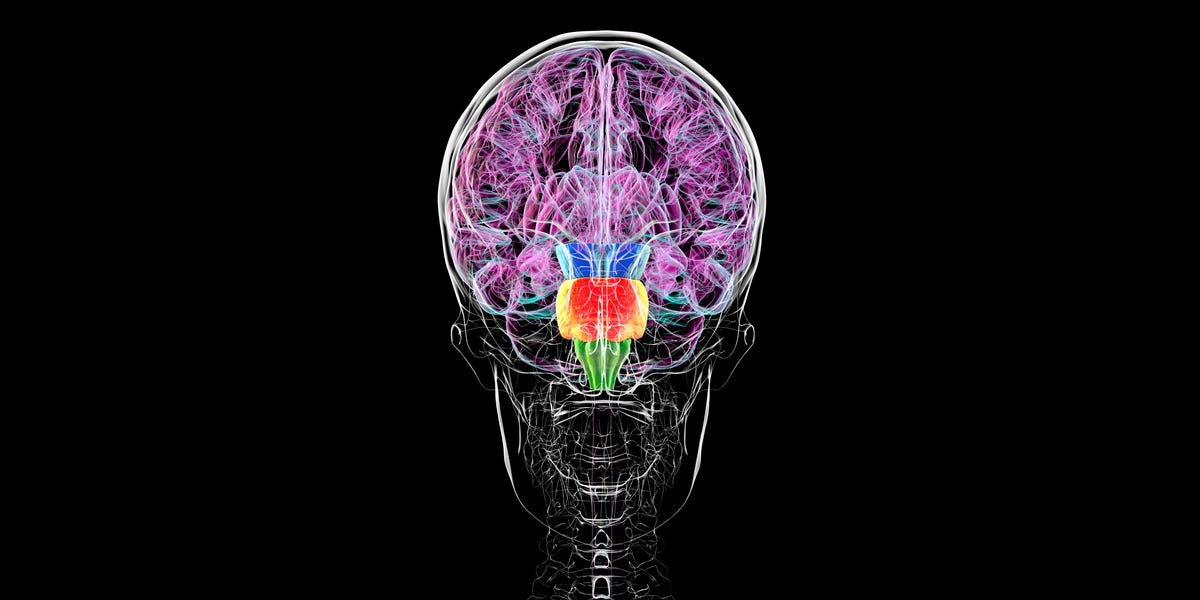
3 min readUnderstanding the ins and outs of human consciousness is a devilishly difficult problem seen in the dozens (or in some estimates, hundreds) of hypotheses put forward to explain our lived experience. However, a majority of those ideas place the cerebral cortex at the center of the consciousness conundrum, and at first glance, the association makes sense. This outer layer of the brain contains more cortical neurons than any other mammalian species and handles all kinds of complex processing, but not everyone agrees.“I’m absolutely confident that the fundamental form of consciousness is raw feeling, and it’s located in the upper brainstem,” University of Cape Town neuroscientist Mark Solms said on a podcast. “My major opponents are the corticocentrist theorists. That is the majority of neuroscientists by far…those who think it’s obvious that the cortex is the seat of consciousness.”But Solms isn’t alone in his assertion. A new paper, published in the journal The Neuroscientist, takes a closer look at this idea by expanding two types of awareness: access consciousness and phenomenal consciousness. While access consciousness refers to things a person is aware of at any given time, phenomenal consciousness explains the raw sentience of existence, or what the paper describes as the “me inside.” As PsyPost notes, if you were to block your eyes, cover your ears, and sever yourself from any source of sensory information, there would still exist an experienced self within you.The idea that consciousness resides somewhere other than the cortex isn’t a new one, and that’s partially due to some pretty compelling evidence that the cortex doesn’t run the entire show. For one thing, some humans are born with hydranencephaly where major parts of the cerebral cortex are missing, but they continue to show signs of consciousness. Studies of patients with extensive damage to the cerebral cortex likewise show signs of lasting consciousness, while damage to the brainstem can cause a loss of consciousness or even a coma.“The leading theories of consciousness, all cortico-centric, have difficulty dealing with these facts and typically fall back on the thought that residual bits of cortex may be enough,” The Hebrew University of Jerusalem’s Marshall Devor and Harvard Medical School’s Mark Baron write in the study. “If so, even minor disruption of cortex, to say nothing of massive disruption, ought to distort or eliminate both raw consciousness and pain sensation.”Redirecting the focus to the brainstem, Devor and Baron conclude that the experience of pain is a major clue that consciousness resides in this lower cerebral structure. Senses like vision and hearing each have a clear home in the cortex, but pain doesn’t. Even when scientists stimulate the cortical areas linked to pain, people don’t actually feel it. The brainstem is also an ancient part of the brain, and humans have it in common with many other animals, which feel pain as much as we do. Devor’s previous work also explored how tiny amounts of anesthetic injected into small pockets of the brainstem caused unconsciousness in rats.“The brainstem computation that we envision is strictly biological and a relatively simple, ‘primitive’ one. What it provides is a kind of ‘flavor’ to the complex, nonconscious computations carried out mostly in the cerebral cortex,” Devor and Baron write. “Without this ‘flavor,’ cortical processing closely resembles computations executed in today’s self-driving cars and robots.”The authors argue that the sensation of pain provided “Darwinian fitness benefits” retained by evolution that first evolved directly in the brainstem, without the need for cortical processing. As a more complex mammalian mind emerged from the mists of evolutionary biology, the brainstem worked with the cerebral cortex to provide sentient experience for a wider range of sensations.“Damage restricted to the cortex may cause blindness or sensory neglect, but it does not cause unconsciousness,” the authors conclude. “Focal brainstem damage does.”Darren lives in Portland, has a cat, and writes/edits about sci-fi and how our world works. You can find his previous stuff at Gizmodo and Paste if you look hard enough.
There’s One Thing That Separates Us From Self-Driving Cars. Scientists Are Fighting Over What It Is.
Full Article
Original Source
Read the full article at Popularmechanics →KhanList aggregates and links to publicly available news content. We do not host full articles from third-party sources. Always verify important information with original sources.