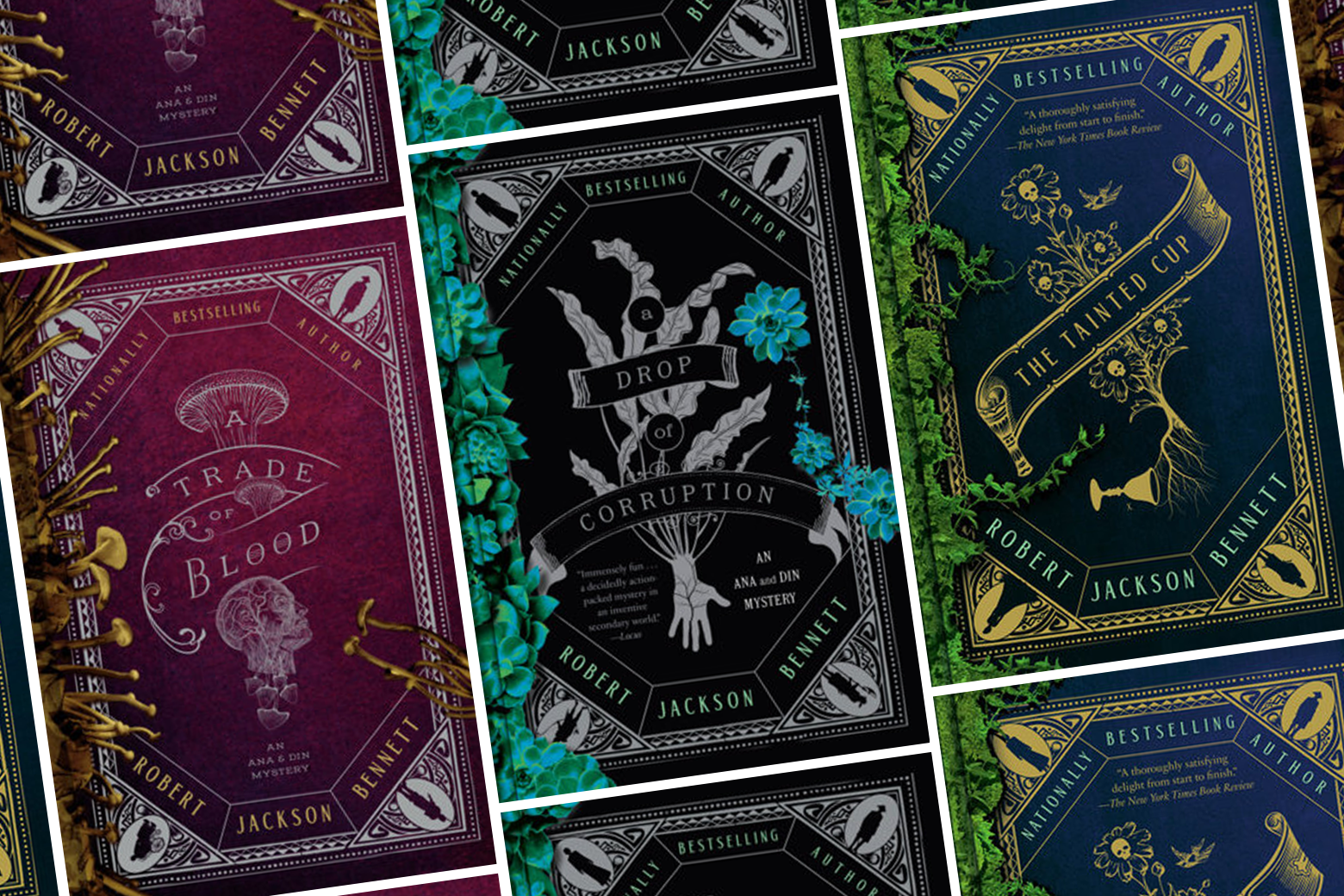
Books The Wild Imagination of the Ana and Din Mysteries Robert Jackson Bennett’s series has been a hit with everyone I’ve recommended it to. By Enter your email to receive alerts for this author. Sign in or create an account to better manage your email preferences. Unsubscribe from email alerts Are you sure you want to unsubscribe from email alerts for Laura Miller? Aug 08, 20265:50 AM Photo illustration by Slate. Images via Del Rey. Sign up for the Slatest to get the most insightful analysis, criticism, and advice out there, delivered to your inbox daily. It’s a strange world, the one in which Ana and Din—the two investigators in Robert Jackson Bennett’s fascinating mystery series—live and solve crimes. In some aspects, it resembles Victorian England, that cradle of detective fiction, and Ana and Din recall the dynamic between Sherlock Holmes and Watson: the brilliant, eccentric master detective and her bemused but ever-ready sidekick. The people of their Khanum Empire travel in horse-drawn carriages, navigate through a hierarchical class system, and benefit from technological advancements that verge on the miraculous. But that technology! It’s very weird, a system of biological enhancements and alterations to living creatures. Instead of engines and machines, the scientists in Ana and Din’s world shape plants, fungi, insects, and other life forms to build houses, light the darkness, lock doors, and perform most of the jobs that need doing in a relatively advanced culture. Fantasy and mystery can be tricky to combine. Part of what makes the Ana and Din series so much fun is watching how deftly Bennett integrates those genres, playing off the freedom of an invented world against the strict rules of the fair-play detective story. The result is wildly imaginative, sometimes pointed, often hair-raising, and very entertaining, a series that has been a hit with everyone I’ve recommended it to. At the heart of the series—the third installment, A Trade of Blood, has just been published—are his two sleuths. Dinios Kol, who narrates the novels, has been chosen to assist Ana Dolabra, whose investigative acumen is rivaled only by her peculiarities. A young man from the provinces who sends his salary back home to a family struggling under the debts run up by his wayward father, Din knows relatively little about the greater world, which makes him a fine avatar for readers who are also gradually discovering how the empire works. While the Holmes-and-Watson parallel may spring most readily to mind, the true model for Ana and Din’s working relationship is the Nero Wolfe mystery series, by Rex Stout. Wolfe, an agoraphobic gourmand, sends his assistant, Archie Goodwin, out onto the streets of New York City to gather information, then uses Archie’s reports to solve crimes from his capacious armchair. Here, Ana, whose mind finds sensory input so overwhelming that she wears a blindfold most of the time, prefers to cogitate in her room, reading old books and devouring bizarre and exotic meats while she waits for Din to return with the goods. Slate receives a commission when you purchase items using the links on this page. Thank you for your support. But Ana and Din are Nero and Archie turned up to 11. Like many of the people in the Khanum Empire, they’ve been biologically altered. Din agreed to undergo a painful process that has left him capable of exactly remembering events and information; he’s basically a human recording device. The middle-aged Ana’s modifications are one of the series’ enduring enigmas, since she suggests in the second book, A Drop of Corruption, that she has also been altered so as to render her unable to speak of them. Profane and tactless, Ana has a habit of grinning (“like a sharkfish,” Din thinks at one point) when pronouncing zestfully on the most ghoulish and sinister developments in a case, and most of the people they encounter during their investigations consider her mad and a bit terrifying. Din, who always addresses Ana as “ma’am,” like the dutiful sergeant in a British detective show, serves not only as her eyes and ears but as a sort of mediator with the various sources and fellow officers Ana tends to offend and alienate. The banter between these two is the most delicious element in the series. A Drop of Corruption—a classic locked-room mystery, along the lines of Knives Out: Wake Up Dead Man—includes a scene in which Din reports to Ana on his investigation of a safe-deposit box, where the murderer has left a pair of clues, one of which is a severed head: “He left … a fucking note?” she asked, incredulous. “It, ah, appears so, ma’am. Along with a head.” Ana’s grumbling stretched on and on. She seemed to have entirely forgotten I was there. “Ah, ma’am?” I asked. “Are yo—” “I mean,” she thundered finally. “He left a note! I just … I just can’t fucking believe that he had the audacity to leave a note! It bothers me terribly!” “I, too, was bothered, ma’am,” I said. “Though mostly by the sight of the hea—” “But frankly, this whole thing reeks of audacity!” She ripped her blindfold off, shot to her feet, and began pacing the room like a convict just told of an extension to their sentence … “A fucking note! I feel we needn’t bother looking at faces to find this man, Din! Just keep an eye out for the fellow with testicles large enough to cause back deformities, and we shall have our culprit!” As circumspect as Din may be with his superiors, the reader knows of his complicated inner life. In the first novel of the series, The Tainted Cup, he conceals the dyslexia that has hampered his advancement in the ranks of the empire’s officers, using his enhanced memory to compensate for his difficulty with reading. The alterations that made him an engraver (as those with this class of skills are called) come at a cost, rendering him sterile and subject to diminishing sanity in later life, as the burden of so much exact memory takes its toll. Din regards this as a sacrifice he’s made for his family, although it’s not until A Trade of Blood that the reader meets a member of that family and learns that they see things differently. Through Din’s eyes, the series explores Khanum, a marvelously ambiguous state based loosely on the Ottoman Empire. The empire, a series of cantons ringed by concentric walls facing the coast, is shaped by a single imperative threat. Every year, during the “wet season,” enormous beasts known as leviathans rise from the depths of the sea and attempt to lumber onto the land, leaving vast swaths of destruction in their wake. Everyone in Khanum lives in exquisite awareness of this danger, and only the empire has been capable of summoning the resources and workers to fend off the leviathans. Eventually, it emerges that the beasts themselves are the source of Khanum’s biological technology. The empire is a society with some obvious flaws, as Ana and Din often discover in the course of their investigations, but the series maintains a sense that it is worth improving and saving. The duo’s investigations also allow readers to explore the wonders of Khanum’s freakish world through the customary rituals of detective fiction. This is a place where an injured engineer—someone whose job it is to maintain the walls and weapons that keep out the leviathans—is confined not to a hospital bed but to an algae bath, and where, if you lose a hand in the course of duty, medics can deploy a swarm of altered snails to rebuild it. The murder victim who kicks off the series in The Tainted Cup dies as a result of trees that grow explosively out of his body. There’s more than a dash of body horror in the Ana and Din series, but that’s tempered by Bennett’s endless inventiveness in coming up with ways that the altered life forms in Din’s world might serve to replace the useful machines and devices in ours. Because, of course, the two worlds are not really that different underneath. Khanum, too, has its wealthy elite class that gets away with too much and its determined strivers like Din. Just as our mechanical technology has consequences, so does the organic technology of Khanum. This becomes a persistent theme in the novels and often serves, if indirectly, as a motive for the crimes that Ana and Din investigate. It’s easy to see the parallels between their world and ours, and if this engrossing series has a flaw, it’s Bennett’s penchant for including tendentious and superfluous author’s notes at the ends of the books explaining the messages he intended to impart about autocracy or the environmental impact of the beef industry. (Since only the second and third novels feature these notes, perhaps the fact that The Tainted Cup won both the 2025 Hugo Award for Best Novel and the 2025 World Fantasy Award went to his head.) But that’s a minor and eminently skippable shortcoming in a series that promises to reveal more tantalizing secrets about Khanum—with its emperor who has lived for centuries but hasn’t been seen for several of them, and its myth-shrouded past—and especially about Ana and Din themselves, all while delivering the reliable pleasures of a great detective yarn, very strange and delightfully familiar all at the same time. Get the best of culture Get the best of movies, TV, books, music, and more. Books Slate Book Review Fantasy Mystery
There’s One Series I’ve Recommended Over and Over. It’s Proved a Hit With Everyone.
Full Article
Original Source
Read the full article at Slate →KhanList aggregates and links to publicly available news content. We do not host full articles from third-party sources. Always verify important information with original sources.