
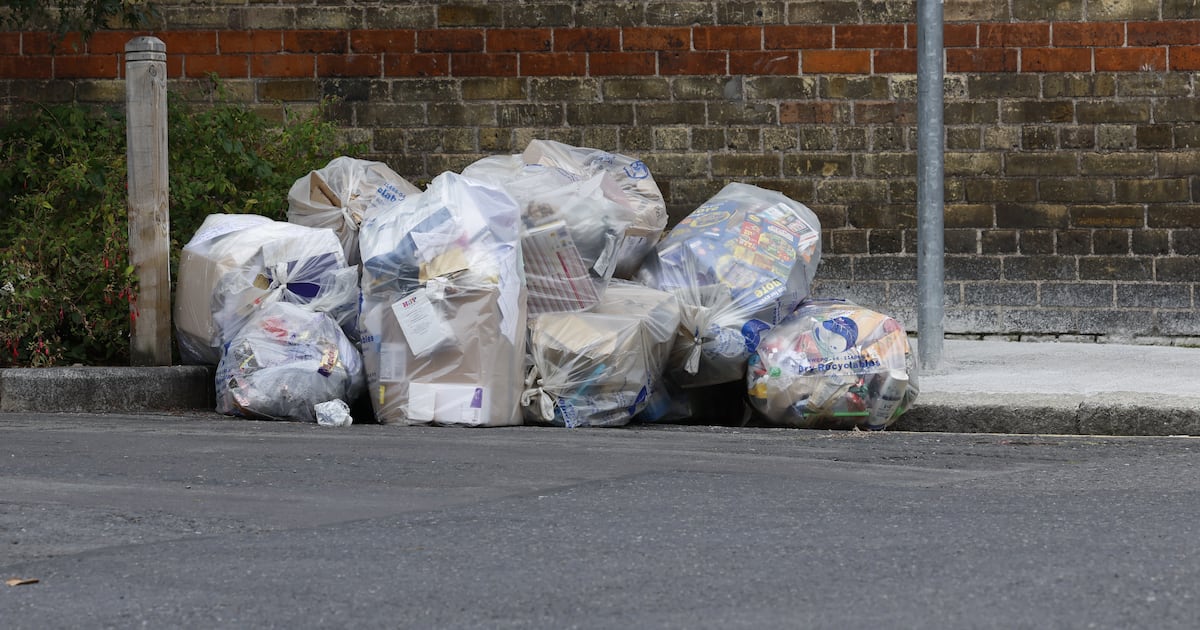
In the early years of the millennium, Dublin’s local authorities found themselves embroiled in waste wars. Hostilities started when households across the capital were, for the first time, charged for council bin collections. The move was deeply unpopular, and many refused to pay.In retaliation, councils stopped emptying bins of non-payers, leading to the emergence of a mighty resistance movement. Bin bags were hurled like missiles into fleeing waste lorries; blockades were mounted, trapping lorries in culs-de-sac. Protesters were imprisoned and political careers of campaigners were launched.Collections resumed, but it was a Pyrrhic victory. By the end of the decade, local authorities were exiting the waste market. Bin collection was being left to the private sector.Dublin City Council was the last of the four Dublin local authorities to end collections in 2012. At the time, its waste service was operating at a loss of €10 million.READ MOREHaving successfully divested itself of costly and contentious waste collections, it may seem like a kamikaze move to reignite the waste wars, but the city council has now said Dublin 7 residents should give up the use of plastic refuse bags and move to bins.The origins of the current conflict date back a decade. Waste-management regulations requiring the use of bins instead of bags came into force in 2016, but residents and businesses on more than 900 streets were given a derogation because their properties were unsuitable for wheelie bins.Streets in the city centre were included, as well as homes in suburbs with no gardens or no direct back access in areas such as Stoneybatter, Phibsborough and Drumcondra on the northside and Portobello, Harold’s Cross and Ranelagh on the southside.The council remained determined to rid Dublin of refuse sacks. Parts of the city were regularly placed bottom of national litter surveys, with the contents of ripped bags strewn on to the streets cited as a primary cause.At the start of 2025, it announced the introduction of compactors to the city centre. These caravan-sized structures, where registered users could deposit bags, were first installed in the south of the city in Temple Bar and St Stephen’s Green last December and then in the north inner city off Marlborough Street and near Capel Street in May.Also in May, the council said the largely residential Dublin 7 suburbs of Stoneybatter and Phibsborough would be “bag free” from July. Unlike the city centre, these areas would not be offered compactors, with households having the choice of taking wheelie bins or using smaller 45-litre “caddie” bins.Stoneybatter is the current battleground in the waste wars. Photograph: Nick Bradshaw/The Irish Times Residents mobilised in response, protesting outside City Hall and displaying brochures of the new bin offerings in their windows, emblazoned with a large red X and the phrase, “No! Not a solution”.The council agreed to suspend action until October 17th to allow “engagement” with residents, though it has stressed it still intends to implement the bag ban.Stoneybatter resident Christine Lucignano says this is a decidedly less considered strategy than the council adopted in the business-dominated city areas.“In the city centre, the council spent at least a year consulting. We got notes through the door at the end of May, telling us we were losing our bags on July 6th, that was the extent of the notice we got,” she says.“The city centre got the option of the compactors, but for us, there’s been no assessment or consultation on potential communal options, or any workable solutions. It’s just ‘bins’, and that’s it.”Christine Lucignano with a wheelie bin in Stoneybatter. Photograph: Nick Bradshaw/The Irish Times For Lucignano, and many of her neighbours, a wheelie bin is not an option.“We have nowhere to put them. My husband’s a window cleaner, and we’ve a dryer in the back yard. That’s where all our storage is, and there is no room for anything else.“I suffered a stroke a while back, and I have issues with mobility on my left side ... the idea of my husband being away, and having to bring a wheelie bin through the house, and down a step ... This isn’t a matter of me trying to be difficult. I just couldn’t do it.”Caddies that could be carried through the house aren’t suitable either, she says.“I’ve heard the guys in the council saying they hold the same amount as a bag – not in a million years do they! And they cost the same as a wheelie bin. Also, after they’re emptied, they’re left thrown in the road, or blow around and get cracked.“Then if you have no outside space and have to store them in your house. Well, doggies do piddle on bins, and you’re bringing that into your house. How is that hygienic?”General waste bags cost from just over €3 to just under €5 depending on the provider, with recycling bags costing less. Bin users are required either to pay standing charges and per-lift costs, or set weekly/monthly charges. While these charges won’t be higher than those paid by bin users in other parts of the city, they will likely present a considerable increase for those switching from bags.“At the moment I pay about €13-€15 a month,” says 83-year-old Marie Hegarty, who lives a few doors down from Lucignano. Her costs are likely to rise to more than €21 a month. “Well, you’d just have to give up something else, wouldn’t you? I’m very practical like that. I wouldn’t buy that much, and I don’t eat that much now.”Marie Hegarty in Stoneybatter. Photograph: Nick Bradshaw/The Irish Times Waste caddie. Photograph: Nick Bradshaw/The Irish Times However, the expense of the bins is not as big a problem as their storage, she says. “There’s nothing wrong with the bags; the bags are perfect. They just fit under the sink; I can’t get a bin under there.”Around the corner, Lucy Hogan has started to use the caddies. “We got them about two months ago, because we were told we wouldn’t be allowed to put out bags any more and we didn’t want to be left without our waste collected, but they don’t hold as much as the bags.”Communication on the issue has been very poor, she says.“We didn’t hear anything about it, then all of a sudden somebody knocked on the door and said, ‘As of next week you can’t use bags any more’. I understand the idea of getting rid of the bags, with the seagulls and all that, but I would rather have a place where we could go, like, a central place where you could put your rubbish.”Over on Church Street, near the Four Courts, Hilde Creagh says her reluctance to switch to bins was largely for environmental reasons. “Caddies are the same price as the big bin, so there’s no incentive to reduce your amount of waste.”Unlike others, she does have a small, railed garden where it has been suggested she keep her bins. “Neighbours are already paving over their gardens for wheelie bins. We all saw the flooding in Cabra recently – that’s what happens where people pave their gardens.”The council previously said it would implement a ban on the presentation of bags as “waste presented in bags frequently becomes scattered across streets due to birds, vermin and human interference”. The council said its “cleansing crews respond daily to incidents involving torn waste bags, often before routine street cleaning can begin”.Hogan is aware of the council’s argument that seagulls and animals tear bags, but she says: “The only bags I’ve seen pulled apart are ones that are illegally dumped”.Similarly, Lucignano says that on the rare occasion a bag is ripped on her street, residents immediately clean it up.“Of course bin bags look horrible on streets when they’re busted open, but that’s almost entirely an issue for the commercial area. We’re not lazy, we’re all very house-proud, and as soon as the collectors are gone we’re all out sweeping up. We want our streets to be perfect.”The council has received more than 400 submissions from Dublin 7 residents on removal of bags, which it has said it will review to help understand “local concerns and opportunities, storage and accessibility considerations, communication needs” and “any issues that should be considered before roll-out”.While Stoneybatter is the current battleground in the waste wars, the frontline will move to the southside early next year, with the bag ban coming to residential areas south of the city where bags are still in use, including parts of Dublin 6 and Dublin 8.
‘There’s nothing wrong with the bags’: inside Dublin’s latest waste war
Full Article
Original Source
Read the full article at Irishtimes →KhanList aggregates and links to publicly available news content. We do not host full articles from third-party sources. Always verify important information with original sources.