
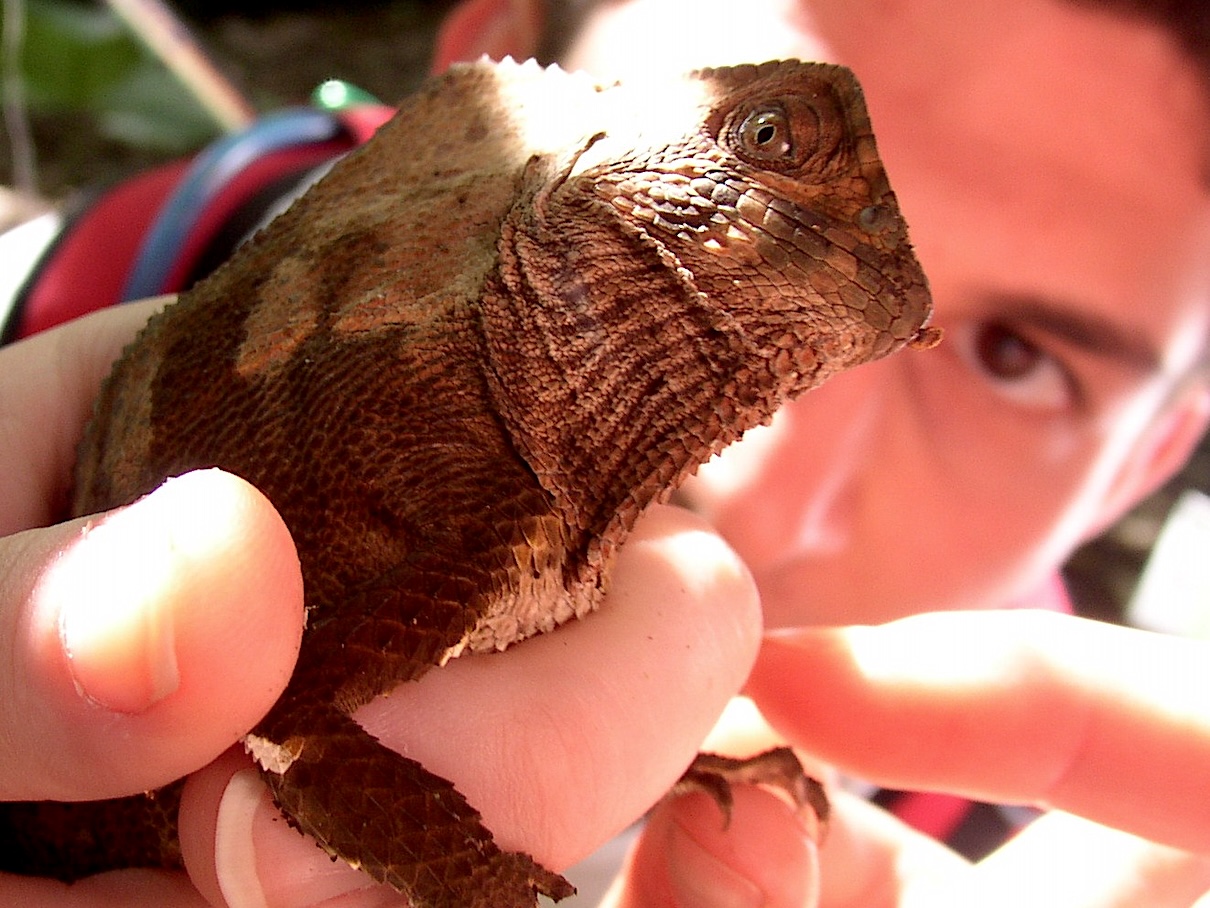
Many college level biology classes require lab sessions that are conducted outdoors, providing students with memorable and sometimes indelible experiences in the natural world.An instructor of ecology labs at Merrimack College in the U.S. state of Massachusetts writes in a new analysis that there’s simply no substitute for this time spent outdoors learning how the world works — either close to home or abroad among rainforests or reefs — and explains how he benefits greatly, too.“I often tell people I can’t believe I get paid to do something I enjoy so much. But the biggest beneficiaries of field courses are the students,” he writes, saying that they “not only help students to develop an understanding and appreciation for the natural world, but also to develop a conservation ethic.”This post is an analysis. The views expressed are those of the author, not necessarily of Mongabay. Leading a group of ecology students down a trail through the forest behind Merrimack College, in North Andover, Massachusetts, U.S., where I teach biology part-time as an adjunct professor, I spot a garter snake. As it rapidly starts crawling away, I grab the snake by its tail. Excited students gather round to check out the foot-long striped serpent, while taking photos with their cell phones. I tell them a bit about garter snakes and ask if anyone wants to hold it. “I do!” one of the students says. I gently hand her the snake. “That’s really cool. I’ve never held a snake before,” she says, before handing it to another eager student. Then we turn the snake loose and continue on our way. Merrimack College biology students with a garter snake found during an ecology lab on campus, North Andover, MA, September 2025. Image courtesy of Don Lyman. Since I began at Merrimack in 1997, I’ve taught mainly ecology labs. Most of the ecology lab sessions are outdoors, so they’re like weekly field trips. They give students the opportunity to step outside of laboratories and classrooms and interact with nature. Field courses provide the same opportunity for teachers. When I head off into the woods with students in tow, I’m in my element. Whether I’m diving into the bushes and scrambling on my hands and knees to catch a snake or a frog to show the class, pointing out a hawk circling overhead, or teaching students how to identify various species of trees, shrubs, and wildflowers, my enthusiasm shows. Sharing my love of nature and biology with my students and teaching them about the natural world around them — whether in a far-off exotic location or close to home — is rewarding. I often tell people I can’t believe I get paid to do something I enjoy so much. But the biggest beneficiaries of field courses are the students. Whether it’s a student seeing wild monkeys or parrots in the Amazon rain forest, or kangaroos in Australia, or a myriad of colorful tropical fish swimming across a coral reef in Belize, it’s always a thrilling, and sometimes life changing experience for them. Even interacting with nature close to home — such as seeing carnivorous plants in a local bog, holding a snake for the first time, or watching a beaver swimming underwater in a stream — can be an exciting and memorable experience. I’ve had many students over the years tell me that the ecology labs were their favorite class and they looked forward to them every week, because the labs gave them a chance to get outdoors and learn about the natural world around them. And field experiences like outdoor labs or field courses not only help students to develop an understanding and appreciation for the natural world, but also to develop a conservation ethic. Kids learning to watch birds inside John Heinz National Wildlife Refuge in Philadelphia. Image courtesy of Lavonda Walton/US Fish and Wildlife Service. What’s that Baba Dioum quote? “In the end we will conserve only what we love; we will love only what we understand; and we will understand only what we are taught.” Professor Bill McDowell, who teaches ecology and conservation biology at Merrimack, said courses with field components are important for a variety of reasons. “First and foremost, field labs are unpredictable and can inspire a sense of wonder and curiosity in students. Whether it is discovering the life that lives within the small pond on campus, or having a snake (thankfully a non-venomous one!) fall from a tree onto a student while sampling tree diversity, these are undoubtedly memorable experiences,” he said. Natural systems are inherently complex, he continued, saying we don’t always have clear cut explanations for the phenomena we observe. “This serves students well because it forces them to think critically and flexibly to try and explain the observations they see. It also emphasizes the unfinished, open-ended nature of science. At its heart, science is something that you do, rather than something you learn. With field labs, you are seeking explanations, rather than simply learning them from a textbook.” Field-based labs also help students to develop a sense of place, he said. For example, as part of his conservation biology course, students visited a local protected area close to their home and assessed what activities were allowed, and what the trade-offs were between human use and protecting natural systems. Peruvian Amazon rainforest surrounding Cocha Cashu Biological Station, a research facility which regularly hosts students learning about tropical ecology. Photo courtesy of Jason Houston. “While the primary goal of the assignment was to apply concepts from lecture,” McDowell said, “I heard from many students about how the activity led them to discover a place they loved, or to reconnect with a place that they had not visited in a long time.” Professor Larry Kelts, who retired in 2008 after teaching for nearly 30 years at Merrimack (and is now deceased), developed the Global Field Studies Program, which provided students with opportunities to study environmentally significant locations around the world, including the Brazilian Amazon, the Great Barrier Reef in Australia, the Serengeti Plain in Tanzania, the desert Southwest, the Galapagos Islands, and Belizean coral reefs and rain forests. Kelts and his colleague, Professor Marcia Walsh, taught semester-long courses that dealt with the ecology, conservation, and human cultures of these ecosystems, and culminated in field trips to these locations that lasted for two to three weeks each. These were amazing experiences that inspired several students to follow in Kelts’s footsteps and become biology and science teachers themselves, including myself: I was a continuing education student on the Amazon course in 1996, and it was while I was on that trip that I was offered the opportunity to join the biology faculty at Merrimack as an adjunct professor, where I ended up assisting with several future field courses. Along those lines, Professor Kristy McDowell, a lecturer and Chair of the Department of Environmental Sciences and Sustainability at Merrimack (and Bill McDowell’s wife), launched a new field course over winter break in 2024-2025. “I was offered the opportunity to lead short-term study abroad in Costa Rica, and I jumped at it. I did dissertation research for my PhD in Costa Rica, and it is a place that I deeply love,” she said. The trip is tied to her environmental policy course, although it is voluntary and open to all Merrimack students. Of all the memorable birds students could see during a field course in Costa Rica is the resplendent quetzal (Pharomachrus mocinno), an iconic bird of Central America’s cloud forests. Image by Cephas via Wikimedia Commons (CC BY-SA 4.0). “In the course, we spend the semester comparing and contrasting environmental policy in the United States and Costa Rica,” McDowell explained. “The trip entails a tour of several different locations and biomes and meeting with conservationists who are doing the work on the ground, so that students can see the policies in action and investigate the realities of interpreting and enacting policy. Overall, students have loved the experience. They particularly love that we go off the beaten path and dig deeper than the common tourist itineraries. They get to meet local people dealing with real environmental issues and participate in a meaningful way.” She also said that field courses allow students to participate in the material in a hands-on way that is impossible to replicate in a classroom: “For environmental science in particular, there is no substitute for students actually going outside. Teaching in the tropics takes it to another level as well. Students who have spent most or all of their lives in the United States are blown away both by the biodiversity of the tropics, and by how closely many people live to nature in a country like Costa Rica. While I can describe these things to them, showing them firsthand makes it real for them and allows them to think about environmental science issues from a new perspective.” Her favorite thing about the Costa Rica course, McDowell said, is watching her students enjoy the experience. “I love sharing a place that holds so much meaning for me and watching them fall in love with it as well. When they say that they don’t want to leave, or they can’t wait to come back, it highlights how valuable the experience is for them. I also love the impromptu moments that you can’t plan for, like running into a squadron of peccaries on the trail or a fleeting glimpse of a blue morpho butterfly.” Jim Hanken, Professor of Biology, Emeritus, and former director of the Museum of Comparative Zoology at Harvard University, said that Harvard incorporates field components into many of its courses, and has policies and procedures in place to help facilitate field studies. Hanken emphasized that instructors of field courses need to follow regulations regarding alcohol consumption, sexual harassment, and other basic safety precautions during field trips just as they would while on campus. He said that several years ago, the Department of Organismic and Evolutionary Biology began offering symposiums for basically everyone who was planning to conduct or lead fieldwork — regardless of whether it was course-related or research-related — over the subsequent year. The author with a gopher snake caught during a Merrimack College field course in Arizona and New Mexico, June 2006. Image courtesy of Kevin Salemme / Merrimack College. “It quickly proved to be so valuable that the science division now offers it to members of several academic departments,” he said. “It doesn’t cover academic-specific subjects, like what kind of binoculars are best for birding, or how to catch a lizard, but instead topics that are common to fieldwork of all sorts, ranging from emergency preparedness to collecting permits.” Field courses that involve travel may add additional personal and institutional impediments for both faculty and students, Hanken added. “Depending on duration and distance of the destination, the trip can be very expensive to put on, and students of lesser means will not be able to participate unless the college or university foots the bill,” he said, which the Museum of Comparative Zoology has done for some. Regarding field trips for courses associated with the Museum of Comparative Zoology (MCZ) and taught by its faculty — such as a week-long Costa Rica field trip that was part of a herpetology course he co-taught with colleague Jonathan Losos — Hanken said the MCZ paid the entire cost of the field trip for all students. Losos, now an evolutionary biology professor at Washington University in St. Louis, Missouri, U.S., said he’s observed the positive effects that field courses have had on students. “I used to teach herpetology [at Harvard], where we would go to Costa Rica for a week,” he said. “What a spectacular experience. I had many students who told me this trip was a life-changing experience. Some have ended up going into science, in part as a result of how this trip affected them.” John Morrissey, a biology professor at Sweet Briar College in Virginia, U.S., who retired in 2025, is a marine biologist and shark researcher and has brought nearly 1,000 students to the ocean on various field courses. The most memorable aspect of these field experiences for him, he said, was taking students who had never seen coral reefs in person on marine biology trips to the tropics. “Hundreds of times I have been able to watch a student slide into the water over a coral reef for the first time,” he said, “and hundreds of times, I’ve had the honor and pleasure of listening to their squeals of amazement and delight as they observe the cacophony of shapes, sizes, colors, and activities of reef-dwellers for the first time.” A student gets a close look at a helmeted iguana (Corytophanes cristatus) during a Harvard University herpetology course trip, Las Cruces Research Station, Costa Rica, March 2008. Image courtesy of Don Lyman. Morrissey added that field courses impacted his own career. Although he was a dinosaur fanatic as a kid and went to college to study biology and geology in preparation for a career as a paleontologist, a two-week field course in coral reef ecology on the north coast of Jamaica changed his career trajectory. “I traded in my rock hammer for a snorkel and never looked back!” he said. Morrissey also cautioned that faculty teaching field courses need to be willing to accept the good with the bad. Field courses often take place in remote areas where emergency services are non-existent, for example. “They need not to be intimidated by the hazards, they need to be able to handle the strenuousness of the course, and to welcome the awesome responsibility of trying to keep 15 to 20 students safe, 24/7,” Morrissey explained. But the pros far outweigh the cons, he added. “I believe that there is no appropriate substitute for field components within courses, and even whole field courses,” Morrissey said. “Sitting in a forest or drifting over a coral reef can be a spiritual experience, to paraphrase Carl Sagan. Being in nature, being surrounded by and immersed in nature, is the only way to grasp its beauty and complexity, its fragility and power, its mystery and its majesty.” Don Lyman is a science journalist, biologist, adjunct college professor, and health care professional. See related coverage: Inspiring young herpetologists in Sri Lanka: Interview with Anslem de Silva Kenyan teen leads charge on tree planting and climate awareness Credits Topics
There’s no substitute for getting out of the classroom and into nature (analysis)
Full Article
Original Source
Read the full article at News →KhanList aggregates and links to publicly available news content. We do not host full articles from third-party sources. Always verify important information with original sources.