
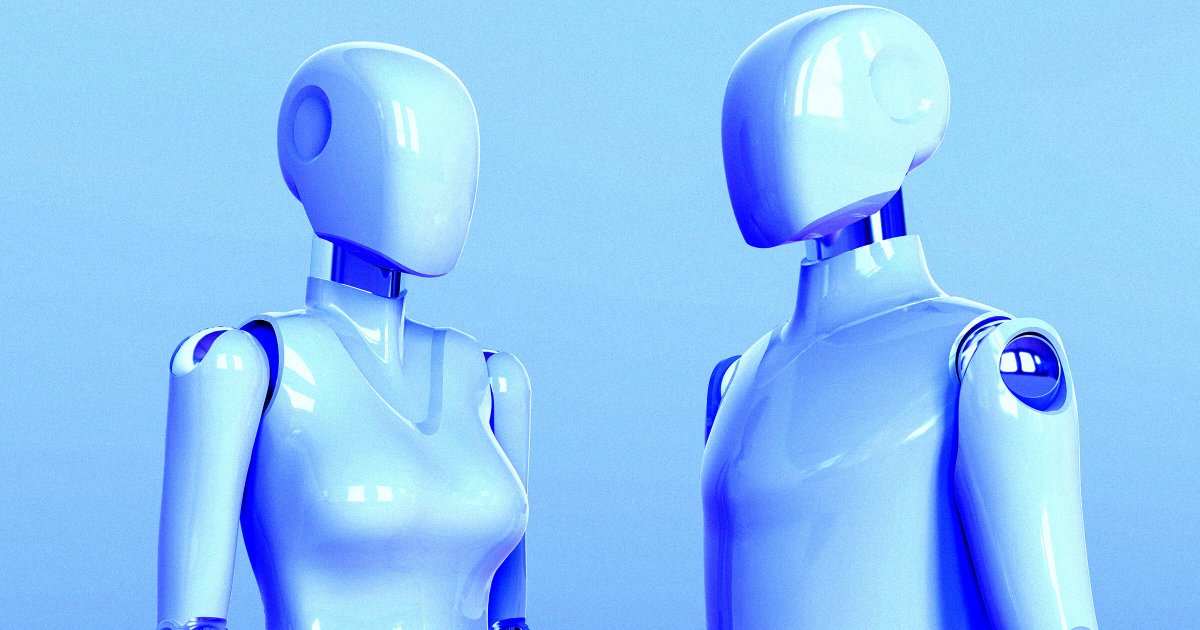
Shutterstock / Futurism Even female AI agents appear to get paid less than their male counterparts. Researchers from the University of Limerick in Ireland found that gender bias in the workplace still persists in how people interact with AI models, leading to female presenting chatbots to receive less pay, they report in a study published in the journal Proceedings of the ACM on Human-Computer Interaction which will be presented at an upcoming conference. In experiments, the researchers had 189 participants work in a virtual reality office place and instructed them to complete work-related tasks with a variety of AI assistants, including those that were either male or female-presenting. To make the stakes more real, the participants were given real money to divide between themselves and the AI assistants. The result: Johan, the male AI, was paid markedly better than “Johanna,” the female AI. In all, Johanna received 10.25 percent less for completing the same work, and it was also perceived as less human-like than its male counterpart, the study found. “What is striking about our findings is that the technology behind these AI agents was exactly the same, but people did not treat them in the same way,” coauthor Mary Hausfeld, an assistant professor UL’s Kemmy Business School, said in a statement about the work. “We often think of AI as being neutral, but the way we design and present these systems can activate those same assumptions and biases that exist in our interactions with other people,” she continued. “We don’t want to inadvertently reproduce existing inequalities in a new technological setting.” The study was intended to investigate how an AI is presented or embodied influences how humans perceive and interact with it, with the researchers noting how these tools are increasingly being framed as “digital coworkers.” They tested three different AI representations inside the virtual office environment: as a traditional chatbot; as a desktop robot lacking a face or movement, or as either a male or human avatar that sat next to them in the virtual environment. Overall, the human-like assistants were trusted more than the traditional chatbot and robot representations, and were compensated accordingly. The humans gave them more money and more credit for their contribution to the work. Strangely, though, the participants denied that their behavior was being swayed by the anthropomorphic AIs. In interviews, many participants insisted they preferred non-human-like assistants and that the gender of the AI assistant was irrelevant. Going forward, Haesfeld argues, we need to be a lot more careful about how AI agents are presented. Their appearance, or how they’re embodied, shouldn’t be treated only as an aesthetic decision. “Such choices may affect how much people trust AI, how they judge its contribution, and even how they financially reward it,” she said. More on AI: Workers Are Spending An Astonishing Amount of Their Own Money On AI for Their Jobs
There’s Even a Pay Gap Between Male and Female AI Agents
Full Article
Original Source
Read the full article at Futurism →KhanList aggregates and links to publicly available news content. We do not host full articles from third-party sources. Always verify important information with original sources.