
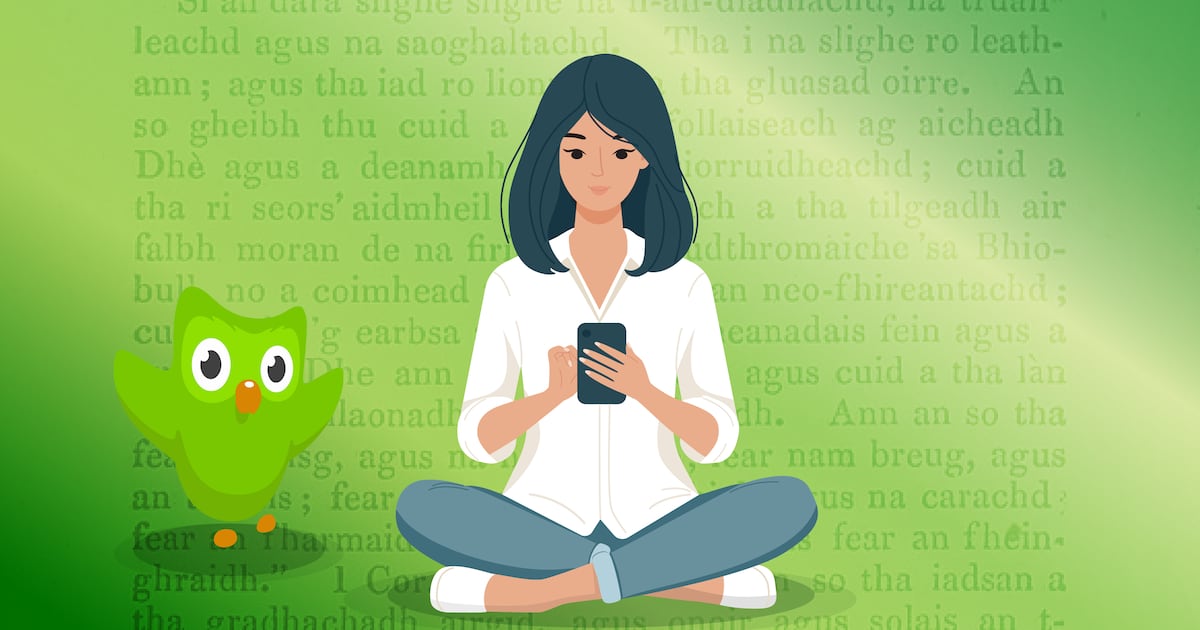
“Itheann an madra mo geansaí.” The Duolingo owl rewards me with a tiny hit of dopamine for being able to translate a sentence about the dog eating my jumper. Something in my gut warms, like a toddler falling prey to a compliment on their objectively terrible drawing. “Oh is that a picture of the dog eating a jumper? Oh, well that’s a lovely picture. I’ll put that on the fridge.” I am a woman in her 30s and I think: “Has it really come to this?” Like every other member of my generation who grew up in Ireland, I spent 14 years learning the Irish language and emerged from school with a mediocre speaking and comprehension level and a visceral resentment. As a teenager, I mistook this resentment for a hatred of the language itself, but this was a simple way to think about a complex relationship. As an adult, I’d go on to study Latin and found myself appreciating the structural and other similarities that my brain recognised as remaining deep in its mass from learning Irish. Like all languages, Irish had given me a different lens through which to see the world and structure reality. It wasn’t really the language but the legacy that felt burdensome. In the classroom, it never felt alive, playful or creative the way a language should. Rather it felt weighty, stiff and slow; delivered like a punishment. It felt like a box you were being instructed to climb into rather than the keys to a new universe of descriptive and conceptual possibility. I walked into the classroom on my first day at secondary school aged 13 with short legs and chronically oily hair, frightened out of my wits at everything around me. Among the terrors was suddenly being educated in a building with students who looked like adult women from my perspective, and chief among them was walking into an Irish class taught exclusively as Gaeilge. READ MOREThe only English I ever heard in the ensuing four years in that room was on the first day, when we were told that learning a language through that language was really the only way to do it, and we would figure it out eventually. It never quite panned out that way for me. One day about a year later, the teacher’s Eye of Sauron landed upon me, and I was called on to share my homework answers in class. I hadn’t done the homework and had no idea we’d been asked to do it. Apparently my Irish was so bad I missed that bit.As a conscientious, annoying teenager with low confidence, my inability to articulate the genuine confusion and explain that I wasn’t merely lazy troubled me for a long time after. I couldn’t remember the word for “lazy” (apparently it’s leisciúil, though I’m sure someone will correct me if it’s not). That memory is second only in “looking dumb at school” moments to the time the geography teacher made me work out a percentage at the board, which I had to be dragged through with bovine idiocy and significant interludes for vocal public humiliation about my mathematical ignorance. When it was over, she confidently declared: “Now for you. You’ll never forget how to do that again, will you?” “No,” I answered meekly, already having forgotten how to do it and never having done it again – or needed to – in the ensuing 24 years.The Irish language carried other weights. For millennials at least, it was entangled in a thick mesh of obligation, Catholicism and citizenship. It was a rote-learned procession of refrains written and recited for exam practice; less a window into a culture and history and more a series of noises you made with your face to pass an oral exam and get out of dodge, never to volitionally utter a word as Gaeilge again. There was nothing of the global and Gen Z Hibernophilia that has since given the language the joyfulness it needs to promote excitement and curiosity in young brains. No CMAT or Kneecap or Gaeilgeoir influencers on social media.[ My English friend was shocked that I got drunk at my grandmother’s funeralOpens in new window ]A December 2025 study by Amárach Research in collaboration with Gaelchultúr and Údarás na Gaeltachta found that 68 per cent of adults nationally say they want to improve their Irish, while that rose to 73 per cent of those under 35. For older people, Irish was force-fed – a language of angry poets, keening freaks and aul fellas leaning over cattle gates. That’s a large generational shift in attitude. This positivity and pride have made it possible for even the calcified cranks like me to revisit their relationship with our native tongue. It represents a different Ireland, and a different sort of Irishness, to those shovelled over us like earth into an open grave by a teaching staff still more than half-composed of nuns on the warpath.I’ll tell you one thing – as many have discovered before me, Duolingo isn’t the answer. It is pleasant, though, to uncover the secret knowledge I had presumed lost, buried so deep in my mind that it had been abandoned with the muscle memory entailed in how to use a hula hoop. It’s nice to recall that you can recall a fox is called a “sionnach”, and to find the shape of lost words forming in your mouth. It’s nice to be able to lift the weight of a grudge off the shoulders of that angry younger self, and to simply say “itheann an madra mo geansaí”. Though, that might not even be right. How would I know? Still, there’s no exam to worry about when you learn for the joy of it.
There’s been a large generational shift in attitude to the Irish language
Full Article
Original Source
Read the full article at Irishtimes →KhanList aggregates and links to publicly available news content. We do not host full articles from third-party sources. Always verify important information with original sources.