
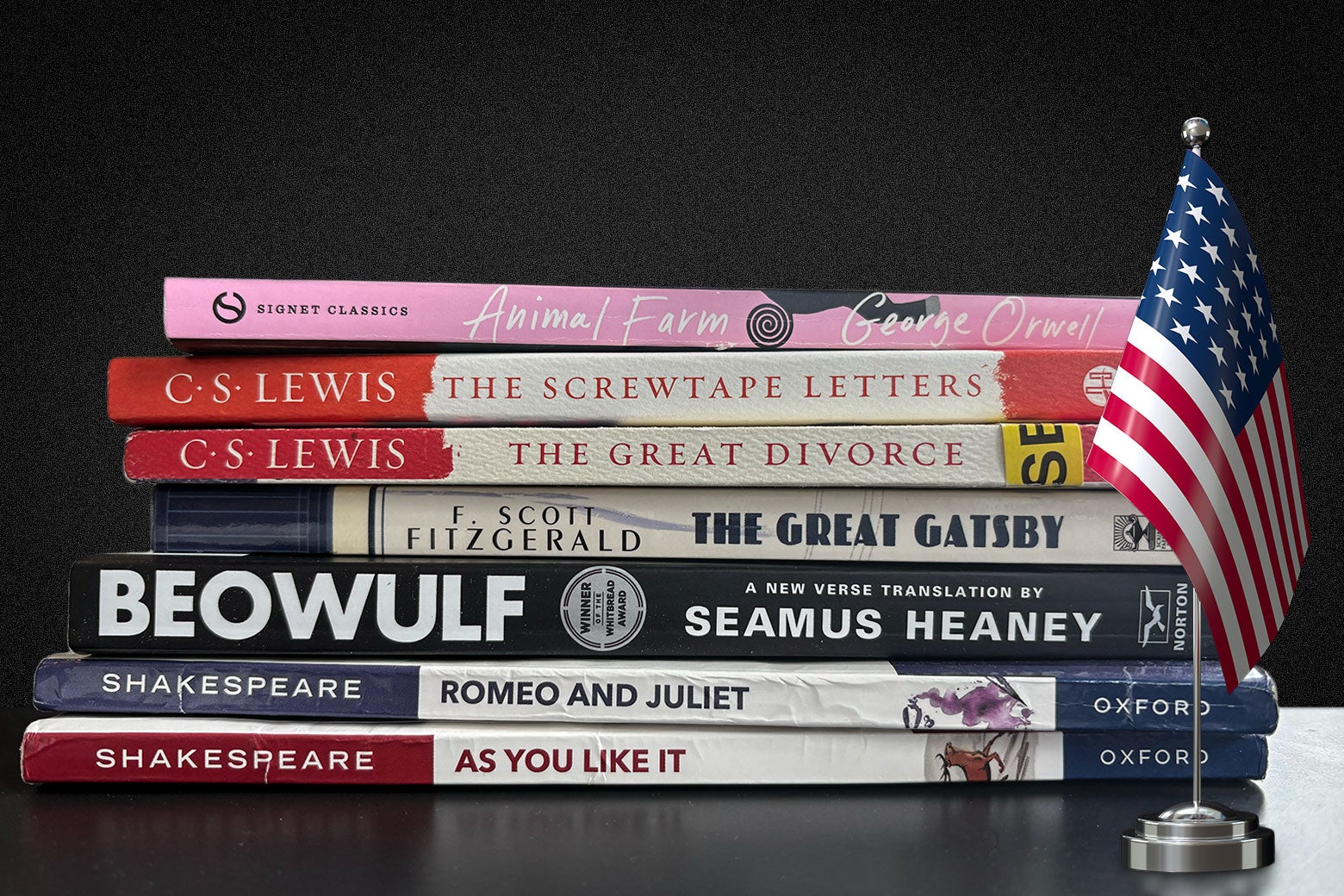
School I Want My Daughter to Love Reading and Writing. How Far Would I Go to Get Her There? Christian conservatives are leading the charge on a type of education that, in the right light, looks pretty appealing. By Enter your email to receive alerts for this author. Sign in or create an account to better manage your email preferences. Unsubscribe from email alerts Are you sure you want to unsubscribe from email alerts for Rebecca Onion? Nov 09, 20265:40 AM Photo illustration by Slate. Photos by Holly Allen and Getty Images Plus. Sign up for the Slatest to get the most insightful analysis, criticism, and advice out there, delivered to your inbox daily. People who credit good K–12 humanities education for their very selfhood, and who now have Gen Alpha kids in public school, are beset by anxieties, both global and local. Take the flood of stories, some anecdotal and some backed by data, about kids getting all the way to college without learning how to read whole books. (Setting aside concerns of rigor, this is simply a missed opportunity. You only have one chance to meet Faulkner with a 16-year-old brain.) Then, more stories, about classroom teachers using screens in instruction, including allowing YouTube to be watched during school hours. My own elementary-age child reports classroom screen time that always seems as if it could have been avoided. This has caused me, the daughter of a retired public school teacher and a believer in the idea of public school, to suffer pangs of distrust in my own child’s teachers, an unfamiliar feeling I don’t very much like. This unease has forced me to admit something: Sometimes, every so often, just a tiny little bit, I wish I could consider sending my daughter to a classical school. Classical education, broadly conceived, is on the rise. The Heritage Foundation maintains a database of classical schools, most recently updated in September of last year, that has 895 entries, one-third of which (as the Washington Post reported) “opened or adopted the model” between 2020 and 2024. Many of classical education’s pedagogical practices have been out of fashion in mainstream public schools for years or decades—think recitation, memorization, the diagramming of sentences. Some of these schools adopt ideas from Catholic or elite private education, like the Harkness method, in which a small group of students sits around a round table and discusses material with the help of a teacher facilitator. It was this no-screens, A.I.-proof way of teaching, used at my own private high school, that set me on the path to hopeless lifetime humanities fandom. You can’t do it with a big class, or with students who didn’t do the reading. There’s one obvious downside: On the ground, classical education is often conservative and Christian. The schools assign household-name Western canon greats—Homer, Dickens, Dostoyevsky—that I’d love my daughter to read one day. More kids having access to great literature and complicated philosophy would sound great if it weren’t for the fact that, although there are educators inside the movement pushing for diversification, it’s these famous, mostly-white-male authors and the constant callbacks to the idea of the Western canon that constitute the movement’s brand. Thanks to the movement to allow parents to divert funding from public schools and enroll their children in private or charter schools, more kids are able to access this way of learning. But which families will choose it? When the Post asked the then acting head of the Center for Education Policy at the Heritage Foundation why kids enroll in classical schools, he mentioned parental opposition to teaching about race and gender and concern over policies supporting transgender students. I love the liberal arts. Do I really need to sign on to this vision of education to end up with a daughter who does too? It’s in this context that I sat down recently to take two practice versions of the Classic Learning Test, a standardized test that’s a rising rival to the SAT and ACT, and that’s often taken by kids who went to classical schools (or were homeschooled this way). Each test took two hours: 40 minutes for verbal reasoning, 40 minutes for grammar and writing, and 40 minutes for math. (Telling myself I was writing an article about the humanities, I skipped the math.) One thing that the people who make the CLT pride themselves on is the idea that the test’s verbal sections are more interesting than the equivalent parts of the SAT because the passages they use are “classic”—not always Greek and Roman, but old, from the kinds of authors I wish my daughter’s imaginary high school teachers would assign. For me, this claim turned out to be true: The verbal part of the CLT was fun. I shut off the rest of the internet, put on the Liz Phair I listened to in high school, and fell into some version of a humanities flow state. I loved reading a piece of Booker T. Washington’s autobiography, in which he complains about the kinds of cranks who often approached him after speeches. (The average one of these, he wrote, has “a long beard, poorly cared for, a lean, narrow face, and wears a black coat. The front of his vest and coat are slick with grease, and his trousers bag at the knees. … They usually have some process for curing all of the ills of the world at once.”) I got to read a passage from Albert Camus’ Nobel Prize acceptance speech from 1947, a bit of a biographical article on Jean-Jacques Rousseau, a passage from William James’ Varieties of Religious Experience, and a piece from Aristotle’s History of Animals (that one twisted my brain into knots). For the grammar and writing sections, I had to copy edit: Should affect be effect; should ill’s have an apostrophe? Would a proposed adjustment to a sentence fit the tone of the piece? Should this be a comma or an em dash? I’m not a New York Times Games person, but as I answered the questions that followed the passages, I felt like one—as if my brain were being stretched just the right, most comfortable amount. When you’re inside the CLT, it can be easy to forget that this test is part of the currently raging culture war over the future of American academia. The test is 11 years old, but it’s only recently that it’s started to expand its footprint, fueled by the presence of Republican politicians in positions of power, and by the post-pandemic expansion of classical education. Ron DeSantis led the way: In 2023 Florida began accepting CLT scores from students seeking to be admitted to the state’s public universities, to be awarded the state’s Bright Futures scholarship, or to fulfill high school graduation requirements. (Christopher Rufo, the conservative activist largely responsible for the past half decade’s hot war over “critical race theory,” is on the Board of Academic Advisors of the CLT.) Other “red” states have followed suit, with Indiana, Arkansas, Texas, Georgia, and Iowa allowing a CLT score to be used for admission to some or all of the states’ public colleges, Wyoming, Louisiana, and Oklahoma letting students use the score to apply for state merit scholarships, and the UNC system allowing its use in certain admissions cases. In 2026 you started to be able to submit CLT scores when applying to elite service academies. (“The CLT is the gold standard,” Pete Hegseth wrote on X.) This new visibility has come with some fairly negative press, as reporters and researchers ask how well the CLT can establish score concordance (proof that certain CLT scores are the equivalent of certain SAT and ACT scores) and show predictive validity (proof that the test can indicate college success in a diverse range of students from all walks of life). I spoke with Arizona State University’s Audrey Amrein-Beardsley, an expert in standardized testing who is working with a team of 11 scholars on a soon-forthcoming study of the CLT. She shared a preliminary document summarizing their findings with me, which I’ll quote from with permission: “Federal and state policy adoption of the CLT has moved faster than the evidence supporting its high-stakes use. … The public should distinguish CLT’s rapid political momentum from evidence that the test works as claimed.” Amrein-Beardsley’s overall takeaway regarding the CLT’s claims: “It’s so premature in the game.” The pool of test takers who got into college using the CLT is growing, but it’s still so much smaller than the huge numbers of people who’ve taken the other tests that the unknowns remain legion. It was in a conversation with two scholars on this team who are studying the CLT’s verbal reasoning sections that I realized why I was able to do fairly well on the test. On the first test, I scored 37/40 and 36/40 on the verbal reasoning and grammar/writing sections, respectively. On the second, 38/40 and 35/40. This wasn’t perfect (I didn’t study!), but it was OK (I didn’t study!). Mark Sulzer, of the University of Cincinnati, explained that he had found that while the CLT’s verbal reasoning questions do require reading longer passages than those in the SAT, they generally require “a lower level of inference” from test takers. As an example of its rigor, the CLT often touts the fact that the test asks takers to solve analogies (like the old “paltry : significance :: banal : originality”), a thing the SAT used to do but doesn’t do anymore. (The very fact that the SAT analogy question used to exist but no longer does is seen as proof of its worthiness—classic small-c conservatism.) Sulzer said, “These are not inherently more cognitively complex—you can make analogies more or less straightforward.” And, the scholars argued, the texts themselves aren’t necessarily more difficult just because they’re old. “Whether something is difficult or easy is really going to depend on whether somebody is steeped into that sort of ethos, that way of interpreting text,” Sulzer’s collaborator, ASU’s David Carlson, said. Sulzer explained that the CLT didn’t follow a basic principle of standardized testing: Someone should be able to come in and, given their ability to think at a certain level, be able to do well while staying “inside the four corners” of the test. “The density of proper nouns within the passages on the CLT that are not explained” is higher than on the SAT or ACT, Sulzer said. I probably did fine because I’m years into reading—all those 19th-century novels about orphans when I was a tween, the assigned tomes for my Great Books course in college, piles of academic cultural histories for my Ph.D.—and now spend all day working as a writer and editor. “The CLT verbal reasoning test draws from older, canonical, philosophical, theological, literary, and historically ‘classical’ texts. That can make the reading task less about navigating unfamiliar contemporary informational prose under heavy inference pressure, and more about recognizing the intellectual world the passage comes from,” wrote the group of academics in that top-level findings document. Jeremy Tate, the founder of the Classic Learning Test and a passionate defender of its principles, described this quality of the test positively, as “fluency.” The CLT, he said, can assess whether you’ve “grappled with these older texts before and have the confidence that comes with having dealt with them.” He told me, and has often said in interviews, that he wants the test to act as a K–12 “lever,” a way to “shape what ends up happening in most classrooms.” Tate said that he had heard from staff already that families were changing educational decisions about high school based on the CLT option being newly available for admission to service academies: “What that means is a student who their dream is to go to West Point, and they’re in eighth grade, well, they’re a lot more likely to go to the classical charter school now than they maybe would have been before.” In our conversation, we kept establishing common ground, then losing it. We both admire St. John’s College; we both have big worries about A.I. But he also posts on X arguing that Anne Hathaway couldn’t “capture” the essence of Penelope in the recent Odyssey adaptation because the actress is pro-choice, cheering on a football coach who mandated that Notre Dame football players attend a mandatory pregame Mass, and calling CNN “woke/crazy.” There are many more examples of Tate waging culture war, online and in interviews. In a New Yorker article, Emma Green described Tate as representing a “common figure in the classical-education world: a dispositionally conservative guy who is also adamant that classical education is not right-wing.” In our conversation, Tate pointed to several CLT employees who are Democrats, as well as to Cornel West, who sits on the CLT board. “I tried to work pretty hard to cultivate a bipartisan brand and perception” is how he put it. Often, Tate argues that classical education teaches people how to have better conversations, whatever “side” they’re on. “I put it this way,” Tate said when I brought up the fact that Hegseth, a person who seems uninterested in reaching across the aisle toward the likes of me, is a fan of the method. “Hitler loved water—he believed in clean water and good infrastructure. OK. Does it make someone a Nazi to also like infrastructure and clean water?” As I told him, I would not send my 9-year-old to our local classical charter school, even though I’d love a screen-free classroom, small class sizes, and for my child to be forced to read The Secret Garden. The politics of siphoning money from the local school system aside, I’m just not sure I trust a school that uses the K–12 curriculum designed by the conservative Christian Hillsdale College (as our local school does) to respect my family’s fundamental, ingrained liberal secularism. I worry we’d be like those wanderers in The Walking Dead who come across a thriving community they eventually discover is surviving only because it’s gone cannibal. But it’s so tempting. As I was writing this piece, a Wall Street Journal article, about a highly-sought-after Harvard humanities course for which students read a book a week, can’t elect pass/fail, must write regular essays, and can’t use digital devices, was going viral. My friends and I started a new book club, this one focused on classics we’d never read; Madame Bovary is up first. We want to read the old, hard books, and for our kids to do so too. Who will start a classical-education movement for libs—or, better yet, for everyone? Until it arrives, I’m back to writing letters to the superintendent, begging him to block YouTube at school. Books Education Kids Republicans
There’s an Unsettling Path Toward Getting Our Kids to Love Reading. I Can’t Say I’m Not Tempted.
Full Article
Original Source
Read the full article at Slate →KhanList aggregates and links to publicly available news content. We do not host full articles from third-party sources. Always verify important information with original sources.