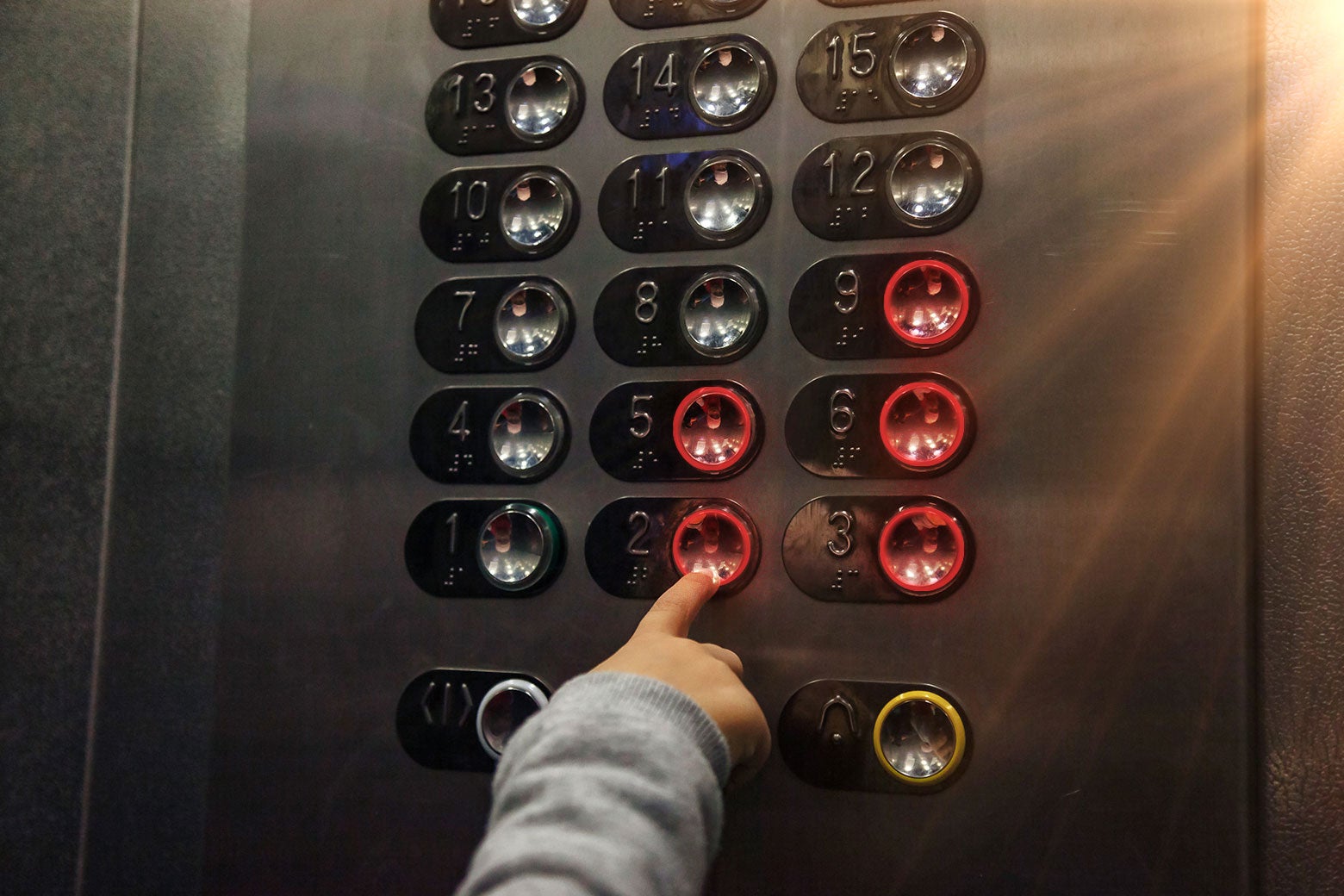
Family Who Made Kids the King of the Elevator? Apparently, there’s an unwritten rule about who gets to press the buttons. By Enter your email to receive alerts for this author. Sign in or create an account to better manage your email preferences. Unsubscribe from email alerts Are you sure you want to unsubscribe from email alerts for Luke Winkie? Aug 01, 20265:50 AM Photo illustration by Slate. Photo by Getty Images Plus. Sign up for the Slatest to get the most insightful analysis, criticism, and advice out there, delivered to your inbox daily. A few months ago, my wife and I packed up our things and moved into what is the largest building either of us has ever lived in. It contains 24 floors in total—23 if you factor in the absent 13th story—and we live on the 15th, on the tower’s eastern face, where large windows overlook the squat brownstones of outer Brooklyn. The building’s primary demographic consists of seasoned millennials who have made peace with the fact that they will stick it out in New York for as long as possible, and as such, a lot of our neighbors are raising young children. This is how I was introduced to a fundamental tenet of urban childrearing I was previously unaware of: Whenever I’m riding the elevator with a parent and their kids, I am never, under any circumstances, allowed to push the buttons on the panel. That responsibility is deferred to the little ones, because if it’s not, catastrophe awaits. I can remember the precise moment this unwritten rule clicked into my psyche: I was taking the elevator down to the gym, and when the doors whooshed open, a harried father—already beaten down by the day he’d endured—escorted his preschool-aged son aboard. The boy noticed that the button for the first floor was already illuminated, and for the length of the descent, he attempted to press every other button in reach. The dad, looking sallow and defeated, stood behind his son and gently parried his small fingers away, almost like he was guarding the paint in a rec-league basketball game. If his kid had it his way, we would’ve been visiting every floor in the building, and the fact that we weren’t ignited a massive tantrum. The boy screamed, his father continued to block his palms, and when I exited the chamber I could still hear him hollering, in a muffled echo, farther down the elevator shaft. Later that day, I wondered aloud to my Slate colleagues if this was a familiar experience. Do our fellow parents also risk a meltdown when they ride the elevator with their kids? Are the buttons really that important? The answer, of course, was a resounding yes. “I was just in an elevator yesterday with my 4-year-old and this man pushed the button for the floor we were going to and I nearly panicked,” said Jenée Desmond-Harris, who writes Dear Prudence. “I realized people who don’t have kids have no reason to know about or respect this extremely important rule.” (Luckily for Desmond-Harris, there were identical buttons on the other side of the elevator door, allowing her son some tactile relief, staving off an implosion a little while longer.) “When you have multiple kids, you just have to let them fight and scream about who gets to press the buttons in the elevator,” said What Next producer Rob Gunther, the father of three children, ages 11, 8, and 3. “Then when they grow out of that, they have the exact same fight about sitting shotgun in the car.” (When I spoke to Gunther, he was returning from a vacation in Bermuda. I asked him if the elevator trips were dramatic. “Every time,” he told me.) In case you suspect that this is strictly a New York problem—the kind of woo-woo permissiveness authored by soft, overaccommodating parents—just know that this isn’t the case. When I extended my query out to the general public, I learned that basically every parent on earth possesses some sort of enduring elevator anxiety because of the way their kids react to the buttons. I found the case of Jarrett Skorup, a marketing professional and a father of four from Michigan, especially enlightening. Skorup lives in the dinky town of Midland, and naturally, its downtown district is home to exactly one elevator building—the local library, with its three floors. Whenever Skorup or his wife takes their children to the library, each of them wants to push one of the buttons. So, in order to maintain family peace, Skorup has become accustomed to visiting every story of the building, in both directions, whenever he checks out a few books. “The librarians are totally used to it, because it’s the only place in town kids can ride an elevator,” said Skorup. “Though, there was this time where we took a trip to Chicago, and my son pressed 15 buttons in the elevator in a 50-floor building. There were other people in the chamber. Luckily, they were amused by it.” Every parent I spoke to dreads these incidents, and is severely apologetic when they occur. But it’s still difficult to say for sure why they’re so common. Yes, if I reach deep enough into the recesses of my mind, I am able to summon up atrophied childhood sense-memories of the thrill of elevator buttons, though I’ve long lost the youthful spirit to articulate that joy today. Thankfully, a few experts filled in the gaps. Reena B. Patel, a child psychologist, reminds me that children are attracted to experiences that “produce immediate, observable cause and effect.” Naturally, a glowing button that rouses a powerful machine from its slumber absolutely fits the bill. “It offers children a rare sense of agency and control within an environment where adults typically make most decisions on their behalf,” continued Patel. (She is also of the opinion that elevator buttons might be especially salient in a child’s mind in 2026, when their parents are constantly “tapping, swiping, and engaging” with their phones. “Given how closely children observe these patterns, their curiosity about buttons and screens is a natural extension of what they see modeled daily,” said Patel.) Another child psychologist, Mona Delahooke, offered an even simpler explanation. Some of the earliest forms of play occur when kids mimic what they see at home, “like when they pick up pots and pans and pretend to cook,” she said. Elevator buttons, therefore, are akin to “a real-life toy.” And as for what a parent should do when two of their children are in the elevator at the same time? Delahooke believes that’s a perfect opportunity to instill some good old-fashioned lessons about sharing in a low-stakes environment. (The youngest presses the button for the ascent, the oldest gets the descent, and so on.) Of course, all of this gets back to the elephant in the room. As I was putting together this story, I encountered plenty of childless friends who are of the opinion that nobody should wait for a kid to press an elevator button, because they have places to go and people to see, and they’re already late for an appointment anyway, and, frankly, the hustle and bustle of modern life does not allow for constant emotional surveillance. “I would be more than happy to live in a world that obliges children for their many needs like healthcare and good teachers; what I’m not going to do is live my life as if children are little terrorists I have to accommodate in fear of their weeping or their parents’ reprisals,” said one of those friends who, understandably, wishes to remain anonymous. “I am struggling enough in this world without having to wait five minutes for some kid to press my floor in an elevator,” she continued. “Let’s just get it fucking going here.” I do get where she’s coming from. But for what it’s worth, this little ritual frustrates parents, too. (“Speaking as a mother, if a kid takes too long with the elevator, fuck ’em,” said Willa Paskin, host of Slate’s Decoder Ring. “Time to learn a lesson about life, little ones.”) It all makes me wonder about the fracturing social contract of the 21st century, as more people decide against having kids, and therefore default to the position that the children in our midst are needy, loud, and annoying. Communication is breaking down between the mothers, fathers, and DINKs. We ought to do what we can to understand each other, even as life, and its infinite priorities, tugs us in different directions. How shall I express empathy for overwhelmed parents while I mull whether children are in my future? Letting the kid down the hall press the big No. 1 until it glows is a decent start. Get the best of news and politics Sign up for Slate's evening newsletter. Family Kids New York City Parenting Etiquette
There’s a Secret, Unwritten Rule Everyone’s Supposed to Follow in Elevators. Disobey It and You’ll Unleash Hell.
Full Article
Original Source
Read the full article at Slate →KhanList aggregates and links to publicly available news content. We do not host full articles from third-party sources. Always verify important information with original sources.