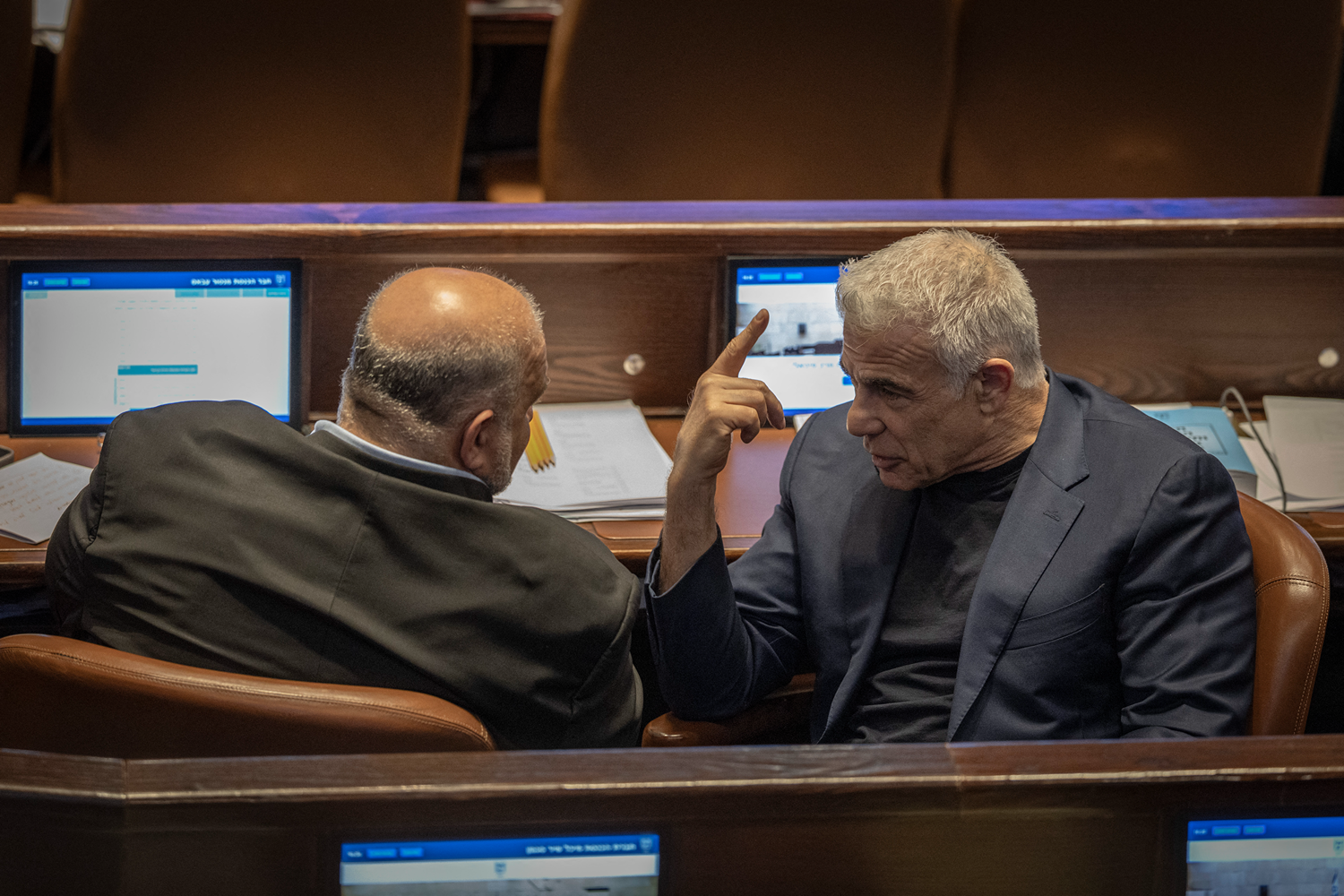
A reluctant opposition needs a radically new pathway on Palestine. By , a Liberalism Rekindled postdoctoral fellow at the Hebrew University of Jerusalem. , and Theodore Sasson, a senior fellow at the Institute for National Security Studies and the Curt C. and Else Silberman professor of Jewish studies at Middlebury College. Opposition leader Yair Lapid converses during a session of the Israeli parliament in Jerusalem on July 16. Opposition leader Yair Lapid converses during a session of the Israeli parliament in Jerusalem on July 16. lia Yefimovitch/AFP via Getty Images July 21, 2026, 12:12 PM The vote by 103 House Democrats to suspend U.S. military aid to Israel has been received by many Israelis with deep foreboding. Coming in the wake of tanking support in U.S. opinion polls, a string of victories in Democratic primaries by harsh critics of Israel such as Darializa Avila Chevalier and Melat Kiros, and the death of Sen. Lindsey Graham, who was called one of Israel’s “greatest friends,” the vote seemed to suggest that the Washington they knew had also passed into eternity. But that conclusion is premature. Israel can still shore up its position in the United States and rebuild bipartisan support. A change in Israeli leadership is a vital first step, but deeper policy changes will also be needed, particularly in how Israel relates to the Palestinians. The opposition parties seeking to lead Israel after the national elections in October need to quickly make it clear that they intend to advance such changes. The vote by 103 House Democrats to suspend U.S. military aid to Israel has been received by many Israelis with deep foreboding. Coming in the wake of tanking support in U.S. opinion polls, a string of victories in Democratic primaries by harsh critics of Israel such as Darializa Avila Chevalier and Melat Kiros, and the death of Sen. Lindsey Graham, who was called one of Israel’s “greatest friends,” the vote seemed to suggest that the Washington they knew had also passed into eternity. But that conclusion is premature. Israel can still shore up its position in the United States and rebuild bipartisan support. A change in Israeli leadership is a vital first step, but deeper policy changes will also be needed, particularly in how Israel relates to the Palestinians. The opposition parties seeking to lead Israel after the national elections in October need to quickly make it clear that they intend to advance such changes. Although the decay of Americans’ support for Israel has many sources, the causes of collapse are mostly related to the Gaza war. This is evident in the sharp downturn in U.S. public opinion on Israel throughout the war, going from a net favorability of 13 percent in 2022 to negative 23 percent in 2026, according to data from the Pew Research Center. The tens of thousands of civilians killed and wounded, including thousands of children, the inflammatory rhetoric of Israeli cabinet ministers, and the policy of limiting humanitarian aid amid accusations of starvation, have badly damaged Americans’ previous perceptions of Israel. It used to be seen as a U.S. ally with similar values and a disciplined, professional army, while older Americans remembered it as the underdog that triumphed against seemingly overwhelming regional hostility. Today, though, Israel is perceived by many Americans as a bullying hegemon that sanctions atrocities against its neighbors. Beyond Gaza, the intensifying settler violence in the West Bank, the expansion of Jewish settlements there, the war against Iran and the government’s insistence on holding onto land in Lebanon and Syria have also contributed to the alienation felt by many Americans. Many of Israel’s supporters in the United States are understandably looking ahead to Israel’s upcoming October elections and hoping that a new government led by Gadi Eisenkot, a former chief of staff for the Israel Defense Forces, or Naftali Bennett, a former Israeli prime minister, will chart a different course on the Palestinian issue. But given the enormous political headwinds that they will face in trying to do so, the choice is not an obvious one. Indeed, as Israel’s election season kicks into gear, the opposition parties are choosing to focus their campaigns on opposing draft exemptions for the vast ultra-Orthodox public (which the government has sought to reenact after they were deemed illegal by Israel’s Supreme Court) and supporting the convening of a state commission of inquiry about the failures that led to Hamas’s attack on Oct. 7, 2023. The Israeli-Palestinian conflict is conspicuous in its absence from the campaign stage. That electoral strategy makes good political sense. The Palestinian issue exposes the opposition to the charge of promoting a Palestinian state, a position opposed by most Jewish Israeli voters since Oct. 7. The opposition parties do not want to hand Israeli Prime Minister Benjamin Netanyahu a winning campaign issue. As a result, opposition leaders have mostly tried to keep the focus off the conflict, arguing that conditions are not right for a diplomatic initiative and expressing support for more modest steps instead, such as curtailing settler violence, improving the quality of daily life in the West Bank, and advancing U.S. President Donald Trump plan’s for Gaza. But this approach is unlikely to turn around Israel’s standing in the United States, which should be a matter of real urgency given the centrality of the U.S. alliance to Israel’s national security. After a short grace period, a new government that doesn’t break with current Israeli policy will vindicate a view of Israel as a society in the grip of a violent outlook that is incompatible with American values. Without a decisive break from the policies of Netanyahu’s government, the hopes that many Americans have invested in new Israeli leadership will morph into even deeper resentment and disappointment. In order to arrest the worsening ties with the United States, as well as halt the slide toward increased violence and de facto annexation, Israel’s next government will need to set the country on a new pathway from its first days in power. This should include canceling new settlements approved by the current government, reversing legal decisions such as certain land management rules that extend Israeli sovereignty in the West Bank, and working with the Palestinian Authority to rebuild institutions of self-government, all with an eye toward a lasting solution to the conflict within a regional framework. It should also include a mandate to investigate harm to civilians in Gaza as a part of the state commission of inquiry that the opposition leaders have vowed to establish. The leaders of Israel’s opposition parties should begin to communicate to Israelis and the world that a future government will seek to transform the conflict and employ diplomatic and security tools for doing so. Most will understand that the full realization of this goal will take time—Israel’s security concerns are genuine, and Palestinians will need time to build up their institutional capacity for self-government—but opposition leaders should make it clear that they intend to move the country in a new direction. These steps are politically ambitious given the current public opinion in Israel and beliefs among its political class. However, only by charting a new course—and waging a political struggle to have it embraced by the Israeli public—can Israel’s opposition begin to rebuild bipartisan support in the United States and ensure Israel’s future as a Jewish and democratic state. Politics Human Rights Avishay Ben-Sasson-Gordis is a Liberalism Rekindled postdoctoral fellow at the Hebrew University of Jerusalem, and a Ruderman Family Foundation Scholar in Residence and Senior Researcher at the Institute for National Security Studies at Tel Aviv University. Theodore Sasson is a senior fellow at the Institute for National Security Studies and the Curt C. and Else Silberman professor of Jewish studies at Middlebury College. Read More Israel's Prime Minister Benjamin Netanyahu sits at the door of a military helicopter during his visit to an Israeli drone center at the Palmachim Airbase near the city of Rishon LeZion, Israel on July 5, 2023. Israel Belongs in the New Saudi-Iranian Order An anti-Abraham Accords is taking shape. That would be a big mistake. OTHER SUBSCRIPTION OPTIONS Stories Readers Liked Go to slide 1 Go to slide 2 Go to slide 3 Go to slide 4 Go to slide 5 Go to slide 6 Go to slide 7 Go to slide 8 Go to slide 9 Go to slide 10 An illustration depicting a man submerged up to his nose in water. The wavy water is divided horizontally into three color bands that mimic a flag: white foam at the very top peaks, a deep blue middle section filled with bubbles, and a red lower section covering his neck and suit jacket. His blue eyes look upward with a wide, strained expression. As the Tide Turns Against Putin, Beware the Drowning Man By Peter Frankopan Negotiators from the United States, Canada, and five European countries converse after finishing the draft of the North Atlantic Treaty in Washington on March 18, 1949. Trans-Atlanticism Isn’t Dead—It’s Being Renegotiated By Alexandra de Hoop Scheffer An illustration of a vintage-style map featuring North America and parts of Europe and Africa. Overlaid on the map are 3D red brick walls shaped exactly like the borders of the contiguous United States and Alaska, casting long shadows to the right. America, the Once Global Nation By Odd Arne Westad A painting depicts Roosevelt on horseback, his right hand raising a sword in the air as he leads a cavalry charge of other U.S. soldiers on horseback. The horses' eyes are wide and bulging with fear, and there are scattered starbursts around the scene indicating artillery fire. An illustration showing a pair of hands tightly wringing out an American flag. Water droplets shaped like missiles squeeze out of the twisted fabric and fall toward a puddle shaped like the map of Iran on a red background. A rocket is seen from a great distance, flying through a deep blue sky during military drills. Several parallel plumes of smoke are seen alongside the rocket's path. A creative illustration against a pale yellow background showing a garden planter containing a dense green hedge. Five human arms emerge from the hedge, with four of the hands holding small flags of China, Russia, the United States, and the European Union, while the fifth hand holds the flag of India. Republican presidential nominee, former President Donald Trump pumps his fist as he walks off stage at the end of a campaign rally at the Santander Arena on November 04, 2024 in Reading, Pennsylvania. Central Military Commission Vice Chairman Zhang Shengmin raises his right hand in a salute to Chinese President Xi Jinping, who is walking a level lower in a red-carpeted auditorium. An aerial photo shows Doha in the booming petrostate of Qatar. NATO and Ukraine About ten soldiers in camouflage combat fatigues fan out, many holding rifles, on a rocky shore as they exit a small armored military boat. The scene is framed by a blue sky and lush green plants in the foreground. Washington Shouldn’t Fear NATO Expansion New allies bring powerful assets—whatever Donald Trump thinks.
There’s a Fix for Israel’s Image Crisis
Full Article
Original Source
Read the full article at Foreignpolicy →KhanList aggregates and links to publicly available news content. We do not host full articles from third-party sources. Always verify important information with original sources.