
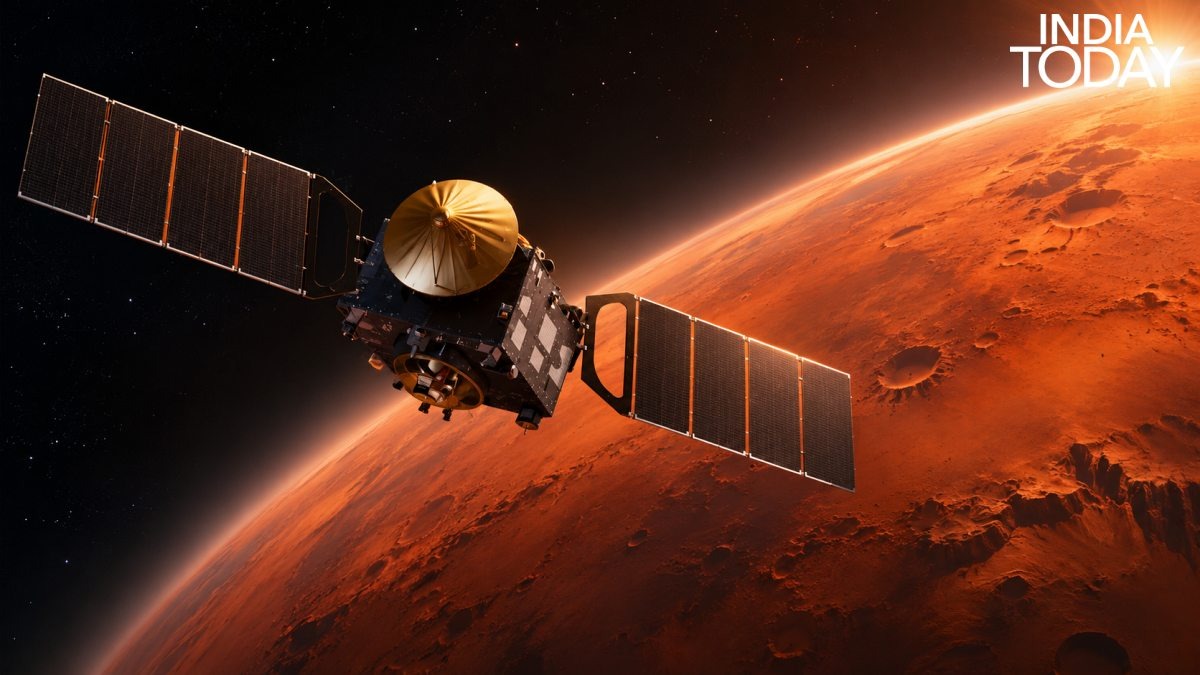
Russia's withdrawal from Chandrayaan-2 prompted ISRO to redirect existing orbiter work towards Mars. The pivot enabled Mangalyaan to reach Martian orbit after a rapid 15-month development.A generative AI image of Mangalyaan mission in Mars's orbit. (Photo: India Today)New Delhi,Nov 5, 2026 12:10 ISTThirteen years ago, on November 5, 2013, a rocket carrying India's first spacecraft bound for Mars lifted off from Sriharikota. But the story of Mangalyaan did not begin with a dream of reaching the Red Planet.In many ways, it took shape after India's plans for its second Moon mission ran into an unexpected roadblock.Around 2011, the Indian Space Research Organisation (Isro) was preparing Chandrayaan-2 in collaboration with Russia.India was developing the orbiter, while Russia was responsible for building the lander. But the partnership ran into trouble after Russia had to modify its lander design following problems with another mission. Eventually, Russia withdrew from the collaboration, leaving Isro with an important decision to make. Isro decided to adapt the existing lunar orbiter design for a Martian journey. (Photo: Isro) India could develop its own lander and rover, but that would take several more years. Meanwhile, the orbiter hardware was already being developed. Could that work be put to another use?That question opened an entirely different route for Isro. The Isro top leadership realised that instead of waiting years to complete a new lunar mission, it could redirect its efforts towards Mars. The opportunity was particularly important because favourable launch windows to Mars come roughly once every 26 months.With a launch opportunity approaching in late 2013, Isro decided to adapt the existing lunar orbiter design for a Martian journey.The spacecraft's hardware and software were modified to meet the demands of travelling to and operating around another planet.The timeline was punishing. After the mission received formal approval in August 2012, engineers had just about 15 months to build, test and prepare the spacecraft for launch.The challenge was not merely changing its destination. Mars was much farther away, communication delays were significant, and the spacecraft had to perform critical operations largely on its own. Isro also had to make the mission work with its PSLV rocket, using a series of carefully planned engine burns to escape Earth's orbit.The team worked tirelessly through day and night to meet the target.On November 5, 2013, PSLV-C25 carried Mangalyaan into space. After a journey of nearly 300 days, the spacecraft successfully entered Martian orbit on September 24, 2014.The mission was initially a demonstration mission with a lifespan of six months.But it continued working for approximately seven and a half years. Isro lost communication with the spacecraft in April 2022 after it had exhausted its mission life. The mission's longevity was helped by careful fuel management and the spacecraft performing its manoeuvres without needing the additional correction fuel originally reserved for contingencies.What began as a difficult turn in India's lunar exploration plans became a landmark in its space programme.Mangalyaan was not simply a Moon mission sent somewhere else; it was a new interplanetary mission made possible by existing work, engineering ingenuity and a narrow launch opportunity.India is now readying Mangalyaan-2 for landing on Mars. - Ends
There was no Mangalyaan. But a failed Russian plan put India on road to Mars
Full Article
Original Source
Read the full article at Indiatoday →KhanList aggregates and links to publicly available news content. We do not host full articles from third-party sources. Always verify important information with original sources.