
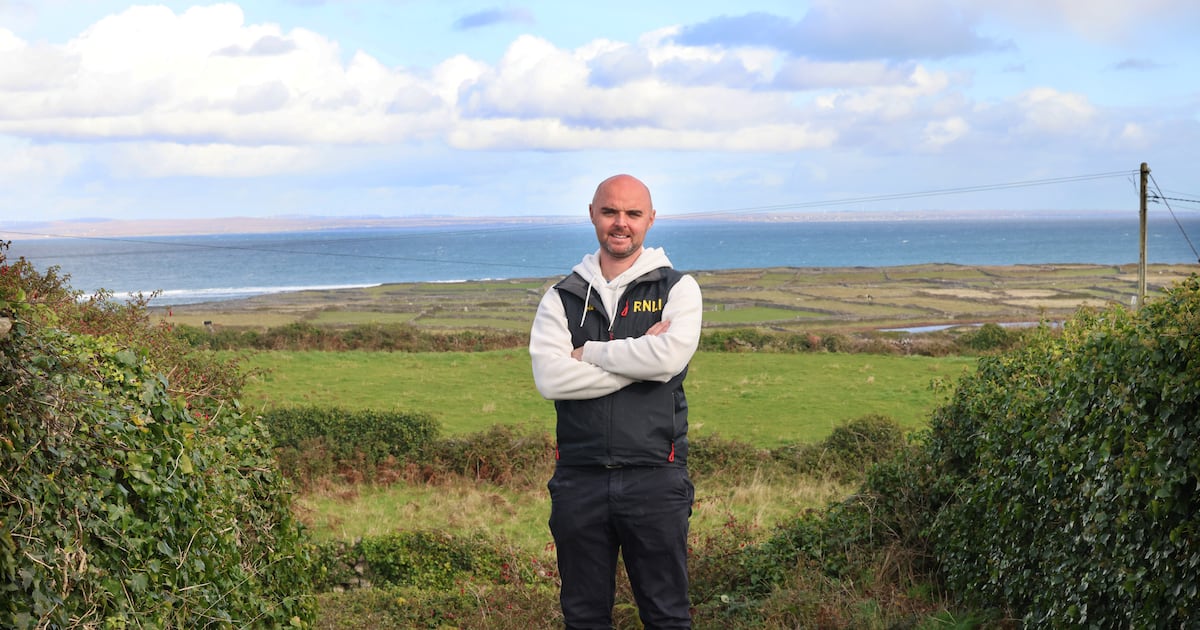
Inis Mór is an island with two faces.It is a bustling tourist attraction, where for six months each year any number of cosmopolitan languages can be heard between the limestone walls that line every road and field on this, the largest of the three Aran Islands.But a change comes over the Co Galway island in late October. As the weather adopts a much more serious disposition, the tourists slow to a trickle and finally stop.With each passing day, the waves on Kilronan beach reach a little higher as the seas become choppier. Each October the island slowly reasserts its dominance over the tourist resort. READ MOREFor Noel Seoighe, metalwork and math teacher at Coláiste Naomh Éinne and owner of the Bláthín cafe, winter is the best time to live on the island. But he admits that it takes a certain kind of person to survive it.“We kind of live two separate lives. You are going flat out, seven days a week in the summer months and you are getting really tired when September comes, so you can’t wait for October to roll around so you can take a break,” he says.After The Sun: What happens when the tourists go home? “You need to be content to live here. It takes a special person to last a winter when things really quieten down.“For me, I think that it is magical in the winter months when you have the island to yourself. It’s then when you feel what real island life is like, especially when a storm is brewing. It’s the end of November let’s say, the wind is coming up and you go to the pub for a pint and a chat with the locals. In the summertime, we are so busy we don’t get a chance to even look at each other.”Born and raised on the island, Seoighe couldn’t wait to leave when he finished secondary school. He spent a year driving heavy machinery in the US state of South Dakota before training as a schoolteacher and spending four years working in Dubai with his Tipperary-born wife Tess.“We were living the high life out there. But something clicks for you after a while and you realise that you need to go back home. So we came back here to build a house and start a family,” he says. Life on the island “goes both ways,” he says. “You know every person but you know every person’s business as well – whether you want to or not.“There is an absence of an age group on the island during the winter, people from 18 up to their mid-20s. They have gone away to get a bit of life experience.“It’s different when you are young. I can see it in my own children, they really can’t wait to turn 18, finish their Leaving Cert and get out of here for a while. But when you go away and experience life elsewhere, you realise that life here is not that bad.”During the summer months, Inis Mór is serviced by more than 12 ferries each day bringing about 2,000 tourists from Rossaveel, Doolin and Galway City.By early November, the number of ferries has dropped to two a day, and in stormy conditions the island may be completely cut off for several days.“You try not to take things too seriously [during storms] and you have to be prepared. You always have a freezer full of food if you live on the island, especially during the winter months,” says Seoighe.“So if the shop is closed for a day or two or the cargo ferry doesn’t make it, you’re not too hungry.“I guess we are resilient out here, more than other communities.”Self-proclaimed “city slicker” Gearoid Browne left his home in Galway city to work for his family business on Inis Mór in 1987.When the salmon smoking company closed in 2008, he made the decision to stay on Inis Mór permanently and make a life for himself on the island.After what he describes as an “unsuccessful spell” working in the Inis Mór Supermac’s, when he gained more than two stone in weight, he eventually set up the Man of Aran cafe and crafts shop.“I love mixing with the tourists, having the craic with them, taking the mick out of them. It’s all go during the summer. But we will be closing the day after Halloween and that will be us for the year,” he says.“Things slow down a lot then. What I do for myself at that stage is that I start baking cakes. I bake porter cakes. That keeps me occupied up until the Christmas.”Gearoid Browne's Man of Aran café and crafts shop will close the day after Halloween, as Inis Mór winds down its busy tourist season. Photo: Dara Mac Dónaill/The Irish Times Browne says he started baking years ago when he had no money.“It was after we lost the business [Aran Salmon] and I wanted to do something for the family, to give people a present, but I had no money to buy anything, he says.“So I started making the porter cakes.“At this stage I make a good number of them coming up to the Christmas each year. I do it, more or less, to keep the mind occupied. I like to be doing something, but I don’t want to be working. We work hard from March to October; we work really hard. I like the down time after, but I don’t like to be sitting on my arse doing nothing.“So that takes me up to Christmas, and after the Christmas it is nearly time to start getting the shop ready for the new season – varnishing floors, preparing.”In recent years Browne has become a season-ticket holder with Connacht Rugby, and he values his trips on to the mainland every second weekend.“It is hard to keep the social side of things going in the winter. It is quiet. People are not going out as much. But I like to cook and so do a few of my friends, so we have dinners together,” he says.“You have to be able to make your own fun. We try to organise a few things. There are things in the hall, they have different functions on. So we support them and that is something we can go to.A few of the locals have Connacht season tickets so they head into Galway for matches.“That gives us a social outlet. We get to go into Galway every second weekend over the winter,” he says.“There were some friends that I have known for years [in Galway City] and I felt I was losing touch with some of them. It’s a small thing in a way, but the season ticket has helped me to re-energise those friendships.”An empty beach on Inis Mór, Aran Islands, Co. Galway. Photo: Dara Mac Dónaill/The Irish Times Aran farmer, Fionn Ó Flaithearta and his partner Maírín Ní Chonceannáin left their jobs on the mainland in 2023 and returned to make a go of living full-time on the island.Having recently opened Minnie’s Café and the Cipín Sauna, the couple are extremely busy during the tourist season and welcome the break that comes with October.“Up until a few weeks ago [when it started to get quiet] we hadn’t really left the island since April. It is six months solid of working flat out. But that is the island life, and there are other ways to live if that doesn’t suit you,” Ó Flaithearta says.“I am all right personally during the winter. The farm keeps me busy, you have to go out and see the cattle even when it is blowing a gale and the rain is coming at you sideways.”Ó Flaithearta is also a carpenter and spends time in his workshop, though in the winter he has his own schedule.“If I want to have a lie-in on a Wednesday morning, I can do it,” he says.“But this time of the year is my favourite. The calm days in October, you have lovely light, you get to appreciate the island for what it is. If you go up to [stone fort and sea cliff] Dún Aonghasa this time of the year, you almost have it to yourself,” he says.“I really enjoy the off season. You can catch up on your jobs. People can come up and see you and you have time to talk and catch up.“In the middle of summer, you can’t see why people are coming here. But this time of the year, the waves are rolling in, the sea is getting a bit rough, it’s getting cold so you throw on your jacket and go out into it. That is when I understand why thousands of people are coming here every day throughout the summer.”The population on Inis Mór grew dramatically this October, with two new babies being born to islanders in just one week. For a community with just 800 full-time residents, this is a recent and significant trend. More people seem to be coming to Inis Mór to start a family.“We have had a mini baby-boom going on all right, which is fantastic to see,” says Ó Flaithearta.“At least for now, more young people are deciding to make life for themselves on the island, which is really fantastic.”Tomorrow: Sorcha Crowley visits the seaside town of Bundoran in Co Donegal
‘There are other ways to live if it doesn’t suit you’: The two sides to life on Inis Mór
Full Article
Original Source
Read the full article at Irishtimes →KhanList aggregates and links to publicly available news content. We do not host full articles from third-party sources. Always verify important information with original sources.