
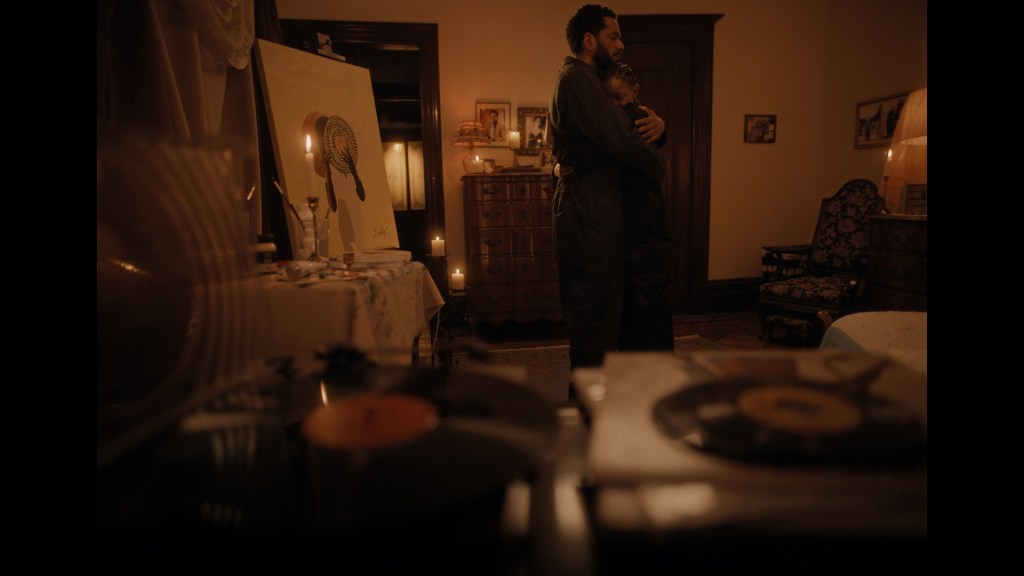
In a world full of noise and obstacles that can make you doubt yourself, learning to love yourself can come from the quietest places, if only you listen for them. After her grandmother’s passing, Drea (Angel Theory), a deaf young adult who aspires to be a poet, is surrounded by close and extended family. Yet, much of their conversation remains just beyond her reach. When her estranged father, Samuel (Biko Eisen-Martin), arrives on a day furlough from prison to say goodbye to his mother, the two have a chance to connect through their shared grief. In Oscar-qualifying short film, Them That’s Not, which won Best Live Action short at the SCAD Savannah Film Festival and the Gold Hugo for Best Live Action Short at the Chicago International Film Festival, writer-director Mekhai Lee brings viewers into Drea’s perspective through shifting sound, as voices drone on or overlap before settling into silence. Drea follows what she can, moving between sign language and lip-reading as she tries to find her place in a family sharing the same loss in different ways. Lee’s poetic, lingering visual style offers a tender portrayal of various expressions of love that lead one to move forward on one’s own terms, despite what others might say. Here with Deadline, the filmmaker talks about capturing an “otherworldly” emotionality, the importance of representation, reconciliation and finding your own community. Watch on Deadline DEADLINE: Where did the idea for Them That’s Not come from? MEKHAI LEE: It came from a myriad of things, but mostly my grandmother’s passing. She died before I had the opportunity for this Sound and Scene grant to come about. There were a number of things I was thinking about, but grief was certainly on my mind. I was considering how isolated I felt in that grief. And I thought about how I was around a lot of my family who were either very close to her or not as close to her; it varied in how they treated the reunion, so to speak. But then, thinking about the program being called Sound and Scene, I heard a quote: “Sound is what turns a crowd into an audience.” I was thinking, “How do you make an audience lean in? How do you force an audience to engage more immersively with something that you can create?” With that quote in mind, I thought removing sound would be really interesting to play with. Not to mention, I’m also considering the deaf family members I have and how often that language barrier can be a hurdle for us, but not one we consider a barrier. It’s just something we have to work against or with to communicate with each other. Then there’s the isolation of grief, the isolation of that language barrier for my family members, for deaf people in hearing families. And then also what it is for me, being a queer person in a heteronormative family, surrounded by people who may or may not speak my language, who may or may not know the culture I subscribe to. That feels like a language barrier in and of itself. So that circle of metaphor, those three things, just really compounded for me. I was like, “There’s something extremely singular there that I can sort of lift out and eke out of that to make an immersive experience for an audience and also a protagonist.” Them That’s Not Concord Originals DEADLINE: The cinematography reminds me of If Beale Street Could Talk. What was your visual style between you and your cinematographer? LEE: Shout out to Sade Ndya, my cinematographer. She’s fabulous. And I’m so glad you said that about Beale Street because, funnily enough, the camera we shot our film on, the ARRI Alexa Mini, is the same camera Barry Jenkins shot Beale Street on. When I was applying for this grant, those were the [comparisons]. It was the visual tone, the visual style of Beale Street and The Last Black Man in San Francisco. Actually, I often say this film is a mix of The Last Black Man in San Francisco and Sound of Metal. Barry Jenkins is a north star for me. He’s a singular director and also just a brilliant Black director who isn’t just creating Black work. However, his Black work is super reflective and inspirational and exactly what I admire and want to fashion myself after. He’s versatile in his entire catalog, down to short films and his first feature and things like that. So he’s definitely somebody I emulated in thinking about what the visual process of this could be. Sade was instrumental in giving me the technical advice to make these visuals happen. We literally had a filter on that ARRI called a chocolate filter that just lifted out folks’ skin and made everybody look really glisteny, moisturized, all of that. It just gave exactly what it needed to give, which we thought would be more of that binary thing: Here’s one thing, here’s one with sound, here’s where it’s not, here’s immersive, here’s not. And it ended up just being something we loved and kept throughout the shooting process. We decided to just use it, just in case we wanted to, just in case we might need it here. So we ended up keeping it completely. Sade and I spoke the same language, which is so beautiful because this film is so much about language and we just immediately had a shorthand. It was actually her idea to include that flame line at the end, because I had mentioned that the room felt ancestral, so it had to have an otherworldly feel. I wanted the lighting to be extremely warm. And that flicker of the light supported the movement of the language, the racking of the focus. There’s a lot of breadth that is readily available in this film. There’s just a lot of experience that really does feel like natural progression instead of just hard cuts, hard edits. We really did want it to feel, for lack of a better term, lived in. We really wanted it to feel like an immersive experience that one could view on- and offscreen. DEADLINE: Where did you find Angel Theory? LEE: My friend Mars Rucker was in a production of Green Day’s jukebox musical American Idiot at Deaf West in L.A. Deaf West is a company that incorporates sign language into its productions. So they’ll have an actor singing and performing the role for a hearing audience, and then directly next to them, another actor will perform the same role in American Sign Language for a deaf audience. Mars was playing the lead in that show, and I reached out to them because I knew they were close to the community I would be writing about. If there was any connection they could help me with, or if they could connect me to somebody at Deaf West so I could begin meeting more actors and getting more immersed in the culture. Mars was basically my ambassador into the culture because I was learning a lot. And then they said that the way I wrote Drea in the script reminded them of Angel Theory, who was dancing in the show. So, I told Mars to send me a couple of options, but that I would love to meet Angel. So, when I met Angel, we sat down on a call, and I thought I would be auditioning her, but she was auditioning me. She was very silent and sat back watching me, and I was just like, “So yeah, I’m doing this project. It’s about this and that, and this is what the thing is.” We’re just chatting, and I’m trying to set up a rapport, get a conversation going. Eventually, she loosened up. We started chatting a bit about the project, and she told me that what won her over was that, in speaking about deafness with this project, I wasn’t treating it as a disability. There was no sort of pity or empathy involved. It really genuinely was another way of conversation, another way of life. That was a big deal for me because I think accessibility is really important. Representation is nothing without accessibility. And that was the main thing for me in approaching this, especially knowing what it is to feel othered, to be on the outskirts, to be an outlier. We often have to learn how the conversation in the center goes better than we learn ourselves sometimes. So I really wanted to give space to those outliers, to the folks outside looking in, and give them their shine, their warmth, their light. That’s what I did to have Angel sign on, and she was the best. Some moments would not exist in his short film if it weren’t for Angel Theory. Removing the hearing aids, Angel’s agency… even in writing it, I felt like Drea was more of an observer. But Angel naturally brought about this drive, this fire. It’s just something you see and feel in her, and that’s because that’s who Angel is. I think it really elevated the piece and the role for me and made it better. Them That’s Not Concord Originals DEADLINE: The ending is many layered. This short kicks off with the grandma’s passing, but it’s also about reuniting with the dad. I love that moment between Drea and her father because, while Drea is having a hard time being understood by her own family, her father really encourages her to stay true to herself. What was important to you in this ending? LEE: Well, this ending comes from a personal place. Yes, my grandmother passed, but also my father is incarcerated, so that was a real conversation for us in my family: “What is it going to look like if he’s not able to say goodbye to her?” While I was dealing with the grief, I was also considering his grief and his removal from it. His return brought about a lot of anxiety and things like that for me, for him, for everyone. And, being gone as long as he has been, he’s experiencing his own language barrier. He is an outlier himself. There was a sort of mirror quality, a reflective quality, that I thought both those characters occupied within that space, which I personally found very interesting. That being said, the reason I was writing toward that line is that it’s something my dad has said to me in my periods of strife, in my periods of anxiety regarding my creative aspirations or whatever. Anytime I would feel less than confident, his response was, “How can you not have confidence when I have the utmost belief in you?” He was essentially saying to me that my friend keeps him lit. My dad has literally said to me, “You are the one thing I got right.” And it has shifted my complete perspective. That’s how I move forward, knowing there’s somebody out there who has that utter belief in me. I thought it was a sentiment worth sharing, which is why I was writing toward that line in particular. It was just one of those things, again, to harken back to the top of this interview; it just flowed out of me. It’s because I was circling with the grief and the reminder of love and the importance of that, and how lucky I felt that I did have folks within my family who at times may seem powerless or may feel powerless, but who had the power to instill in me a drive, a fire, a tenacity. So it’s interesting how power and love can work in that way, because he can’t even come home and say goodbye, but via phone call, via a letter, he’s able to instill in me this drive, this get-up-and-go attitude. That was what I wanted to highlight in that final scene: It’s not really about how you get it done, but the fact that you have the desire to get it done means something. DEADLINE: How has the festival circuit been for you so far? LEE: We’ve played at 55 festivals so far and counting. And we’ve had 21 award wins. So, I believe it’s been going great and has been an incredible journey. DEADLINE: What would you like audiences to take away from this film? LEE: Every time I hear that question, I’m in a different place when I answer it. Today, what I want people to leave with when I set out to write this is that I wanted to harken to our hyper-individualistic tendencies, especially in the way that we live today. I’m reminded of what I’ve just said about that get-up-and-go, go-get-it attitude. And in Billie Holiday’s “God Bless the Child,” [that’s the sentiment she] was celebrating. But I wanted to subvert that meaning with the song, with the film, with [the father-daughter] relationship. Often, we’re surprised by the community that comes to the aid that surrounds us. So, it’s important, it’s imperative, that we remain open to who can be called community, that our own doesn’t exist solely in what we’re able to self-generate. Our own can be the beautiful people we love and call family; we call chosen family, whatever that may look like for you. What I want people to be left with after watching this is to remain present and open to who can show up in your life, to be a welcoming community, and to be a new connection. There’s new potential for growth, beauty, and family wherever you look. I think that’s how you get something like this blue wave, people communicating, people having a conversation. It feels aligned in that way that just happened, but when I first set out to make this, that’s what was on my mind.
‘Them That’s Not’ Filmmaker Mekhai Lee Unravels The Importance Of Self-Love & Empowerment in Oscar-Qualfying Short Film
Full Article
Original Source
Read the full article at Deadline →KhanList aggregates and links to publicly available news content. We do not host full articles from third-party sources. Always verify important information with original sources.