
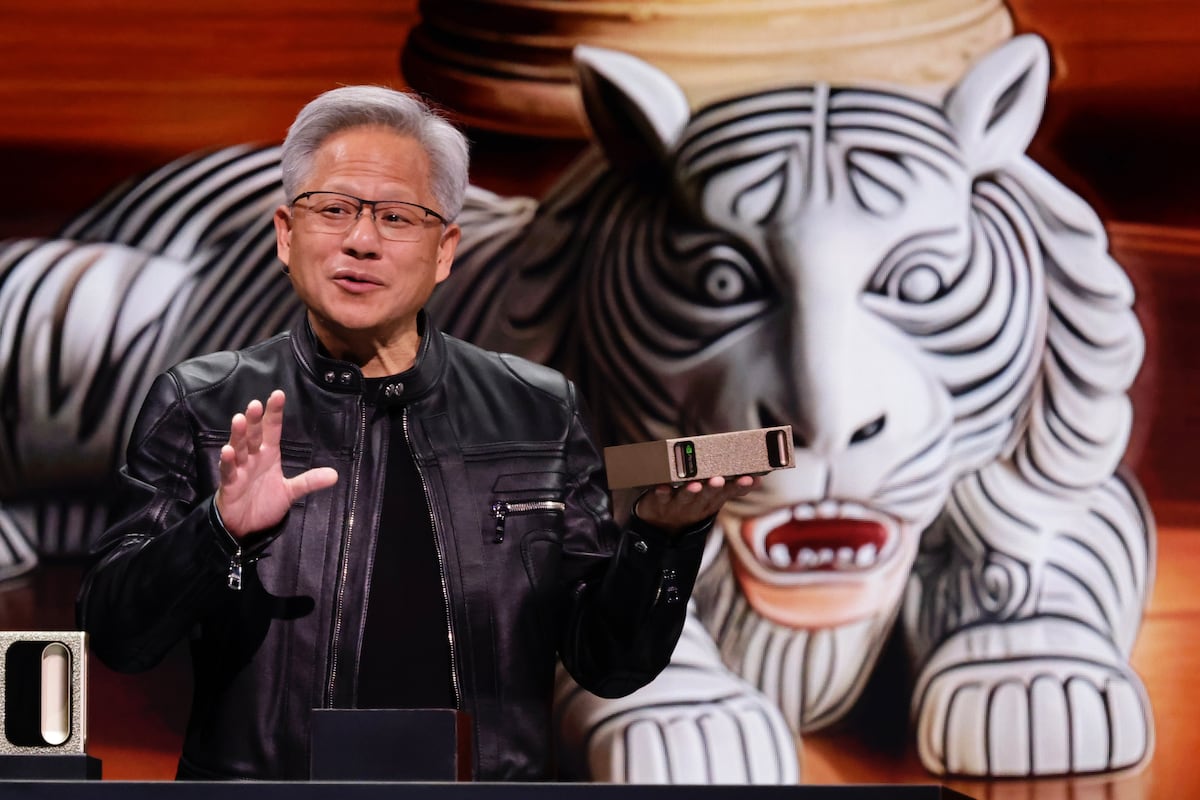
Behind the sensational details surrounding Nvidia CEO Jensen Huang’s admission of an extramarital affair is an alleged Chinese espionage plot to gain access to the technology giant’s most advanced chips.The United States has been investigating the powerful executive, who is close to President Donald Trump, for nearly a year. But it was a letter from Huang that brought the matter into the headlines last Sunday. The 63-year-old admitted in a letter to Nvidia’s board that he had been unfaithful to his wife with a woman named Alice Huang, who is suspected of being a Beijing spy. The Chinese government has denied the allegations, and Trump himself weighed in, saying the FBI was investigating the matter but that he did not believe the head of the world’s largest chipmaker had any reason to worry.The alleged scheme recalls other industrial espionage cases that have rocked prominent companies. This week, a case in which the United States government accuses Chinese company Huawei of being a “criminal” enterprise that “stole” from American companies to establish itself as a telecommunications giant was heard in court.US accuses China’s Huawei of theft“Theft, deception, and concealment” were three words used by Justice Department attorney Taylor Stout during a November 9 hearing in a New York court.“For 20 years, that’s how Huawei, a massive Chinese telecommunications company, victimized American companies and abused the American financial system, all in an effort to dominate the telecommunications industry around the world,” Stout argued, according to Reuters. The alleged misconduct attributed to Huawei by the United States included a conspiracy to steal trade secrets from several American companies, including Cisco Systems and T-Mobile.The company’s defense rejected the allegations. “It’s about competition, not conspiracy. Innovation, not theft. Ordinary business dealings, not criminal conduct,” attorney Brian Heberlig said, according to Reuters.The case dates back to 2018, when the United States accused Huawei and its chief financial officer, Meng Wanzhou, of fraud and alleged violation of U.S. sanctions. Prosecutors said the company had misrepresented its business dealings in Iran to circumvent the sanctions and move money through the U.S. financial system. The allegations later expanded to include the alleged theft of trade secrets, which Huawei maintains was limited to “actions by individual employees” that were addressed at the time.The case also made headlines in 2018 when Wanzhou was arrested in Vancouver at the request of the United States. The executive fought extradition for three years and was able to return to China following a diplomatic agreement among the three countries involved. The charges against her were dismissed in 2022 as part of an agreement, but her statements are expected to be used as evidence in the current case against Huawei.Wind turbine manufacturer nearly bankrupted after losing its technologyWhen wind turbine manufacturer AMSC did business with Chinese company Sinovel Wind Group, it could not have foreseen an outcome that would bring it to the brink of bankruptcy. In 2018, Sinovel was found guilty in a U.S. court of stealing trade secrets from AMSC and was handed the maximum fine allowed by law: $1.5 million. That figure was negligible compared with the more than $550 million in losses AMSC suffered, according to a court in Madison, Wisconsin.“Rather than pay AMSC for more than $800 million in products and services it had agreed to purchase, Sinovel instead hatched a scheme to brazenly steal AMSC’s proprietary wind turbine technology, causing the loss of almost 700 jobs,” the U.S. Department of Justice said in a statement at the time.The scheme was carried out with the help of Dejan Karabasevic, the former head of the engineering department at an AMSC subsidiary in Austria. Two executives from Sinovel’s research and development division persuaded him to join their company and take with him the source code used in AMSC’s turbines.Karabasevic downloaded the code from a computer in Wisconsin, United States, onto a computer in Klagenfurt, Austria. Sinovel subsequently commissioned several wind turbines from AMSC and copied the stolen code into them, completing the theft for which it was later held responsible in a U.S. court.The ‘Spygate’ scandal that rocked Formula OneIn this case, the fine was considerably higher: $100 million. The penalty was imposed on McLaren in 2007 after the team was found to possess confidential information belonging to its competitor, Ferrari.At the home of Michael Coughlan, McLaren’s chief designer at the time, investigators found a dossier of approximately 780 pages containing detailed technical information about the design, engineering, construction, testing, and development of a Ferrari Formula One car. The dossier also included information about the vehicle’s weight distribution, aerodynamics, and fuel systems, according to a document outlining the decision by the International Automobile Federation (FIA).The investigation also found that Coughlan had held dozens of telephone conversations and exchanged more than 100 text messages with Nigel Stepney, who was then employed by Ferrari.P&G contractors rummage through Unilever’s trashThe two consumer goods giants became embroiled in a dispute in 2001 after Procter & Gamble acknowledged that contractors had searched through and taken documents from Unilever trash bins outside its offices in Chicago, Illinois.Procter & Gamble agreed to pay nearly $10 million and allowed an independent auditor to monitor the company, assuring its competitor that it would not use the nearly 80-page hair-care business plan that the contractors had retrieved from the trash.No further details of the out-of-court settlement were disclosed at the time. Procter & Gamble said the contractors had not broken the law but had violated the company’s ethical policies. The company itself informed Unilever that the contractors had improperly obtained the plan related to its hair-care division, according to an article in The New York Times.
‘Theft, deception, and concealment’: Other industrial espionage scandals that echo the Nvidia case
Full Article
Original Source
Read the full article at English →KhanList aggregates and links to publicly available news content. We do not host full articles from third-party sources. Always verify important information with original sources.