
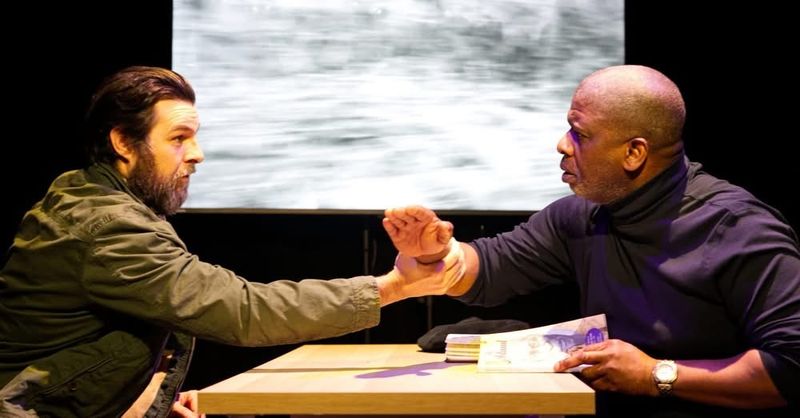
South Africa’s secretive war in Angola half a century ago is playing out nightly on a London stage in a visceral play confronting racism, war, trauma, redemption and the limits of forgiveness.It is a riveting psychological thriller with memorable performances and clear messages for humanity regarding the growing global trend to revert to tribal identities such as race, which divide rather than seek common ground.It is powerful rather than comfortable viewing, particularly for those such as myself who lived through the apartheid era.The play both demonstrates in microcosm how wrong things can go when hatred and anger run out of control, and the give and take needed to resolve conflict. The narrative is all the more powerful for being based on a chance meeting in which two men are forced to confront their troubled past. There is no happy ending – rather some sort of redemption by attrition.The drama unfolds on a train bound for Dundee between a South African-born black British journalist who despises apartheid, and a white Afrikaner soldier who served in the Angolan border war to uphold the apartheid regime and thwart its efforts to control Angola.South Africa-born Playwright Paul Hertzberg’s The Moth is being performed to critical reviews in London . (Photo: Sheila Burnett)Angolan border warSouth African-born actor and award-winning playwright and screenwriter Paul Herzberg, who left South Africa in 1976 after serving as an auxiliary in the Angolan border war, has returned to the Angolan border war theme for the third time. He has a distinguished and diversified career in theatre, film, and television spanning 50 years, which includes playing the late Shimon Peres in the smash hit Oslo at the National Theatre and in London’s West End.The Moth was originally developed from a 10-minute video monologue produced during the Covid-19 pandemic. It won an international award and was selected for 26 festivals worldwide, and was watched by 30,000 people on social media.The play had a successful tour in the north of England last year, with about 40 performances in several cities, including Newcastle and Liverpool. Shortly after the start of its London premier at the Finborough Theatre (October 27 to November 21) Herzberg received the news that the play had been nominated for four fringe theatre awards. John Josana (Faz Singateh) is a black South African whose father went into exile in former East Germany when he was a baby, leaving his mother behind. He later went to Britain where his stored anger about apartheid and what it had done to his family was exacerbated by racism and patronising liberals.SADF conscripts on patrol in Johannesburg during apartheid. (Photo: Graeme Williams / South Photographs) Post-traumatic distress disorderJosana found himself on a train sitting opposite Marius Miller (Micky Cochrane), an Afrikaner who had sought therapy in Britain to overcome his post-traumatic distress disorder and start a new life away from his violent father, a former Nazi officer.Muller alternates between brief eruptions of explosive anger and a naively friendly approach to Josana, who is irritated while trying to read a book on Robben Island and Nelson Mandela.Muller refuses to take no for an answer. The last straw for Josana is a detailed account by Muller of how he ended the life of a wounded and dying black freedom fighter.There are many twists and turns over a period spanning 30 years, during which Josana withholds his forgiveness while Muller becomes increasingly obsessive in seeking it – pitching up unannounced on one occasion at Josana’s home. Josana advances his journalistic career by writing up Muller’s harrowing story, and after 29 years allows Muller to share his television platform – the Confessional – so they can offer their conflicting truths to the nation. The intensity of the play is reminiscent of Herzberg’s earlier work The Dead Wait (2002), which saw the long and harrowing journey of a young conscript instructed by his commanding officer to carry a wounded freedom fighter on his back to the border for interrogation.Herzberg says that forging a long-term friendship with a conscript who experienced the horrors of combat on the border war had inspired some of the detail in his plays.But he is cautious about describing his plays as autobiographical as he was an auxiliary in the army.“I had a good idea of what was going on, but I was not directly involved in the combat,” he said in an interview.SADF soldiers on parade in Pietermaritzburg in 1985. (Photo: Paul Weinberg / Gallo Images) Obsessive search for forgivenessHerzberg said the audience’s empathy is initially more with Josana as a double victim of racism, but it swung back and forth as Muller persisted with his obsessive search for forgiveness.“I wanted the moral dilemmas to be complex,” he said. “I wanted to explore deeply the unlikely bonds between the two men.”Herzberg said that the Angolan border war was conducted under extreme secrecy, and conscripts had to sign documents swearing them to secrecy. He said that even to the present day very little had come out regarding the details of the war, either at the Truth and Reconciliation Commission or elsewhere. Herzberg added that many soldiers on both sides of the conflict suffered in varying degrees with post-traumatic stress disorder.“I was fortunate not to be in the frontline. But I was left with tinnitus in one ear. I got over that eventually, but still react to sudden loud sounds and have a sixth sense when danger is imminent.”Herzberg said he had been surprised at the sharp divergence in reviews of the play following the London premier.“The critical response has been like nothing I have ever known – on the one hand, euphoric with rave reviews and the four nominations and, on the other, with one or two early reviews, aggressively critical.“I always knew this play was going to have an effect on people, but I didn’t know it would be this polarising.” DMJohn Battersby is a former correspondent of the New York Times and the Christian Science Monitor and editor of the Sunday Independent from 1996-2001. He was the UK Country Manager of Brand South Africa from 2004-2015 and is now a London-based writer and consultant. He is the co-author of two books on Nelson Mandela.
THEATRE REVIEW: Angolan border war resurfaces in powerful London play exploring race and reconciliation
Full Article
Original Source
Read the full article at Dailymaverick →KhanList aggregates and links to publicly available news content. We do not host full articles from third-party sources. Always verify important information with original sources.