
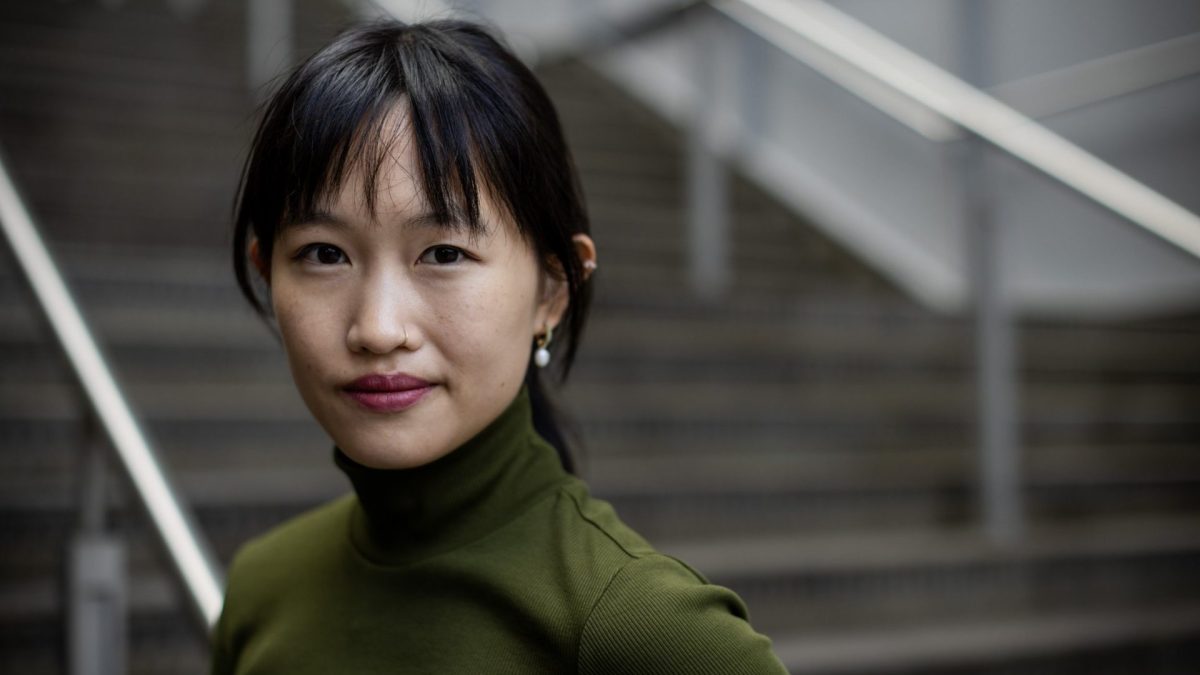
Rebecca F Kuang hurtled through the first draft of Yellowface, her best-selling 2023 satirical thriller about race and the publishing industry, in a mere month. You’ll know Yellowface: the one with the bright lemony cover and the monochrome side-eyes floating along the top? The award-winning book has now sold more than 1.5 million copies and is being developed for television; Kuang says the idea came to her “fully formed”. But the 30-year-old novelist and academic – speaking to me from a London hotel room in the run-up to the release of her new book Taipei Story – insists she is unlikely to write a follow-up to Yellowface, or even necessarily another thriller. “I think it’s really dangerous as an artist to chase the market or try to recapture lightning in a bottle. It would just be a massive disappointment to write a book that hits the same audience as Yellowface.” And readers should expect something very different: Taipei Story is an altogether quieter affair, a coming-of-age tale about a Chinese American undergrad studying abroad who suffers an extreme identity crisis after her grandfather dies. The two books are worlds apart. Genre-hopping, career-hopping and location-hopping are all kind of Kuang’s thing, though. Born in Guangzhou, China, she emigrated with her parents and two siblings to the US aged four. She was raised in Dallas, Texas, where she says she was one of just two Asian kids at school and was bullied for her strong Chinese accent (long since gone). At high school, she was seriously into debating and it’s here that she also met her husband, Bennett Eckert-Kuang – although they didn’t date until later, reconnecting at college. Now, they live in Boston, where Eckert-Kuang is a PhD student and researcher in philosophy at MIT. Kuang is finishing her PhD in East Asian Languages and Literature, and is also visiting professor of English at the College of the Holy Cross in Worcester, Massachusetts. “We’re both academics so we don’t know where we’re going to end up. But Boston’s our home for now. It’s the first place I got to choose as my own home and set down roots. A part of my identity I have chosen for me.” It is wholly unsurprising that Kuang has chosen one of the world’s most famous academic locations for her spiritual home. She also has an undergraduate degree in International History from Georgetown, a Master’s in contemporary Chinese studies from Oxford and a Master’s in 20th century Chinese literature from Cambridge. “Oh yes, I wear being a nerd proudly on my sleeve,” she nods enthusiastically. If she had to pick between being a novelist and being an academic, which would she choose? She looks distraught. “Probably novelist because I don’t actually like academic writing. I like talking about academic things and creating stories from them. And I love teaching. But I’m lucky because I don’t have to choose.” Kuang and her husband Bennett Eckert-Kuan starting dating at college and are both academics (Photo: Marleen Moise/ Getty) Kuang wrote her first novel almost by accident while she was doing her undergraduate degree. She stumbled across the writing software Scrivener and started drafting a story inspired by the Sino-Japanese war without any real aspiration to full-time writing. Still, within a year she had an agent and her grimdark fantasy The Poppy War, now part of a trilogy, was published when she was just 21. A year before Yellowface there was Babel, or The Necessity of Violence, a speculative fiction set in Oxford. Her last book, Katabasis (2025), was a gentler, dark academia novel about magicians. “Every time I start a project it’s like learning how to write a novel for the first time because I’m always switching genres or voices,” she says. “I think the challenge is exciting. I have so much admiration for writers like Agatha Christie who built a career doing the same thing over and over and still making it fresh. I can’t do that. Maybe it’s because I’m still pretty young, or haven’t settled on the voice I really love, but I’d just get bored writing the same stuff.” And now there is Taipei Story, which, like The Poppy War, was sort of an accident. Kuang started writing diary entries when she was studying at an intense Chinese language programme in Taiwan, without a view to turning them into a novel. “I was just writing down observations of what I was feeling, what I was witnessing, things I was doing around the city.” Her grandfather had died suddenly not long before: “I remember just being so angry with myself because I sort of came to writing and also to learning Chinese because I wanted to reconnect with my extended family. I had this grand project I was dreaming about, to do with language and connection, that I didn’t get to complete. So I had all this shame and guilt.” Given the depths of Kuang’s instinctive erudition, it’s quite a feat that Taipei Story manages to explore complex theorems such as linguistic determinism without becoming didactic or dull. The book’s success is, I think, largely to do with its protagonist, Lily, an insecure and discombobulated 19-year-old student at Yale who, while doing a hardcore summer Chinese language programme in the capital of Taiwan, struggles to fit in or figure out what she wants, and ends up isolating herself from everyone she knows. Kuang, 30, has many things in common with Lily: both were born in Guangzhou, emigrated young to the US and have suffered the loss of a grandparent. Both also have extensive histories of familial loss in the Cambodian genocide. “The difference, though,” says Kuang, “is that Lily is so much younger. All of Lily’s insecurities, her propensity to be hyper judgemental, her obsession with authenticity, her extremely flawed interpretations of world history. These are journeys I went through when I was a teenager. When you’re doing a coming-of-age novel you can either approach it with condescension, I think, or you can tunnel back and recognise the mistakes you were making when you were that young. It was kind of a project in having compassion for how stupid I was.” A lot of Taipei Story is about the tensions of being a second-generation immigrant or what is sometimes known as a “third culture kid”: someone who has spent a lot of time straddling the culture of their parents’ origins and the culture of the country in which they have grown up. I wonder if Kuang feels like third culture kids always end up feeling like outsiders? “Um, like Lily, I have always had the feeling that I don’t fully belong in a space unless that space is people with my specific background. So, in that sense, yeah.” She pauses. “But unlike Lily, I’ve never really been bothered by that. I don’t view it as a setback. And actually, in my creative career, it has been an enormous asset. It makes you very observant. If you’re always on the border, you’re paying attention to habits or ways of speech or social codes that other people take for granted and perform without thinking. Now, I think straddling cultures is kind of a superpower.” It doesn’t help poor Lily that she shares the tiniest of studio apartments with her roommate Anna and then catastrophically falls out with her over a boy. “Lily and Anna are probably equally inconsiderate,” says Kuang. “I’m pretty sure I wasn’t the best roommate.” How so? “Oh my gosh, well, at Georgetown I often had a hankering for Asian food so I would order kimchi and store all these very fermented, fragrant things in our living space. I made all these stir fries and stuff.” It’s hard to imagine Kuang being inconsiderate. When we speak she’s in London about to officiate her friends’ wedding (“I just have to read a nice speech I wrote about their love, I’m not ordained or anything”) and in person she comes across as both deeply cerebral and hyper self-aware – “although the last few years have made me think a lot about grief, connection and reckoning”. Not only have a few extended family members died in recent years; she and her husband also went through a very difficult period when he became very ill, very quickly, and was rushed to hospital one night with severe abdominal pains. He ended up being diagnosed with Crohn’s disease. It was a “frog-in-water” situation, she says, in that they just didn’t realise how bad he was. He’s managing much better now, but “writing is always a good escape”. If you don’t already have a hankering for Asian food, by the way, Taipei Story will give you one. Its frequent, gloriously rich descriptions of dragonfruit and Takoyaki balls and all manner of dumplings made me ravenous. “I didn’t even think of it as a novel that was interested in food,” muses Kuang, “which I think just speaks to the plenitude and variety of food there. I had a great time eating my way through Taipei.” Back to that linguistic determinism. The book interrogates something called the Sapir-Whorf hypothesis (yes, nerd alert): the idea that you will have a drastically different experience of the world depending on which language you’re speaking. “I mean, it’s now well-known in linguistics that that’s not true. But what about: language affects your experience of the world? You might be a slightly different person in different languages. What about that? It’s something I thought a lot about in Taipei. But also my own experience of having spoken Mandarin, then forgotten it, then relearned it academically as an adult.” So is Kuang a different person in Chinese? “I think I’m much sweeter and more polite because I’ve spoken Chinese so much in a classroom setting. I’m not often impatient or casual in Chinese. With my mum I sometimes switch to English to be mean.” The use of Chinese characters dotted throughout the text also plays on this idea of different cultures extracting different things from us. When Lily’s grandfather dies, for example, her teacher tells her to “Please restrain your grief”. “If you said that to someone in English they’d be like, ‘What is wrong with you?’ But in China, these are nice things to say, they mean you are concerned.” There’s some more location-hopping to come: Eckert-Kuang has been offered a job at UCL in London and the pair will be moving to the UK in a few years. Is Kuang excited? They talk about what it would be like to raise a child here, she tells me: potentially another third culture kid. “Is my child going to have a British accent? That’s going to be so weird!” Taipei Story is published by the Borough Press on 8 September, £22
The Yellowface author on why she’ll never write a sequel
Full Article
Original Source
Read the full article at Inews →KhanList aggregates and links to publicly available news content. We do not host full articles from third-party sources. Always verify important information with original sources.