
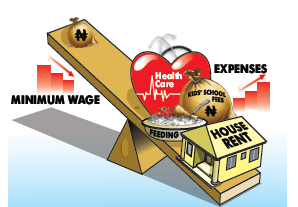
THE WORSENING PLIGHT OF WORKERS Government must do more to contain the cost of living crisis Amid crushing hardship fuelled by galloping inflation and rising cost of living, many Nigerians spend significant portions of their incomes simply to commute. For workers, particularly in urban centres, it is a daily agonising experience. Following persistent threats of strike by labour, the federal government at a recent meeting with the Nigeria Labour Congress (NLC) approved a monthly N70,000 transport allowance for workers across all levels for six months, beginning this month, to cushion the impact of fuel subsidy removal. However, the Trade Union Congress (TUC), a major ally in the crusade for workers’ welfare, rejected the allowance outright, insisting that workers need a proper wage increase, not “haphazard measures”. It was a stance that sparked a sharp disagreement between the two labour leaders, a dispute that spilled into the streets and degenerated into embarrassing personal attacks. This prompted the intervention of some veteran labour leaders. But even if some affiliated unions of the feuding leaders are still reportedly queueing behind their own and deepening the discord, many have cautioned both the NLC and TUC presidents, Joe Ajaero and Festus Osifo not to walk into a trap that might weaken organised labour. Former NLC President Comrade Ayuba Wabba said, “We have made it clear that workers’ organisations are supposed to be one because the objective is one and the aim is one.” Indeed, there is every cause for labour to unite for the crucial battles ahead in the interest of workers. As NASU President, Comrade Makolo Hassan, rightly pointed out recently, the N70,000 national minimum wage has become so miserable, unbefitting for any worker. The prevailing economic realities have rendered the amount grossly inadequate. “With the increase in pump prices, astronomical rise in cost of food, transportation, housing, electricity, healthcare and other essential commodities,” said Hassan, “the current minimum wage has effectively become a slave wage that can no longer sustain Nigerian workers and their families.” Shortly after the federal government approved the national minimum wage of N70,000 in July 2024, organised labour intensified agitations for salary raise amid worsening economic conditions. Things have taken a turn for the worse, aided by the prolonged crisis in the Middle East which has further shot up the cost of fuel, leading to anguish in many homes. The cost of food, transportation and services is mostly determined by fuel in an environment where transport infrastructure is at best epileptic. The prevailing hardship is further worsened by increases in electricity tariffs and the impact of recent tax measures. Unfortunately, the CNG (Compressed Natural Gas) alternative pushed forward by the government is still saddled with several operational and infrastructure hurdles. Besides the high cost of conversion of vehicles, there is a severe scarcity of refuelling stations across the country, with some motorists spending a full day or more to have a gas refill. Only last week, the federal government inaugurated a new CNG facility in Karu, Abuja, to expand the country’s refuelling network to just 106 stations. It is in this stressful mix that workers have stepped up agitations for a new minimum wage. However, the federal government has maintained that the move is “premature and potentially disruptive.” The Minister of Labour and Employment, Muhammad Dingyadi, said that the current wage is due for review in June 2027, arguing that the National Minimum Wage Act, 2019, as amended in 2024, provides for a three-year review cycle. The N70,000 palliative is more or less a fallout for the long wait, and we endorse it. So is the federal government cash support programme that provides N50,000 monthly grants to some vulnerable households across the country to help ease the rising cost of living. The government must make deliberate efforts to tackle the increasing challenge of poverty.
THE WORSENING PLIGHT OF WORKERS
Full Article
Original Source
Read the full article at Thisdaylive →KhanList aggregates and links to publicly available news content. We do not host full articles from third-party sources. Always verify important information with original sources.