
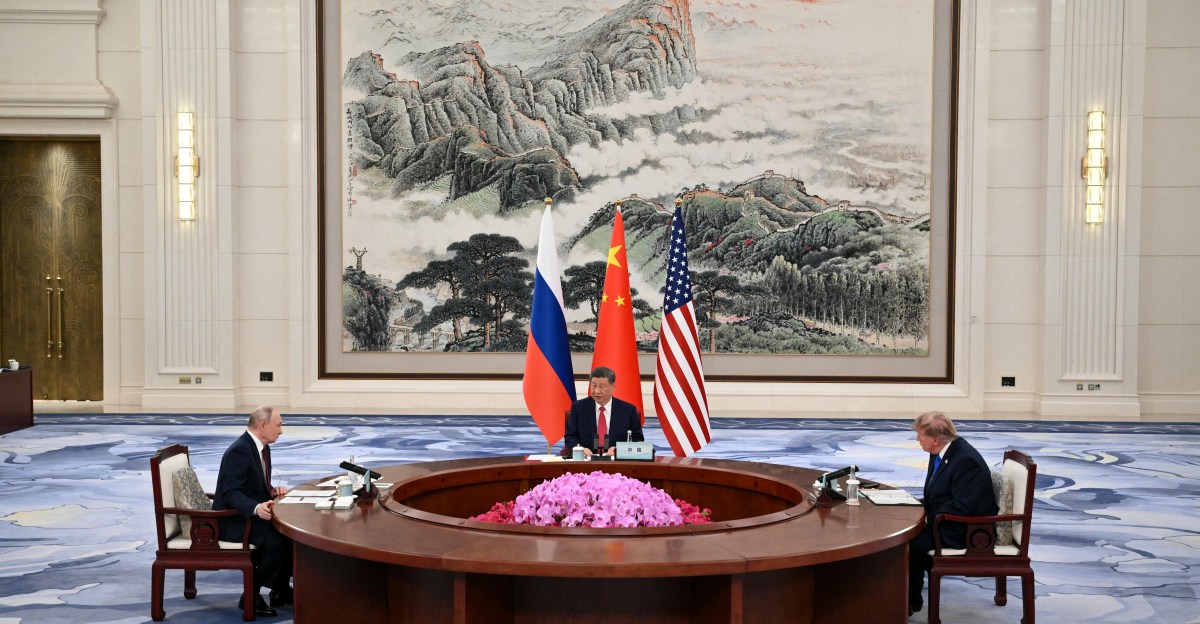
This story appeared in Today, Explained, a daily newsletter that helps you understand the most compelling news and stories of the day. Subscribe here.President Donald Trump is on his way back from China after a four-day Asia trip that included taking in a surreal cover of “Y.M.C.A.,” heaping praise on a noted kleptocrat, and making earnest — if slightly cringe! — declarations of star-crossed presidential friendship.But the highlight of the trip was surely Trump’s unprecedented trilateral meeting with Chinese President Xi Jinping and Russian President Vladimir Putin, the first between those countries’ leaders.Today, ExplainedA daily, curiosity-driven guide to the big, weird, and fascinating ideas shaping the news cycle.The three men sat around a comically large and reflective roundtable to discuss issues like reforming the United Nations, increasing the world’s supply of petroleum, and reducing the risk of nuclear war, which they all thankfully agree would be a bad idea.A major nuclear treaty between the US and Russia lapsed nine months ago, and China has been a sticking point to negotiating a new one. In fact, all three countries are — in one realm or another — major obstacles to each other’s geopolitical ambitions.Accordingly, no breakthroughs were reached during their hour-long chat. But they did agree to keep chatting…including about nuclear proliferation.Go a little deeperI was surprised to learn that there’s currently no nuclear arms control treaty between Russia and the US. The two countries had agreed to mutual limits on their nuclear arsenals under a series of arms-control agreements dating back to the early 1970s. But when the latest one lapsed in February, nothing replaced it. (This despite Trump’s decades-long enthusiasm for nuclear disarmament.)How, exactly, did we get here? To find out, I reached out to Rose Gottemoeller, the chief negotiator of the New Strategic Arms Reduction Treaty, or New START — that US-Russia nuclear deal that just recently expired.The original START was signed in 1991, just before the collapse of the Soviet Union. For the first time, the two countries agreed not just to stop growing their nuclear arsenals, but to actively reduce their strategic weapons.New START slashed their stockpiles even further: to 700 missiles, 800 launchers, and 1,550 deployed warheads, Gottemoeller said. (When you consider that the world had roughly 70,000 nuclear warheads at the peak of the Cold War, it’s a pretty massive accomplishment.)But New START was negotiated during a brief, shining, Obama-era moment of optimism for nuclear arms control. Then Russia started getting grabby in Ukraine, and that optimism curdled.The treaty was extended once, in 2021, about a year before Putin began a full-scale invasion. Since then, neither country has been in a particularly diplomatic mood. On the contrary, both Trump and Putin have at times signaled they might be a little nuke-curious.The good news, of course, is that neither president ever acted on that curiosity. And in fact, the lapse of New START earlier this year hasn’t triggered a buildup. “So far Russia and the United States are sticking with the status quo limits,” Gottemoeller told Vox.The bad news is that either country could reverse course, and there are complications to negotiating firmer limits in the future. One of the biggies is China, which is rapidly building up its own nuclear stockpile — and thus disincentivizing Russia and the US from cutting theirs back further.That’s the context for this morning’s trilateral, where Trump spoke explicitly about nuclear arms control before heading into the closed-door meeting. Gottemoeller, for her part, said she was “hopeful” the summit would “be a catalyst for new talks with the Russians [and] also nudge open the door to first talks with the Chinese.”We’ll have to wait and see about all that. But the three leaders did release a vague post-summit statement that reaffirmed “a nuclear war cannot be won and must never be fought.” That, crucially, is a callback to a statement that US and Russian leaders released in 1985 after a summit that reinvigorated nuclear arms-control talks.One link for later➨ Talk to more strangers. That occasionally awkward but ultimately life-affirming small talk helps you feel connected to other people. And according to University of Kansas researcher Jeffrey Hall, it boosts your entire community, too. By offering “dignity to another person...and by stretching yourself outside just the people you know well, you’re actually building a healthier environment for all of us,” Hall says.Before you go…Did you know…that almost 15 percent of adults suffer from tinnitus — a persistent, often ringing sound in their heads? It was once believed to be psychosomatic, but new research suggests it’s the result of a very specific type of hearing damage. Today’s trivia: Which popular therapy method was influenced by Buddhism? (You can find this and other brain puzzles in Vox’s daily crossword. Look for the answer in tomorrow’s edition.)Yesterday’s trivia: Yesterday we asked you for the name of the US soccer player who scored the game-winning penalty kick at the 1999 Women’s World Cup. That would be Brandi Chastain, who famously — iconically! — fell to her knees and tore her jersey off in celebration. See More: AI and nuclear weaponsArtificial IntelligenceChinaDonald TrumpInnovationPoliticsRussiaTechnologyToday, Explained newsletterWorld Politics
The world’s most powerful frenemies talk nuclear weapons
Full Article
Original Source
Read the full article at Vox →KhanList aggregates and links to publicly available news content. We do not host full articles from third-party sources. Always verify important information with original sources.