
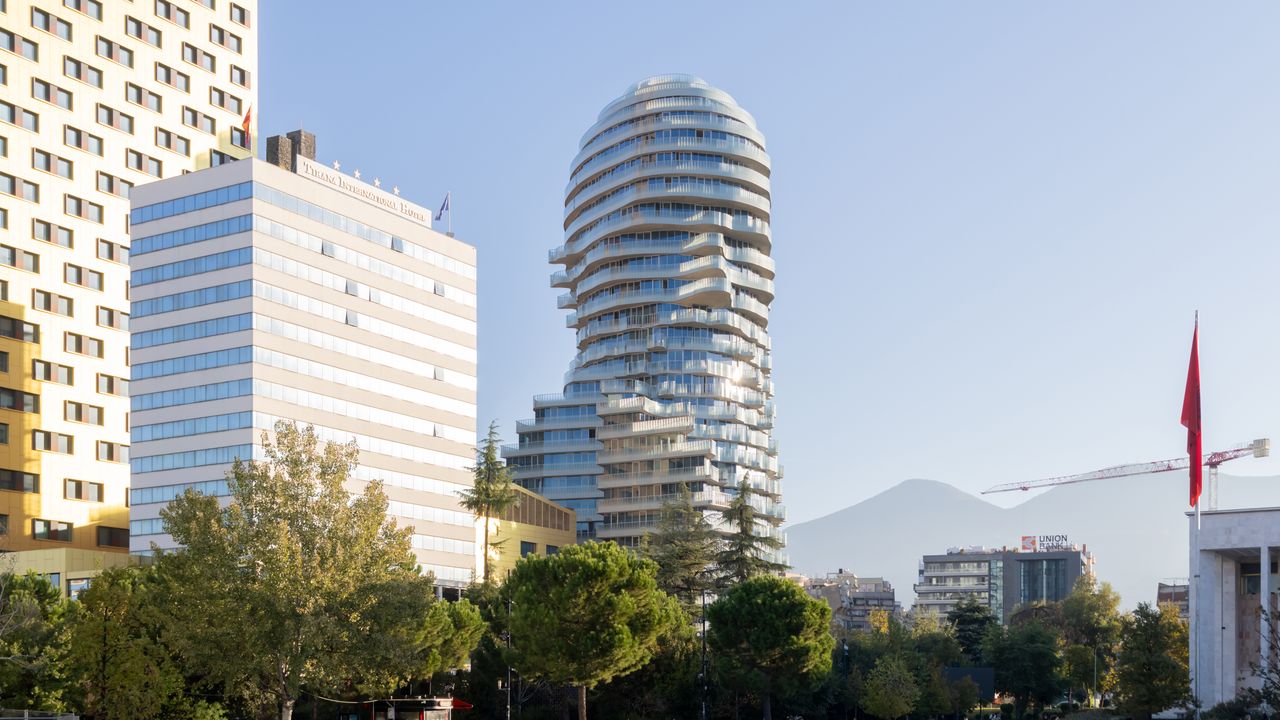
My dizzying 72 hours in Albania's architectural hotbed, where I toured odd buildings, hugged an embattled prime minister, and wondered who would buy a condo in a nosePhoto: Iwan Baan“I'll try to focus on this, which is not the easiest thing today,” says Edi Rama, the embattled prime minister of Albania, after a night spent monitoring violent protests in the capital, Tirana. But Rama quickly warms to one of his favorite subjects. “Architecture,” he says, choosing his words carefully, “has the power to change societies. It’s like a strong medicine. It can heal, or it can kill.”Albania Prime Minister Edi Rama Photo: Fred A. BernsteinA journalist who covers architecture, I had been hearing about a building boom in Albania for several years. It seemed like half the architects I knew in New York were on a first-name basis with the prime minister, a working artist and, at 6’-7”, a former pro basketball player. So on October 19 I flew to Tirana—a short side-trip from Greece, where I was on vacation with my husband—to look at some of the new buildings and interview Rama about them. But I arrived during a season of civil unrest. The prime minister, whose assistant had told I needn’t postpone the trip because everything was fine, had moved to a secure location on the outskirts of the city; some of the buildings I had come to see had just been vandalized by protesters; and at one point I was accused, publicly, of aiding a government spy. (The charge was— need I even say this—absurd.) And, because I’m in the early stages of Parkinson’s disease, I experienced all this from a four-wheeled mobility scooter, which I had rented for about $100.Skanderbeg Square As I tooled around the city center, much of it seemed unaffected by the protests. In fact, most of Tirana was charming. But weren’t those Molotov cocktails we heard going off during an al fresco dinner? Those weren’t on my drinks menu.What was on my menu in Tirana, a city of about 600,000 in a country of about 2.3 million, was confusion. Confusion about why the protesters were so angry, and about why the prime minister seemed so unconcerned. In his 13 years in office, Rama, 62, has been remaking as much of Albania as possible with the help of foreign architects. Even the heavily guarded villa where he agreed to be interviewed, a raw concrete building dyed bright red, is largely the work of the Spanish architect Pablo Bofill.51N4E's Book Building When protesters began demanding Rama’s resignation last May, he was about to host his second annual gathering of architects from around the world, one of the high points of his year. Architects like the Danish superstar Bjarke Ingels and the Chilean Alejandro Aravena, who won the Pritzker Prize in 2016, “pay to come here and talk and they love it,” Rama says. But this year the get-together, from June 3 to 5, drew protesters with signs that read “Starchitects go home!” Those protests presaged the more violent demonstrations in October and November.I haven’t attended either of Rama’s conclaves, but what I’ve heard reminds me of my visit to Ordos, Inner Mongolia, in 2008, which I wrote about for The New York Times. A wealthy industrialist, aided by the artist Ai Weiwei, had brought 100 young architects from around the world to the isolated desert city. Their task was to design 100 villas for anonymous (and seemingly nonexistent) Chinese millionaires. The architects picked numbers out of a bowl to determine which of the 100 sites was theirs, and before flying home they were paid for their designs with wads of cash. None of the villas was built, but being in Ordos was a bonding experience for a generation of architects, a few of whom have recently been to Tirana. At least until the latest protests, the mood among Rama-anointed architects—giddy optimism coupled with uncertainty about what would actually be built—echoed the mood in Ordos almost 20 years ago. Both situations felt surreal.Rama normally works in an office on the Boulevard of Martyrs of the Nation in the center of Tirana. But on October 20 the boulevard's sidewalks were missing hundreds of paving stones, which protesters had used to shatter storefronts. (Some that weren’t shattered bore hastily made signs telling protesters, “Don’t target us. We are with you.”) And some of the stones were reportedly thrown at police during nighttime clashes that authorities say left hundreds injured. Police have used tear gas and rubber bullets as protesters set small buildings, like an information kiosk in the vast Skanderbeg Square, on fire. Near the shell of the kiosk, workers scrubbed fresh graffiti off a statue of Skanderbeg himself.The Tirana Pyramid, built by followers of the brutal dictator Enver Hoxha, who died in 1985, as his memorial, and turned into a public amenity by the Rotterdam firm MVRDV, was also damaged.MVRDV's Tirana Pyramid There’s a reason some Albanians—it’s impossible to say how many—resent the foreign architects and the attention lavished on them. In the 26 years since he became the mayor of Tirana and then prime minister, Rama has initiated or encouraged more than 50 international architecture competitions for projects ranging from parks to museums to large housing developments. Forty-eight of those were won by foreign architects (some working with Albanian firms), according to Adelina Greca, who leads the National Territorial Planning Agency, which organizes competitions for the government. Only two were won by Albanian firms working alone. In addition, Rama has played matchmaker, giving private developers the names of foreign architects he strongly recommends they hire.As a result, Tirana’s compact city center is filled with buildings in bright colors and novel shapes. There is a so-called vertical forest, a skyscraper laden with trees and shrubs, by the Italian architect Stefano Boeri. The green-colored building is just a stone’s throw from the bright red Marriott by another Italian architect, Marco Casamonti. The Plaza Hotel, by architect Johan Anrys, of the Belgian firm 51N4E, starts as an ellipse at its base and morphs into a rectangle at its crown. But the champion attention-getter is a condo building by MVRDV in the shape of a head. Its facade and balconies resolve into facial features, most conspicuously a pronounced nose. The architects have publicly identified it as the head of Skanderbeg, a 15th century military hero. But some Albanians think it’s Rama. Both ideas are “urban legends,” says the prime minister. “It’s the form of a man through history,” he says, contradicting the architects’ own statement. Nodding at this reporter, he says, “It also looks like you."Tirana's Rock (aka the Skandebeg building) is an MVRDV-designed condo in the shape of a head A Marriott designed by Marco Casamonti of Archea Associati, left, and the “vertical forest” skyscraper by Stefano Boeri The vertical forest, the Marriott and the Plaza Hotel are all handsome additions to the city. So, too, is the “head,” but is it too much of an architectural one-liner? Who, I wonder as I pass it several times a day, is going to want to live in the nose?Rama tells me—on-the-record and perhaps unwisely—that the only Albanian architects who have a problem with his overtures to foreign firms are “the mediocre ones.”The "nose” of the MVRDV building Anrys, who 22 years ago became one of the first foreign architects in Albania, told me that working there has taught him "what architecture truly means for improving society.” He said he knows that Albanian architects wonder, "Are we not good enough?" and believe we're taking jobs from them. "It isn't true. I have a studio in Tirana with 20 Albanian architects." Overall he says, the foreign architects have “brought Albanian architects more work than we've taken."Rama tells me—on-the-record and perhaps unwisely—that the only Albanian architects who have a problem with his overtures to foreign firms are “the mediocre ones.” The rest, he explains, see that having first-rate architects from abroad, including Herzog & de Meuron, OMA, and Diller Scofidio & Renfro, working in Albania will raise everyone’s game.The foreign architects who win competitions are required to enlist architects licensed in Albania to help them execute their plans. Rama compares the situation to that of China, which 20 years ago was giving its most prominent building commissions to foreign architects, including some of the same ones working in Albania today. Chinese architects, Rama says, got a free education from the western masters.“If we continue this kind of cooperation,” says Greca, who has worked for Rama almost continuously since 2003, “there will come a day when Albanian architects will win competitions not only here but around the world.”Anti-government protesters on the streets of Tirana, with the art installation Tirana Moons by Austrian architect Chris Precht in the background But Greca’s association with Rama has made her a controversial figure among local architects. On my first day in town, our route intersects that of a lunchtime protest march. We stop to watch. Greca notices many architects and architecture students in the crowd. (The Faculty of Architecture and Urbanism of the Polytechnic University of Tirana is nearby.)Within minutes, Gent Progni, an organizer of the march, posts a photo of Greca and me on Instagram. The caption claims she had sunk so low as to use a disabled person (me) as cover to spy on the marchers. (Ten days later, the post has almost 7,000 “likes.”) Later, in a text responding to questions from this reporter, Progni wrote:“My opposition is not to foreign architects but to the way Edi Rama uses prestigious international names to legitimize controversial development projects, often without transparency, meaningful public consultation, or accountability. This is a significant issue for our protest movement, but it is part of a much larger struggle against corruption, the concentration of power, and the sale of Albania’s public wealth.”Rama himself isn’t happy with all of the new buildings in Tirana. He complained about one whose facades are made of stone “until a certain altitude,” where the cost-cutting developer switched to a printed material that only looks like stone. Other buildings stand partially complete, or complete but eerily empty. And in several cases developers have replaced foreign architects with local ones midstream, in order to complete buildings without meeting the original design specifications. “We need the investors to stick with the architects,” Rama says. But funding is less available than he would like. “Certain architecture needs a certain quality,” he says, philosophically. “But compromises are forced by the limitations of the place.”The problems with his building boom go deeper than facade materials. There are accusations of money laundering and other forms of corruption, which grew louder at the end of May, when Rama agreed to support efforts by a company associated with Jared Kushner and Ivanka Trump to build luxury resorts on previously undeveloped land. It was a coincidence that the big architecture conference started just a few days later, leading directly to the calls for starchitects to scram. Among the protesters, that demand became entangled with environmental and anti-Trump sentiments in what became known as the Flamingo Revolution.A housing project by Madrid-based firm SelgasCano European journalist and curator Anneke Abhelakh has recently published a brilliantly illuminating book, The Albanian Files, which gives 60 foreign architecture firms eight or more pages to describe the work they are doing in Albania. Altogether, the book lists more than 500 projects. Of those, only about one-tenth have been realized. Rama says he is looking forward to the completion of many more.But can that really happen, given the pressure to resign? The prime minister, who won the most recent election by the biggest majority of his career, says he isn’t going anywhere.In fact, seemingly oblivious to the mood on the street, he wants to further celebrate his stable of foreign architects. Near the end of my half-hour interview, he mentions that he is thinking of turning The Albanian Files into a museum, with one room for each of the 60 foreign firms to show drawings, models and photographs of their work. He said he already has a site for what he says will be “a big store of dreams, hopes and challenges, illusions and delusions. It will be a great place to go.” Its designer will be chosen, naturally, in an international architectural competition.I left Albania with lots of questions and thousands of photos to sort through. In one of them I have my arm around Rama. Why the affectionate pose? A reflex when the camera comes out. But I suppose also that, politics aside, I can’t hate a man who loves architecture.Prime Minster Rama with writer Fred Bernstein Photo: Charles Upchurch
The World’s Most Famous Architects Are Building in Albania. I Had to Find Out Why
Full Article
Original Source
Read the full article at Architecturaldigest →KhanList aggregates and links to publicly available news content. We do not host full articles from third-party sources. Always verify important information with original sources.