
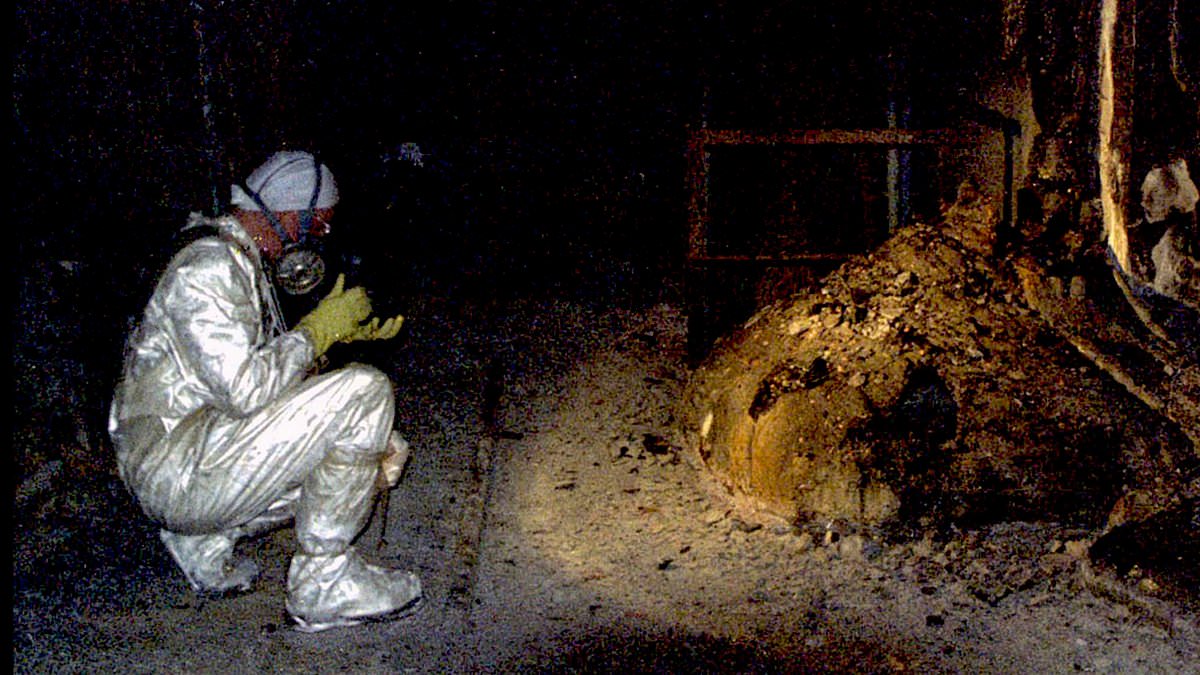
Published: 05:00 EST, 14 November 2026 | Updated: 05:01 EST, 14 November 2026 The radioactive 'lava' created during the 1986 Chernobyl disaster remains one of the most dangerous materials on Earth.Now, more than four decades later, scientists have uncovered fresh clues about how the eerie substance formed inside the doomed power plant.When reactor four exploded, nuclear fuel, concrete, sand and metals fused together under extreme heat to create strange lava-like formations that oozed through the ruined building.Using powerful microscopes and lasers, experts discovered that much of the lava's distinctive black-brown colouring comes from tiny uranium-rich particles trapped inside the solidified mass.The lava contains particles that appear to have been altered multiple times, indicating the molten radioactive material underwent a complex series of melting, dissolving and recrystallising events as the disaster unfolded.'After the explosion, interaction of debris of the destroyed core with construction materials began in former under-reactor room 305/2, leading to formation of the 'lava',' the scientists wrote in the journal Progress in Nuclear Energy.'The complex history of growth, dissolution and eventual new growth events recorded in zircon indicates dynamic evolution of the Chernobyl lava during its formation.' Among the most famous debris the so-called Elephant's Foot, a highly radioactive lump discovered deep inside the wreckage The team examined samples of Chernobyl's lava using high-powered microscopes and laser-based analysis techniques More than four decades after the disaster, scientists have uncovered fresh clues about how 'lava' formed inside the doomed power plant. Pictured: The Chernobyl nuclear site as seen in 1986The team, from the Frumkin Institute of Physical Chemistry and Electrochemistry in Russia, examined samples of Chernobyl's lava using high-powered microscopes and laser-based analysis techniques.This allowed them to study the debris – and especially the zircon crystals within it – in extraordinary detail, uncovering clues about its chemical makeup.They found evidence that parts of the reactor core reached extreme temperatures before the explosion, with some regions apparently remaining dangerously overheated for more than a minute.The resulting melted radioactive material has often been compared to volcanic lava because it flowed through the reactor building before cooling into glassy, rock-like formations.Among the most famous is the so-called Elephant's Foot, a highly radioactive lump discovered deep inside the wreckage.The team found the debris contains cracks, voids and structural weaknesses that influence how it responds to pressure.These flaws could affect the way the material fractures during future clean-up operations, and could prove crucial as engineers continue the hazardous task of cleaning up the disaster site. The team found the debris contains cracks, voids and structural weaknesses that influence how it responds to pressureThe authors' findings support the view that temperatures and melt compositions varied significantly in different parts of the reactor as the accident progressed, rather than the entire mass behaving as one uniform molten blob.They also found that much of the radioactive debris has remained surprisingly well preserved over the past four decades.However, subtle signs of chemical weathering are now beginning to appear.A separate study, published last month, revealed microscopic fragments of nuclear fuel blasted out of the reactor remain remarkably unchanged.This defies the expectation that they would have gradually broken down over time.And the team says it could have significant implications for understanding the long-term health risks posed by the radioactive contamination.In conclusion, the researchers say the findings help reveal what happens to radioactive fuel debris as it ages.It may also provide valuable lessons for the ongoing decommissioning effort at Fukushima Daiichi in Japan.
The world's most dangerous LAVA: New study reveals secrets of Chernobyl's radioactive debris
Full Article
Original Source
Read the full article at Dailymail →KhanList aggregates and links to publicly available news content. We do not host full articles from third-party sources. Always verify important information with original sources.