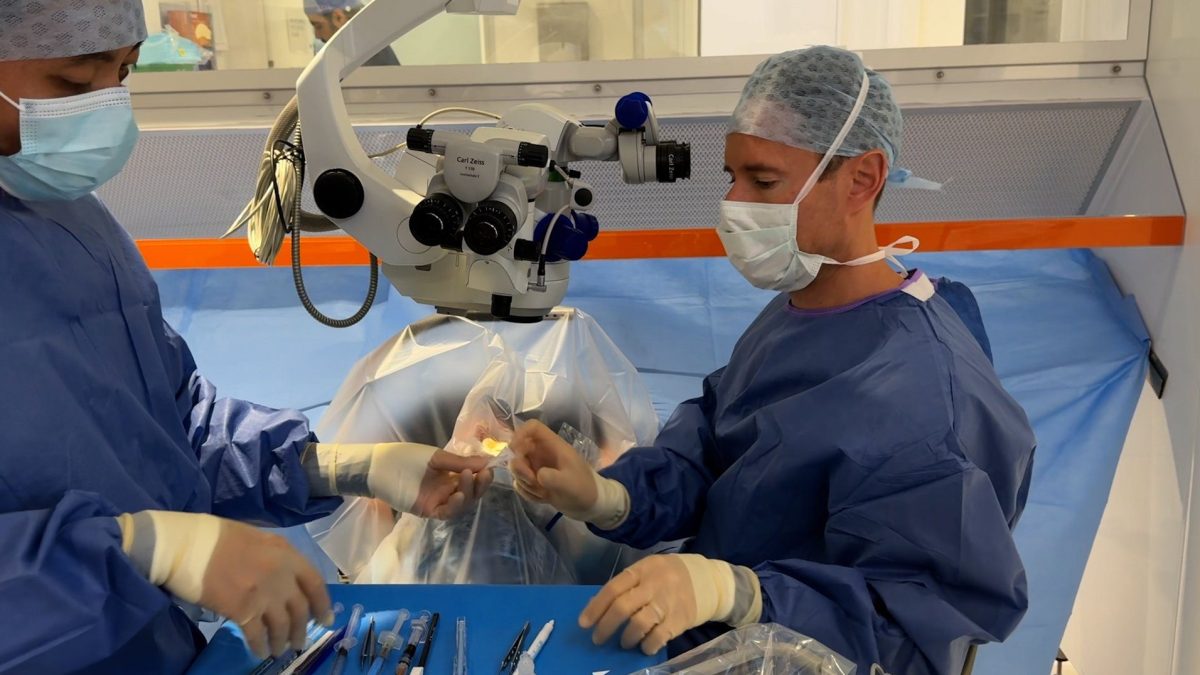
This is Everyday Science with Clare Wilson, a subscriber-only newsletter from The i Paper. If you’d like to get this direct to your inbox every week, you can sign up here. Hello and welcome back to Everyday Science. Last week I got to watch something that was almost miraculous: cataract surgery. This is when surgeons remove the lens from inside the eye, usually because it has become cloudy with age, and insert a plastic replacement. As the commonest operation in the world, its impact is life-changing, restoring vision to people who in some cases were almost blind. Shorts In fact, the operation has become so effective that people are increasingly opting to have it even before they get cataracts, just to improve their vision. “People take it for granted. But I think it is one of the cleverest inventions of human beings,” says Bita Manzouri, an eye surgeon who will be the next president of the United Kingdom and Ireland Society of Cataract and Refractive Surgeons. Lens replacement surgery began in the 1940s, after a British surgeon noticed that in shot-down RAF pilots, who had tiny chips of their plastic cockpits embedded in their eyes, the plastic triggered no reaction. At the time, people who were basically blind from cataracts did have their lenses removed but then would have to wear thick “Coke bottle” glasses to replace the natural focusing function of the lens and they still didn’t end up with good vision. Since then, the implanted lenses have improved greatly, and the surgery to insert the lens has become much safer. A close-up view I had a close-up view as I watched the operation taking place at OCL Vision, a private London clinic. A growing number of British patients are opting to pay for this procedure as it lets them choose newer types of lenses. If you have surgery through the NHS you have less choice of lens. Watching this kind of operation is not for the squeamish so I will skip the gory parts. But what amazed me is that this complex, intricate procedure inside one of the most delicate and precision-engineered parts of the human body is all done via tiny 2mm-wide incisions. The eye’s natural lens is held inside a capsule, a bit like the flesh of a grape inside its skin. To get rid of it, a fine tool is inserted through the capsule to pulverise the lens with ultrasound, with the debris then sucked out. I can see it all, in a magnified view on a screen over the patient’s head. Next, the new plastic lens is inserted while folded-up through the tiny incision. When released, it unfurls into shape like a tiny pop-up tent. Throughout, OCL eye surgeon Allon Barsam speaks reassuringly to the patient, while using both hands and feet to operate all the different machinery. The whole procedure takes eight minutes per eye, and the patient doesn’t even need a general anaesthetic – they are just lightly sedated and given local anaesthetic. “They can’t see any instruments because the microscope light is so bright that all they see is shapes and shadows, like a kaleidoscope pattern,” says Barsam. About half a million people a year have this operation in the UK, and the number is growing, both because we are living for longer and because we have higher expectations about our health and eyesight as we age. No need for glasses or contact lenses Almost everyone who lives long enough develops cataracts to some extent, and in the UK about two thirds of people will undergo the surgery. The fact that the operation is almost inevitable is partly what is driving more people to get it done before any cataracts develop. That’s because it can bring a further advantage – of leaving people without the need for glasses or contact lenses. People can already have laser eye surgery to correct their vision by reshaping the cornea, the outer surface of the eye. But this cannot prevent the stiffening of the lens that starts in people’s forties, and which means almost everyone eventually needs reading glasses for close-up vision in old age. Some people get fed up with putting their reading or distance glasses on and off and so calculate that as they will eventually need cataract surgery anyway, they may as well have it in advance and improve their vision with an artificial lens at the same time. This has only become possible with the newest kinds of multifocal artificial lenses, which means people can focus on things far away, in the middle distance, and close up. Currently, this kind of elective procedure remains a small fraction of lens replacement surgery, but it is growing fast, says Barsam. In fact, the person whose lens replacement I was watching has no cataracts, but was having the procedure out of choice, using one of the newest Galaxy “spiral” lenses. “My mother had had cataract surgery so I knew I would probably need it too eventually,” says the patient, Jo Wadham. However, Manzouri cautions that potential patients should carefully weigh up all the pros and cons before getting lens replacements. Even the newest multifocal lenses have drawbacks: for instance some people experience visual disturbances, such as seeing glare and halos around bright light sources at night, which can interfere with driving. For others, their distance or near vision may be less sharp than formerly. “You’ve got to get your head round and be comfortable with the downsides,” says Professor Paul Ursell, an eye surgeon and professor at the University of Bradford. “A large part of what we do as surgeons is ensuring that people have got a full understanding of what those are.” Manzouri adds: “To be able to take the human lens out and replace it with a like-for-like lens, that’s the holy grail of lens replacement surgery. We are not quite there yet.”
The world’s most common operation that people now have before they need it
Full Article
Original Source
Read the full article at Inews →KhanList aggregates and links to publicly available news content. We do not host full articles from third-party sources. Always verify important information with original sources.