
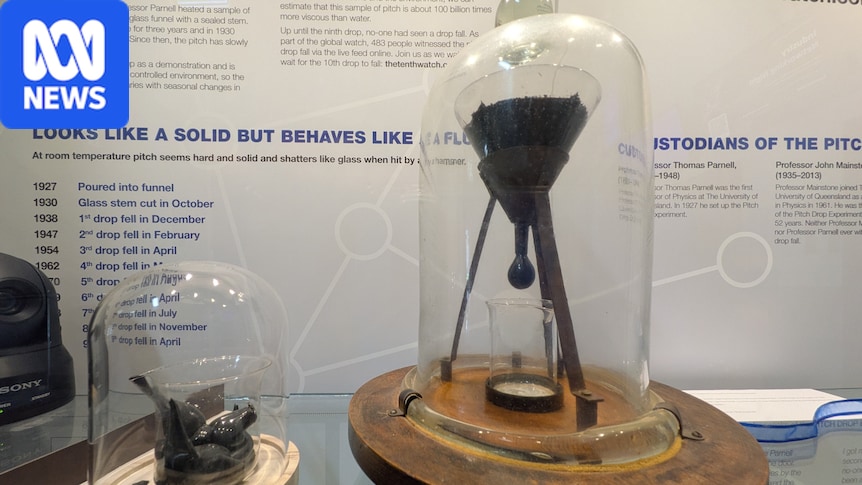
The world's longest running science experiment is sitting behind glass outside a lecture theatre at the University of Queensland.Hundreds of students walk past it every day, some perhaps unaware they are witnessing a slowly unfolding process that began almost a century ago.The pitch drop experiment began when the university's first professor of physics, Thomas Parnell, wanted to showcase the astonishing properties of what was then a commonly used material.Pitch is an organic material that is the result of heating coal or wood in an oxygen-free environment.Professor Andrew White is the third custodian of what is officially the world's longest running science experiment. (ABC News)It was once regularly used for waterproofing decks, boats, coffins and household containers.In 1927, Professor Parnell heated up a batch of pitch and placed it in a sealed glass funnel, which he left to cool.Three years later he cut the bottom off the funnel and the pitch began to flow like a liquid — at an incredibly slow rate.Professor Andrew White is the experiment's third custodian and said the pitch is an example of something that looks like a solid, but can behave like a liquid."If you take a brand new tube of toothpaste on a cold day and hold it very carefully by the end and take the cap off, it doesn't flow. But as soon as you squeeze it, you put a pressure gradient on it," he said.Professor John Mainstone was the second custodian of the long-running experiment. (Supplied: University of Queensland)"Pitch is like that except billions of times more viscous than toothpaste."Professor White said the pitch is moving at "about an atom a second".He said that was more than ten times slower than continental drift."The ground beneath your feet moving in Australia is the red bull version of the pitch drop experiment," he said.The last drop fell in 2014 and the next is expected within the next few years. (ABC News)No pitch drops witnessedSince the bottom was cut off the funnel in 1930, just nine drops of pitch have fallen from the beaker.Remarkably, not one has ever been witnessed.Professor White said his predecessor, Professor John Mainstone, spent an entire weekend at the university in 1979 when he was expecting a drop to fall."He sat here all Friday night, all day Saturday, all Saturday night through to Sunday morning. It didn't drop," Professor White said."He went home, had a shower, came back in Monday morning and the pitch drop had dropped."Nine years later, it was the 1988 Expo in Brisbane. The University of Queensland had a stall set up at South Bank with a display cabinet for the pitch drop.A photo of the pitch drop experiment taken after the sixth drop fell in 1979. (Supplied: University of Queensland)Professor White said the drop fell in the "few minutes" when people left the room to get a drink.By the year 2000 and with the advent of the internet, it was hoped that finally a drop would be caught on camera.Unfortunately Queensland's weather had other ideas, and an ill-timed blackout meant another long wait.The installation of air conditioning to the building in the 1980s had also increased the time between drops.The last drop fell in 2014 but the beaker below it was so full of the previous pitch drops that the new one did not actually drop.The pitch drop experiment makes for a good teaching moment for budding physics students. (ABC News)"It just touched and then spent about eight years very slowly falling over," Professor White said.Now, a brand new, empty beaker awaits the tenth drop.Professor White said that is expected to happen in the next couple of years."I'd love to be able to witness it in person, but I would settle for just a really good recording."
The world's longest running science experiment is about to turn 100
Full Article
Original Source
Read the full article at Abc →KhanList aggregates and links to publicly available news content. We do not host full articles from third-party sources. Always verify important information with original sources.