
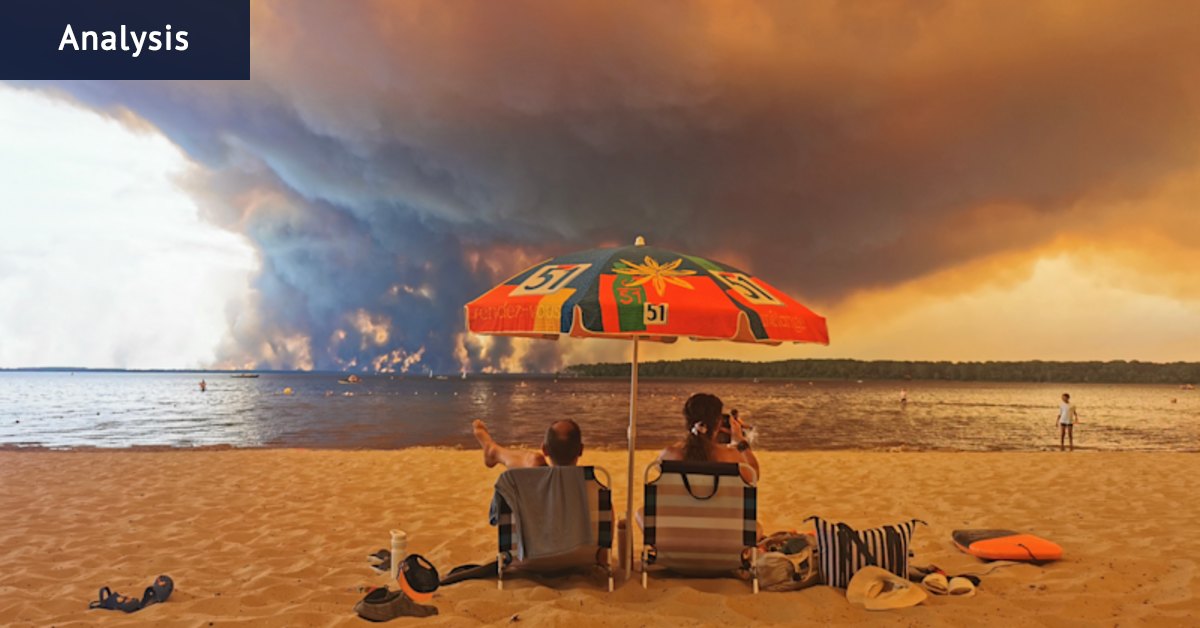
September 3, 2026 — 7:00pmWhen the world came together in Paris a decade ago and agreed upon a 1.5 degree global warming target, the mood verged on jubilant.Then United Nations Secretary General Ban Ki-moon declared the Paris treaty “a covenant with the future” and said the world was now in a race against time to arrest global warming.Europe was struck by fires that displaced 300,000 over summer.AFPOn Wednesday, in a new report by the UN called Limiting Overshoot, it finally conceded that the race to that target had been lost. Due to our collective failure to cut greenhouse gas emissions fast enough, the most optimistic scenario would see warming crash through 1.5 degrees by the end of the decade, warm to 1.8 degrees later this century and then – if we are lucky – we may be able to stabilise the climate and force down temperatures over centuries to come.In the report, this is referred to as “overshoot, peak and decline” and is a strategy that will require not only the sort of radical cuts in emissions we have so far failed to achieve, but the mass deployment of devices to remove carbon from the atmosphere and lock it safely away. These technologies do not yet exist at scale.Even if this was achieved, the world we are left with will be permanently damaged by our 275-year-long experiment with fossil fuels at immeasurable cost to human life and wellbeing, let alone to the natural world.“This is by no means an acceptable or preferred pathway; it is simply the best remaining option,” said the report, in uncharacteristically blunt language for a UN scientific report. “Avoiding every additional fraction of a degree of global warming and reducing the time in overshoot decrease risks and damages and increase the chances of bringing temperatures back down.”Prime Minister Anthony Albanese and Climate Change Minister Chris Bowen were at the Pacific Islands Forum meeting in Palau when the report was published, and addressed it at a press conference, but not before the prime minister dealt with other issues.He discussed the group’s work to address HIV, drug smuggling, new Qantas flights to Palau and Australian support for training police around the region.When he was finally prompted to address the Overshoot report, Albanese did not shy away.“We all need to do more,” he began. “Climate change is real, the science is real, the action that is required is real as well.”The world we are left with will be permanently damaged by our 275-year-long experiment with fossil fuels at immeasurable cost to human life and wellbeing.APBowen reinforced the UN’s central message, too, that rather than the document being an excuse to surrender to warming, the Overshoot report was evidence that the world needed to do more, faster. ”The more we miss it by as a globe, the harder it will be to repair that overshoot, and the greater the implications.“Then the press conference moved on to other issues, at least until Albanese was asked if Australia had been criticised at the forum for its massive export of planet-warming fossil fuels. He rejected the suggestion outright. “The transition [from fossil fuels] can’t happen overnight,” he explained. “It requires strategies and policies to be put in place.”All this might be true, but to anyone paying attention to the scope of the climate crisis already unfolding around us, there was an unfathomable gulf between the enormity of the threat and Albanese’s measured response.In that gulf, you can find an explanation for why the world has failed to act, despite decades of increasingly clear and urgent warnings about climate change.Like other leaders, Albanese understands the political risk of taking the sort of action that climate change demands. The costs will be borne individually, locally and nationally, the actuary Sam Gutterman once observed in an essay on this conundrum, while the benefits are global. The cost of cutting emissions will be borne today, but the benefits will emerge over centuries.While many people declare they want climate action, politicians are still punished for demanding too much from them to take action. Hence, Albanese’s moderate language in Palau. Australia’s climate policies would be introduced in a “sensible, practical way that brings the Australian population with us”, he said.That sensible, practical way includes, as the Climate Council has noted, the approval of 36 new, expanded or extended coal, oil and gas developments since it came to office. That would be 37 if you include BHP’s Grevillea Pit Continuation Project, which was ticked off on Thursday afternoon. “The prime minister said the entry fee for credibility in the Pacific is taking climate change seriously, and then his government approved 55 million tonnes of coal while he was still in the room with Pacific leaders,” said Climate Council chief executive Amanda McKenzie.The problem is that political realism is now colliding with physics, which is beginning to turn on us to horrifying effect. As Albanese spoke, 38 Australians remained missing in a disaster in Nepal supercharged by warming, while 1500 people overall have been confirmed dead and another 4500 remain unaccounted for.Half an hour after Albanese spoke, three Pacific leaders held a press conference. The news in the report had been worse for them than for most other nations. “In Pacific atoll states such as Tuvalu and Kiribati, the loss of habitability is a present reality, occurring well before total physical submersion,” it said, predicting that climate damage would cost Tuvalu’s economy 110 per cent of GDP by 2100.Stripped of the luxury of political pragmatism, their tone was sombre rather than measured.Tuvalu’s climate minister Maina Talia confessed he’d had trouble sleeping, having been briefed on the report the day before.“Loss and damage is a reality that currently exists in my country, in the countries represented here. It will only accelerate with any overshoot, encompassing economic and non-economic losses that no finance can fully restore. Our lands, our ancestral lands, our heritage, our identity.”Get to the heart of what’s happening with climate change and the environment. Sign up for our fortnightly Environment newsletter. From our partners
The world made a ‘covenant with the future’ – and we broke it
Full Article
Original Source
Read the full article at Smh →KhanList aggregates and links to publicly available news content. We do not host full articles from third-party sources. Always verify important information with original sources.