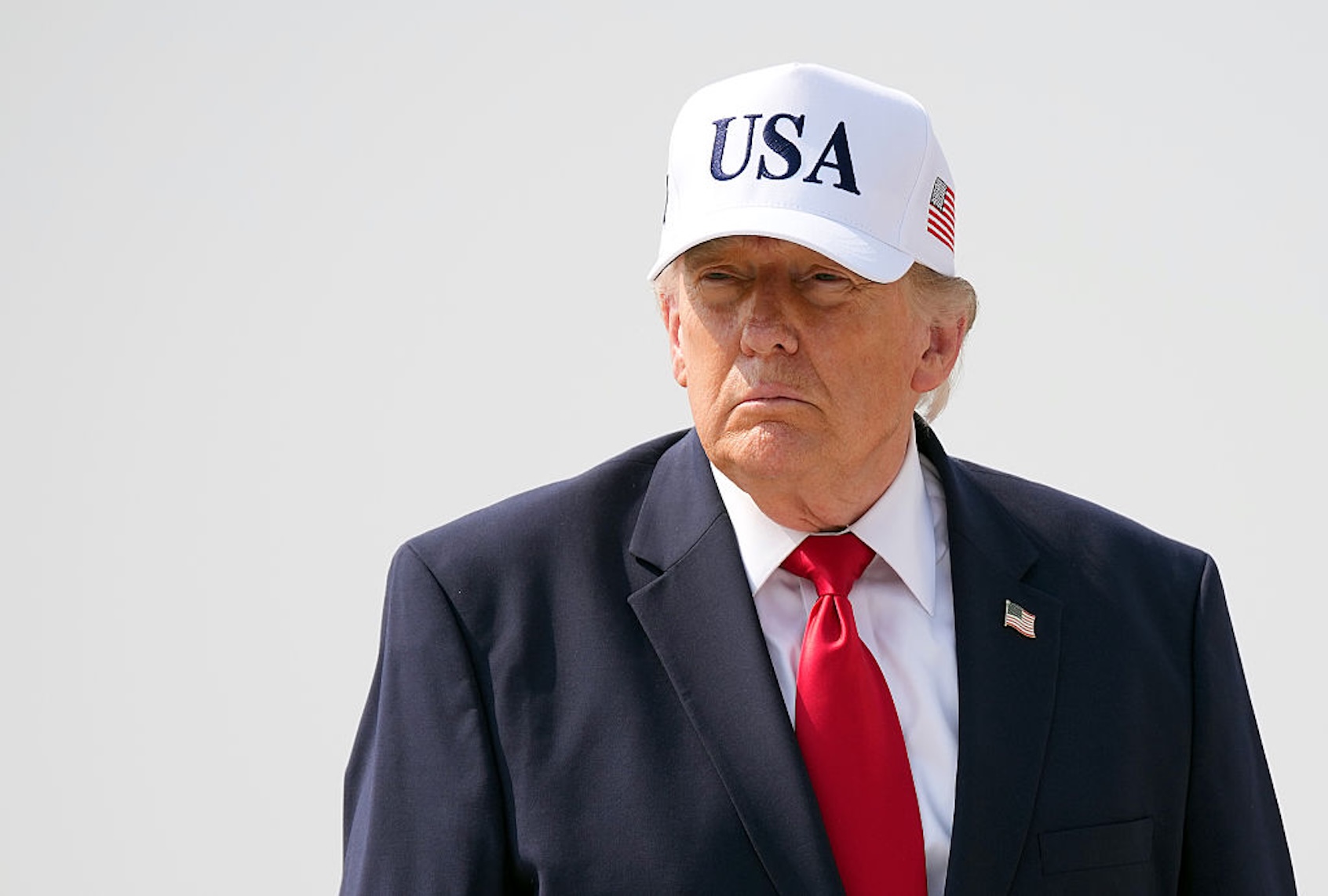
commentary The president’s empty threats and erratic diplomacy has underscored America’s unreliability Published August 7, 2026 6:30AM (EDT) President Donald Trump (Andrew Harnik/Getty Images) Most of Donald Trump’s success in politics has stemmed from his reputation as a savvy dealmaker. But in his 11 years on the national political scene, that has been exposed as a fiction — a persona invented by Tony Schwartz, the ghostwriter for the president’s bestselling book “The Art of The Deal,” who followed him around for 18 months and realized in the process that no one would want to read a book about the real Trump. After Trump announced his run for president in 2015, Schwartz told the New Yorker’s Jane Mayer he felt deep remorse for creating this erroneous image of Trump, saying if he wrote the book today, he would call it “The Sociopath.” He said, “I genuinely believe that if Trump wins and gets the nuclear codes, there is an excellent possibility it will lead to the end of civilization.” His words were startling, to say the least, but Schwartz’s description of the president’s true personality was revelatory. The man who touted himself as the world’s greatest dealmaker was a pathologically dishonest hype artist with the attention span of a four-year-old, described by Schwartz as having “a stunning level of superficial knowledge and plain ignorance” who seemed “driven entirely by a need for public attention.” His alleged negotiation prowess was actually nonexistent, as the multiple failures of his businesses should have made clear. In Trump’s first administration, it became obvious that his idea of dealmaking consisted of willingly succumbing to flattery by malevolent actors and ineffectually bellowing at allies. Professional diplomatic and national security advisers managed to steer him away from most disasters, although he commonly embarrassed the nation on the world stage by displaying his ignorance and fondness for sucking up to adversaries. Trump’s second term is a whole other story. The president has confused his “Art of the Deal” with the art of diplomacy, and they are most definitely not the same thing. Even if he were actually talented at the former, which he is not, it would have no bearing on the latter, and the consequences of that are turning out to be substantial and damaging. By this point, it’s a cliché that Trump is “transactional,” which many (if not most) people understand to mean he is negotiating on behalf of the American people, bringing riches and security to the nation. In reality, Trump’s often self-serving deals are gravely harming the national interest. Credibility is everything for a country like the United States, and now, without it, we are unleashing powerful forces that will be very hard to control. Diplomacy isn’t just signing a particular agreement between two countries. That may be the culmination of negotiations or just the beginning, but it isn’t actually the goal, especially for a superpower. The aim is to manage relations between countries over the long term to maintain stability and predictability; it’s not a “winner take all” proposition. Credibility is everything for a country like the United States, and now, without it, we are unleashing powerful forces that will be very hard to control. Trump is a pathological liar. Schwartz discovered that from the very beginning. He was attached to Trump at the hip for many months, listening in on every phone call, observing his conversations and racking his brain to figure out how to present the man as a lovable rogue rather than the damaged personality he really is. The whole world has seen this up close for the past decade. At first, allies depended upon the professional diplomatic and national security apparatus to continue to run things in spite of Trump’s erratic behavior and belligerence. They understood early on he loved pomp and circumstance, and that he was easily flattered by obsequious compliments, so they played along, giving him the pageantry of over-the-top state visits and paying homage to him at his properties and the White House. But for the most part, they were just trying to wait out the term, expecting that the American people would realize the error of their ways and revert to being a serious nation. This time around is different. A recent report in the Washington Post by Steve Hendrix and Anthony Faiola revealed that the world is no longer taking the U.S. seriously, leaving the government with no credibility. As a result, international relations are unstable and dangerous. Start your day with essential news from Salon. Sign up for our free morning newsletter, Crash Course. When Trump regained office the second time, the world quaked at his swagger, backed up by a bizarre tariff regime that seemed to be put together by Mad Libs. The markets dropped, recriminations flowed, and it looked as if Trump had finally been completely unleashed. To some extent, he had been. He and his close circle had decided to do whatever they wanted and see what they could get away with. But it soon became evident there wasn’t really any strategy or even any particular goals, despite the apparent participation of people like Elon Musk and the authors of Project 2025. In the end, it was all about Trump’s whims, which changed from minute to minute. The short attention span Schwartz described is now even more pronounced. The president’s obsession with building monuments to himself notwithstanding, he flits from subject to subject, bellowing threats to all who oppose him and rewarding his cronies with ever more obvious modes of corruption. The world has decided to stop paying attention. “[M]ost consequently,” Hendrix and Faiola wrote, “Iran refuses to bend under American bombs and reopen the Strait of Hormuz, and Russian President Vladimir Putin persists in his war in Ukraine. Europe met Trump’s recently renewed demands for Greenland with a collective sigh, and trading partners have shrugged off the latest tariffs.” Over the years, world leaders have had varying reactions to American presidents of both parties. But the country’s leaders have never been disregarded. Jeremy Shapiro, director of the U.S. program at the European Council on Foreign Relations, told the Post he was surprised at how long Trump’s bluffs and bellicosity had worked, crediting it to the “awesome power and deep, long-stored-up diplomatic capital of the United States” that Trump has “finally started to blow through.” The president’s threats are now seen as empty, and his so-called deals aren’t worth the paper they’re printed on. This was most recently on display in mid-July when he made a big, splashy announcement of a nuclear deal with Saudi Arabia. Within a day, Trump added a poison-pill requirement by way of a Truth Social post that left the Saudis reeling. His threats to annihilate Iran are now falling on deaf ears because he’s all over the place, usually lying about the progress of diplomatic talks, showing that he’s full of bluster and bombast but lacks a strategy to win and ideas about how to get out. America’s political dynamics have us all just trying to hold on until he’s out of office so we can try to rebuild from the rubble. But the loss of credibility, the exposure of the nation’s weaknesses and the people’s willingness to put such a man in charge will not be easily repaired. The long-term damage to our international reputation, coupled with the weakness we are demonstrating in any number of areas, will leave us vulnerable for a long time to come. Related Topics ------------------------------------------ Related Articles
The world is finally calling Trump’s bluff
Full Article
Original Source
Read the full article at Salon →KhanList aggregates and links to publicly available news content. We do not host full articles from third-party sources. Always verify important information with original sources.