
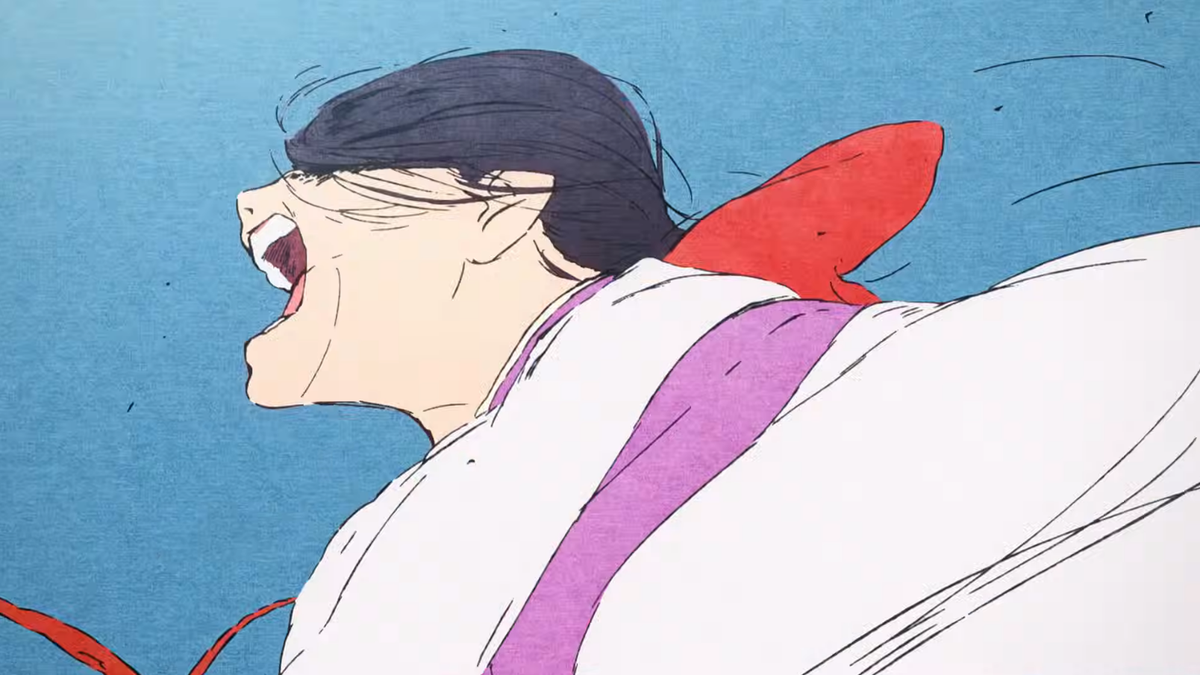
The World Is Dancing has been the only anime this year that has consistently given me goosebumps across its 13-episode run. Adapted from Kazuto Mihara’s completed six-volume manga and produced by Cypic with Shochiku and CyberAgent, the series takes the childhood of Zeami Motokiyo, the actor, playwright, and theorist who became one of the central architects of Noh (the Japanese dance-drama tradition), and reconstructs it as a coming-of-age story about a boy who cannot understand why anyone would devote their lives to dancing.Set in 1374, during the Northern and Southern Courts conflict in Japan, the story begins with Oniyasha, the childhood name of Zeami, as the son of Kan’ami, head of the Kanze troupe of Sarugaku performers, following his gradual transformation from an irritable, privileged prodigy into an artist capable of thinking about performance as something larger than his own talent. The production even appointed Noh performer Kohei Kawaguchi as Noh supervisor and historical specialist Katsuyuki Shimizu, while bringing in professional choreographers to aid animation staff.The World is Dancing (Japanese)Director: Toshimasa KuroyanagiCast: Yumiri Hanamori, Takahiro Sakurai, Shimba Tsuchiya, Maaya Uchida, Romi Park, Katsuyuki Konishi, Yōji Matsuda, Nobuo Tobita, Inori MinaseEpisodes: 13Runtime: 25 minutesStoryline: Oniyasha was a boy born in 1374 — a time of turmoil — to the leader of the Kanze troupe of Sarugaku performers; his everyday life was transformed when he encountered a truly magnificent danceA quick history lesson for context: the Muromachi period was a fertile mess for performance art, with the Sarugaku school of dance still evolving as its performers adapted and cannibalised whatever theatrical cultures around them had to offer. Kan’ami incorporated elements of the rival form Dengaku and other contemporary traditions into his own practice, laying the groundwork for the more codified form of Noh that his son Oniyasha would later refine. From the fourteenth to the fifteenth centuries, Noh gradually took shape from a stew of older Japanese and imported performance traditions, assimilating chant, music, acting, and rigorously arranged dance into its structure, with its iconic performance masks eventually becoming one of its most defining visual elements.Oniyasha therefore grows up alongside an art form that has yet to earn the prestige of “classical theatre.” In 1374, when he is twelve, erstwhile shogun Ashikaga Yoshimitsu (Takahiro Sakurai is an absolute delight here) sees him perform with Kan’ami in Kyoto and takes an interest in the boy and his father, thereby bringing the Kanze troupe into the orbit of shogunal patronage. The awkwardness is baked into Oniyasha’s position: he is a child performer whose face and body have suddenly become valuable to powerful men, and also an unwilling beneficiary of a patronage system that can leverage artistic favour as social currency. Oniyasha, being twelve and therefore possessed of the perfectly reasonable instinct to question why everyone is taking dancing so seriously, keeps poking at the whole enterprise with a question that becomes difficult for his father or anyone else from the troupe to answer: what exactly is any of this for? A still from ‘The World is Dancing’ | Photo Credit: Prime Video The crack in Oniyasha’s indifference comes through a destitute dancer he encounters in the first two episodes, whose performance leaves a much deeper impression on him than anything his father has taught him. She is physically exhausted, impoverished, and visibly unravelling, yet when she dances, all the frustration and humiliation that have accumulated around her suddenly find a form in the movement. Her feral dance is ragged, feverish and almost self-destructive, with the desperation of someone who has nothing left to preserve, and Oniyasha is transfixed because, for the first time, dancing looks like a very genuine act of expression. He wants to know how the body can say something the mouth cannot, and that curiosity becomes the first real spark of the artist he will eventually become. A still from ‘The World is Dancing’ | Photo Credit: Prime Video Cypic’s animation answers Oniyasha’s newfound curiosity with an extraordinary degree of formal prowess. For the unacquainted, Noh brings in moments that would look almost uneventful in a conventional anime, with long stretches of stillness and movement reduced to tiny shifts in posture, making it a particularly difficult art form to translate into animation, so Cypic really had their work cut out for them here.Still, the studio kept finding stunning new ways to draw dance. Translucent watercolour washes bleed into thick ink contours, calligraphic strokes suddenly slice through impressionist frames, and backgrounds periodically dissolve into petals, wind, rippling water, and other bursts of painterly invention, giving almost every dance sequence its own visual temperament and making the animation feel wonderfully alive without ever reducing itself to a single house style. The mid-season Sotoba Komachi sequence turns the stage into a gentle, moving painting of sorts as Oniyasha performs Kan’ami’s own play before Yoshimitsu. The later Shiokumi performance brings Oniyasha and rival patron Zojiro together for a Dengaku dance about two women gathering salt by the shore, with their synchronised movements gradually folding into one another. It is one of the prettiest visual ideas in the anime, turning a competition between the two young rivals into a dance that really works through the pleasures of collaboration.The animation was one of the first things people noticed when the series began airing, and it is easy to see why. Heavyweights like Witch Hat Atelier and Jujutsu Kaisen Season 3 have plenty of visual firepower. However, The World Is Dancing does more with less, making it one of the season’s real standouts. The dancing would lose a great deal of its impact without the music too, with traditional Noh chanting woven into Daisuke Shinoda’s beautiful score. The choice of music is immaculate throughout, often giving the performances a strange, almost ancient pull that the animation alone would likely not conjure. A still from ‘The World is Dancing’ | Photo Credit: Prime Video But the gorgeous audio-visual feast in The World is Dancing comes with some equally sharp ideas about art, especially how an artist can fundamentally shape a tradition without ever being able to keep hold of it. Zeami had already put a name to this centuries ago in Fūshikaden, where he uses the “flower” as a metaphor for the elusive quality that makes a performance come alive, while the idea of yūgen locates beauty in subtlety, suggestion, restraint, and everything left just beyond explicit explanation. The anime keeps returning to flowers as a recurring visual motif, attaching different flowers to emotional and artistic states. It’s a fitting motif to track the art form from bloom to decay.The final three episodes are consequently devastating because Oniyasha’s adolescent ennui returns just when he seems to have figured out what dance means to him, only now it has curdled into exhaustion and self-disgust. His final performance of Jinen Koji, the same piece tied to his father at the beginning, brings the story neatly back to its starting point, although Oniyasha has by then changed his relationship with the stage completely. He is no longer dancing to prove that there is something special about him and is finally learning to disappear into the work. It reminded me of how unignobly captivating I found last year’s Kabuki drama and Japan’s Oscar submission Kokuho, where I understood very little of the history or technicality of the other traditional Japanese performance art kabuki, yet still feel enraptured and entirely absorbed by the spell of the performance. That is ultimately what makes The World Is Dancing so transfixing. Great art has a way of outliving the person who made it, and sometimes that means the artist has to get out of its way. There is something so selfless and moving about losing one’s self to dance (which Daft Punk knew a thing or two about), and perhaps that is why The World Is Dancing feels like such a generous little gift of an anime.The World is Dancing is currently available to stream on Prime Video
‘The World Is Dancing’ series review: Lose Yourself to Dance
Full Article
Original Source
Read the full article at Thehindu →KhanList aggregates and links to publicly available news content. We do not host full articles from third-party sources. Always verify important information with original sources.