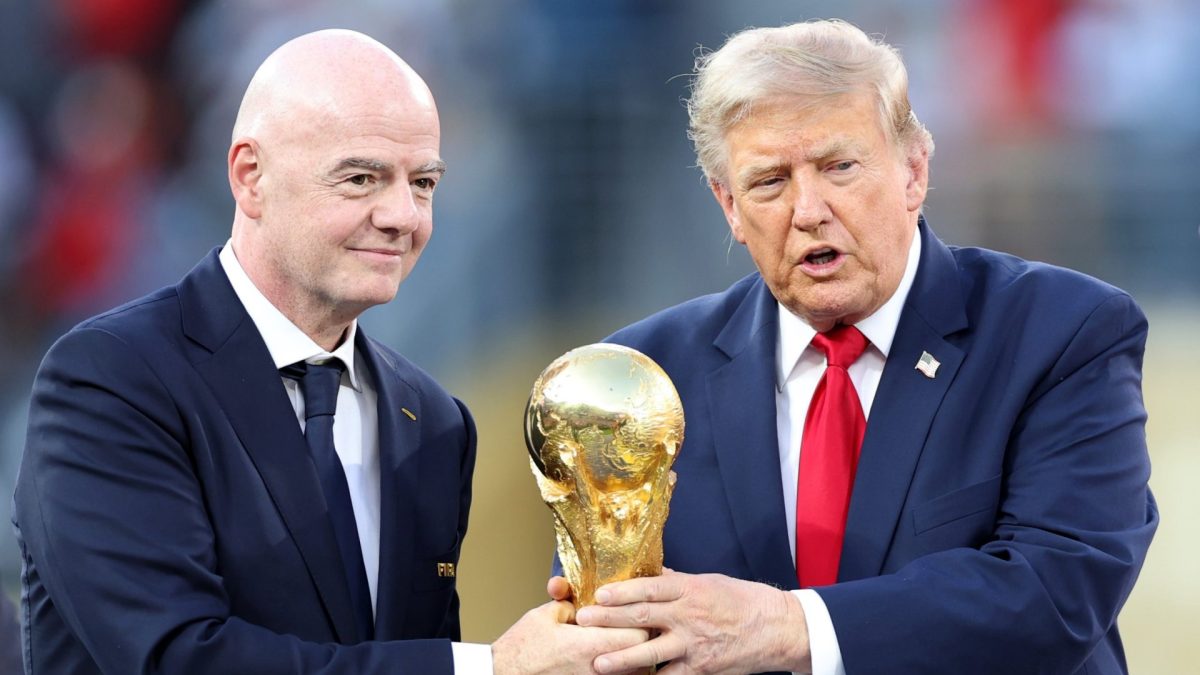
Gianni Infantino came to power because of a man called Chuck Blazer, a big, bouncy, bearded man who sounded as if he should have been Ted Lasso’s chairman at AFC Richmond. Blazer was Fifa’s most senior North American representative who accepted bribes of $11m to vote for Morocco and South Africa’s bids to stage the 1998 and 2010 World Cup. His arrest for this and many other things led to Sepp Blatter’s downfall and Infantino’s arrival as the new reforming president. There are two interesting things about Blazer. One was that Fifa was and is a not-for-profit organisation. The other is that he had three sumptuous apartments in Trump Tower. One for his offices, the other for himself and a third for his cats. Sepp Blatter claims their close relationship ‘is deeply damaging football’ (Photo: Getty) Now, with the revelation that Fifa plans to sell stakes in a company that would run the World Cup, the “not-for-profit” bit has been shunted aside and the values of the family that own the Trump Tower are nakedly front of stage. The money that stands to be made from selling stakes in the World Cup to private investors – with the brother of Trump’s son-in-law Joshua Kushner’s Thrive Capital to the fore – would dwarf the cash dear old Chuck was able to pocket before the FBI came knocking. At the head of this company is likely to be one Infantino who might expect to be paid 200 times more than the $227,000 he would earn as secretary-general of the United Nations, a job President Trump was recently touting him for. Today, Uefa is presenting itself as the great obstacle to Infantino’s proposal. A boycott of the World Cup would wreck it entirely, but a boycott is unlikely to happen since the next tournament will be staged mostly in Spain, who are world champions. The Spanish government has estimated the 2030 World Cup would bring between €7-8bn into its economy and create 170,000 jobs directly or indirectly. Unemployment in Spain has been around 2.5m for nearly 20 years. Spain is not going to vote for a boycott. The best sanction Uefa has is to boycott the Club World Cup, which it instinctively dislikes because it challenges its own overblown Champions League. If Infantino’s scheme were just a story about millionaires becoming billionaires, it might not carry so much resonance. However, the only way these millionaires will become richer is by further debasing the greatest sporting show on the planet. As Infantino pointed out amid complaints about ticket prices for group games being measured in thousands of dollars, the World Cup is virtually the only thing Fifa does. It is certainly the only thing that makes it money, which the Club World Cup did not. Cape Verde are up there among the greatest World Cup underdogs (Photo: Getty) There are just two routes to ramp up Fifa’s already enormous income. One is by expanding the competition to 64 teams, creating more matches, more advertising, more broadcast rights. The other is by staging it more frequently. There is a case for expansion. The joy of Cape Verde almost holding their own against the eventual finalists Spain and Argentina this summer would not have been possible without a 48-team tournament. There were, nevertheless, eight nations who qualified for the 2026 World Cup who would not have done so under the old format. In 29 games they managed a single win– and that was when two of them, DR Congo and Uzbekistan, played each other. The direness of the entrants for a 64-team tournament can be imagined. Who knows? Even Italy might make it. The South American federation Conmebol is pushing hardest for expansion, mainly because only one of its 10 members would not qualify. A 64-team tournament would also raise a projected $2.5bn more in broadcast revenue compared to the 32-team affair in Qatar. The 1970 tournament in Mexico, widely regarded as the greatest ever, had 16 teams. It raised less money yet produced infinitely more memories. It was Blatter who first proposed a World Cup every couple of years. It would earn the investors in Infantino’s new company astonishing sums, but the price would be enormous. The allure of the World Cup is its rarity, the thought you might not see the likes of Lionel Messi ever again. Well, hold on a couple of years and here he is once more along with his very marketable chums, Kylian Mbappe, Harry Kane and Lamine Yamal. The allure of sport is that one mistake, one ill-judged putt, one well-directed punch, one beautifully-timed shot can change everything. It is called jeopardy and what football has done is to remove jeopardy from its contests as much as possible. The 1970 World Cup had 24 group games. Its distant 2026 cousin ran to 72. Qualification is ever more straightforward, finishing third in your group is not necessarily fatal and if there is a superbly worked goal scored against you, VAR might detect a foul in the build-up play. As a safeguarding measure, Fifa points out that every member will have a share in the World Cup company, but these shares can be sold. So, you are Gambia, with perhaps the lowest turnover of any African federation with no chance of qualifying, and you can sell your share to whoever. Read more Kevin Garside: Dear Gianni Infantino, meditate on this On The Road: 101 things I learned by driving 7,835 miles across Trump’s America Someone or somebody who might want World Cups staged every two years in nations like Saudi Arabia who will pay dazzling upfront sums or who like the United States can maximise every scrap of economic potential. In 1962, Chile staged the World Cup two years after being laid waste by an earthquake. The Chilean delegate to Fifa, Carlos Dittborn, promised: “Because we have nothing, we will do everything.” Countries who have nothing have long been of no interest to Fifa and this proposal makes it official.
The World Cup’s very existence hangs by a thread
Full Article
Original Source
Read the full article at Inews →KhanList aggregates and links to publicly available news content. We do not host full articles from third-party sources. Always verify important information with original sources.