
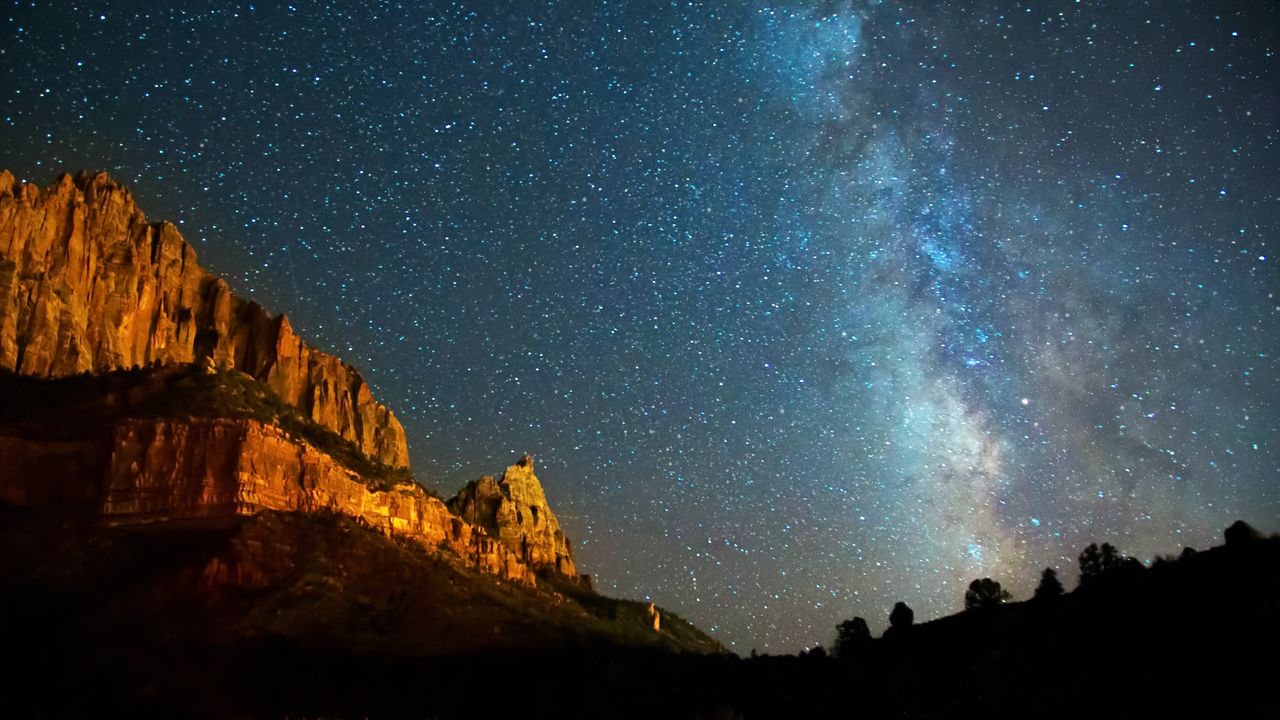
Once the sun goes down and the crowds disperse, nature comes alive. On a trip to Southern Utah, writer Jamie Spain finds a new way to see America’s parks after dark.GettyI’ve spent the majority of my life doing outdoor activities: camping, hiking, biking, kayaking, you name it. It’s intrinsically part of who I am, something that defines my siblings and I so deeply it feels like it’s braided into our DNA.Perhaps that’s because, when I was just two-and-a-half years old, my parents took my siblings and me on a two-month-long road trip from New York to Arizona, hitting dozens of state and national parks on the way. We still talk about that adventure, lovingly referred to as the Out West Trip. It was the first time I visited Utah’s national parks, known as the Mighty 5: Zion, Arches, Canyonlands, Capitol Reef, and Bryce Canyon.Once night falls in Utah's national parks, most travelers head back to their campfires or motor lodges—except for those willing to brave the dark and explore their nocturnal side. GettyA lot has changed since I first visited. Now, millions of visitors head to Southern Utah every year, flocking to these five well-known national parks in addition to the whopping 46 state parks across the whole of Utah. Even in the staggeringly hot and dry summer season, these protected areas teem with tourists from all over the world—Zion alone reported over 1.4 million visitors in June, July, and August of 2026, while Arches reported over 445,000 in the same season.Once night falls in the Utah desert, though, the temperatures cool off, most tourists head back to their campsites and motor lodges, and the stars shine through that clear desert sky. All of the Mighty 5 are certified dark sky parks—Utah, in fact, boasts the highest concentration of certified International Dark Sky Places in the world. So maybe it's no surprise that, in recent years, these destinations have embraced night-centric recreation, showcasing a lesser-known version of themselves for those willing to brave the dark.In Capitol Reef National Park, the The Temple of the Sun summit stands against a sky full of stars. GettyIt's why, nearly 30 years after my first Utah park trip, I decided to return—this time, experiencing Southern Utah’s state and national parks once the sun set. I’m a night owl, but I also wanted to revive that sense of wonder I felt so long ago when I first visited. I knew the parks by day, but by night? They were brand new to me. And so, in late September, my friend Sarra and I plotted a week-long road trip linking four national parks and three state parks in Utah. Our goal was to take it easy during the daylight hours with a gentle hike or two, and store up our energy for a nocturnal expedition come sundown. We wanted to get to know Utah’s parks in a way that too few do.The sun sets in Capitol ReefIt’s 9 p.m. when we walk into Capitol Reef National Park with hiking guides Samuel and Suzanne Francis, the married owners of Western Whiptails Adventures. The sun has set by a couple hours; my friend and I rely on flashlights, while our guides trust themselves in the dark. As we begin on the trail, I’m struck by the silence surrounding us, serene in a way I’ve experienced only in the redwoods, where the massive trees cradle you against human noise; by day, the stone of Utah’s parks almost reverberates with the many overlapping voices of the crowd. Now, there is no sound left to bounce.The view of the Hickman Bridge in Capitol Reef National Park at midnight. Jamie SpainOur goal is to hike to Hickman Bridge, a natural sandstone arch—completely in the dark. It’s a 1.8-mile round-trip that begins with an initial climb on switchbacks, flattens out in the middle, and then resumes a narrower uphill path with a bit of a scramble required to reach the view. It’s a hike that should take about 1.5 hours in daylight. Sam says he and Suz have led hundreds of guided tours throughout the park and surrounding public lands, but nothing quite like this. “Capitol Reef’s landscape takes on an entirely different character at night,” he says.I feel the ground under my sneakers shift from hard-packed dirt to softer sand as we set out, and the herbal scent of pinon and Utah juniper trees tickles my nose. We’re surrounded by dust and desert, but the area feels alive with the chirping of bugs and rustling of leaves.Suz leads us to little-known petroglyphs, then points out a site where the Fremont people once stored corn. Sarra and I shine our flashlights and look on in admiration. It’s a respite in the adrenaline-pumping stretch of the hike—we have gained a couple hundred feet of elevation, and I am imagining the drop-offs that I’m quite sure lie beyond the tiny circle of my flashlight. My grip gets tighter and I begin to sweat through my layers, realizing that the dark can't quiet my fear of heights. Suz is up ahead, climbing like it’s second nature: “If you turn your flashlights off, your eyes will adjust,” she says, turning back. I laugh, knowing there's no way I can get myself to follow her advice.The nearly full moon directly over the sandstone summit in Capitol Reef National Park Jamie SpainA hard-to-find petroglyph site in Capitol Reef National Park Jamie Spain“Many animals in Capitol Reef are nocturnal or crepuscular, especially during warmer months,” Sam says, listing off the species we share the night with as we plod on. “Bats, kangaroo rats, desert cottontails, foxes, desert bighorn sheep, mule deer, or even the rare ringtail.”Once we reach flatter ground, I concede to turn off my light, blinking to let my eyes adjust. I realize the nearly full moon above is blindingly bright—and yet we can still make out hundreds of glittering stars sharing the sky. “The darkness really offers a unique connection to the landscape,” says Sam. I can't help but agree.And then we finally catch sight of the stone bridge, bathed in moonlight and backlit by stars, appearing especially mammoth in the low light. We sit beneath it, the silence wrapped around us, the space above looking unimaginably infinite. “I’ve seen this bridge plenty of times during the day,” says Suz, agreeing with me, “but at night, it's even better.”The starry sky shines over Dead Horse Point State Park, where after-dark activities include scorpion spotting and stargazing. GettyNight crawlers in Dead Horse PointWhile Capitol Reef's night hike was nothing short of thrilling, another type of excitement awaits us at Dead Horse State Park. The park is known for its dramatic red-rock canyon vistas and hiking trails that cross them—and yet the evening programming is just as robust, with scorpion searching, stargazing, sunset walks, and astronomy talks all included in the $20 entrance fee. Unlike Capitol Reef, where we were possibly the only visitors on the grounds that night (despite it being open 24 hours), Dead Horse is known for its nocturnal programming (much of which begins around 8 p.m., and runs until the park closes at 10). According to Ally O'Rullian, public information officer at Utah State Parks, Dead Horse Point naturalist programs have “likely included dark sky viewings” since as early as the mid 1970s, and this new slate of activities was added to the regular calendar in 2015 as part of its application for International Dark Sky status. We are far from the only ones out tonight—it feels as though this is how the Dead Horse is meant to be appreciated.A group of travelers gather around a state ranger as they prepare for a scorpion search Jamie SpainWe've opted to go scorpion searching, which is exactly as wacky as it sounds. Scorpions are biofluorescent, meaning they emit a visible bluish glow under UV lights. And so we gather at the Visitor Center, where ranger Jimmy Burch is handing out special flashlights. This is one of the most popular activities at the park, Burch says, and perhaps unsurprisingly, the one with the greatest youth turnout. We do feel like kids, as our group of a dozen or so of all ages start down a gentle, meandering path, shining our torches on brush and rocks to see if we can find anything hiding among them. Shine a UV light directly on a bush with a scorpion in it, Burch says, and it would be nearly impossible to overlook the glowing body within. “If you hear hissing, step away,” he cautions, as we sweep the area. Burch assures us that no one has ever been stung on one of these walks.We are nearing the end of “scorpion season” in late September, as the weather is getting too cold for the critters to wander freely. In winter, scorpions enter a low-activity state and hide in dark, quiet locations, like underground burrows, conserving their energy against the cold. I wonder if that means we won't see much—but then, after just a few minutes, a boy in my group begins to call out, “Scorpion, scorpion, scorpion!” Burch heads over, congratulatory as he crouches down a few inches away from the tiny, glowing arachnid. The rest of us follow, taking turns leaning closer to take in its luminous body, just a few inches long. It turns out that scorpions are perfectly happy to hang out under the UV light, surrounded by a large group of people taking photos. It doesn't move a single muscle as we pap it in awe.Setting up kayaks at the edge of the Sand Hollow State Park reservoir, just as the moon begins to rise Jamie SpainJaw-dropping colors appear in the sky over Sand Hollow State Park and its reservoir. GettyMoonlight paddling in Sand Hollow State ParkReady for something a bit calmer, we make the early morning drive to our final destination: Hurricane, Utah—about 25 miles away from Zion National Park, and home to the lesser-known Sand Hollow. Initially, we had plans to do nocturnal canyoneering in Zion, but when the weather turned, it gave us permission to settle into a slower place.For the past two years, Sand Hollow State Park—known for its large reservoir set against red-rock cliffs—has been offering a monthly full-moon paddle in the warmer months, to complement the hiking and biking trails that families enjoy year-round.The paddle is only available from April through September (depending on the weather) and starts at moonrise—which is just after 7 p.m. for us, when our group meets ranger Callie Mallow on the shore of the reservoir. Just on the other side of sunset, the sky still has tinges of light to it, and we can hear the gentle chatter of dozens of other people who are still swimming, fishing, and hanging out on the water's edge as we pull our kayaks into the water. The park is open until 10 p.m., and those accompanied by a ranger can stay even later. I feel as though I'm at an after-hours summer camp, as I notice the people on piers, jumping in the water, and sitting at picnic tables nearby.Two kayaks at the edge of Sand Hollow State Park reservoir at the end of the moonlit paddle Jamie SpainThe night is relatively warm, as we make the gentle paddle out. We take pauses to float and listen to history; Mallow points at an island in the middle of the water: "a family of raccoons lives there", she tells us.We let our kayaks rest when we near the isle, collecting among the rippling water to watch the moon continue its rise. I hear the water brushing against my kayak, and realize my eyes are now more used to navigating these wild spaces in the absence of the sun.Our group is substantial. Sometimes there will 30 kayaks or paddleboards on the water at a time, Mallow says. “The moonlit paddle is pretty popular,” Mallow tells us from her own kayak, as we circle the island. "We hope programs like these both spark adventure and curiosity in visitors, and encourage neighbors to fall in love with their backyard.” As we navigate the water, we come across night fishers and a swimmer (“people train for the Ironman here,” says Mallow). I wonder if the scuba divers who were on the shore when we pushed off were entering or exiting. Before this trip, my imagination couldn't have fathomed so many ways to experience these lands after sunset.As parks get increasingly crowded, I have to wonder if nighttime adventures will become a part of my regular routine. There are always new ways to discover America’s national and state park system—and now, I know that darkness can make even the most familiar places feel like a whole new world. Once you get past the fear of it—the dark, the height, the critters—you are free to soak up the feeling of being so small against the endless night sky, amazed by all the life that continues even once the sun has gone down.Jamie Spain is Condé Nast Traveler's Travel Bookings Editor where she covers hotels, stays, and deals. She currently lives in New York City and has been in the industry for over six years, previously covering entertainment, lifestyle, and product reviews. You can find her past work in Good Housekeeping, People, ... Read More
The Wonder—and Weirdness—of Exploring a National Park in the Dark
Full Article
Original Source
Read the full article at Cntraveler →KhanList aggregates and links to publicly available news content. We do not host full articles from third-party sources. Always verify important information with original sources.