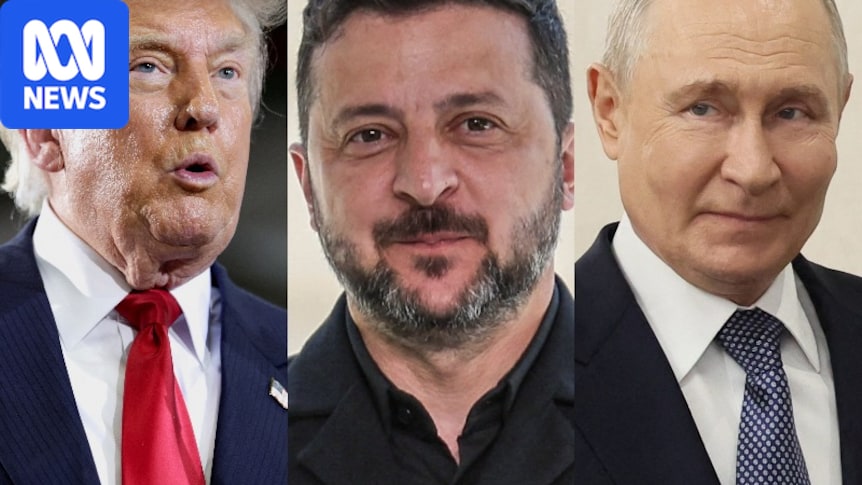
A large inland sea connecting military supply lines through Russia and Iran could now be a pivotal theatre for two major wars that are usually thought of as separate.Over the weekend, Kyiv's main domestic intelligence agency, the SBU, said Ukrainian drones hit a Russian missile boat as well as two cargo ships in the Caspian Sea that "were under international sanctions and were used to transport military cargo between Iran and Russia".Iranian officials immediately disputed the assertion, saying Ukraine hit a commercial vessel carrying iron and killed one sailor.As the two sides fought over the origins of the targeted vessels, Iran's foreign ministry spokesman Esmail Baghaei vowed revenge and summoned Ukraine's top diplomat in Tehran in protest, in what appeared to be a sign of the two wars colliding in a new front.A satellite view of the Caspian Sea, a major inland lake bordered by five countries including Iran and Russia. (Supplied: NASA Earth Observatory)For more than five months, global attention has been focused on another Middle Eastern waterway, the Strait of Hormuz, as the Iranian regime threatened freedom of navigation of commercial ships and placed pressure on the world's energy markets.But analysts say the latest attacks in the Caspian Sea indicate the Ukraine war and the Iran war are not isolated theatres, but parts of an "emerging Eurasian conflict system in which Russia and Iran are mutually dependent".And it is through a 371,000-square-kilometre area that those two conflicts intersect, Basil Germond, professor of international security at Lancaster University, told the ABC.The Caspian Sea is the largest landlocked body of water in the world and is bordered by Russia, Azerbaijan, Turkmenistan, Kazakhstan and Iran.Because of its geographical position, it is often out of reach and off the radar of most of the world, but historically it has been an important East–West trading route, dating back to Imperial China and the Silk Road.Russia has long used it as a platform for "long-range power projection" and as a sanction-immune bridge to its ally, Iran."This sea is not a sea where Western powers can really exercise any form of leverage," Professor Germond said.Since Moscow's full-scale invasion of Ukraine in 2022, the Caspian Sea has become even more important as a "safe haven" for Russia's Black Sea-based naval forces to relocate after major attacks.But Ukraine's intervention over the weekend has likely shattered the assumption of safety in the inland sea.Analysts say Kyiv's ability to project more than 692 kilometres from Ukraine's nearest border into Russia and Iran's "safe space" indicates the two conflicts remain in danger of colliding and escalating.And with the Caspian Sea now in play, what happens in this theatre next could have ramifications for not just one war, but two.Why Ukraine is targeting IranTensions between Iran and Ukraine have existed for some time and largely centre around Tehran's support for Russia's military campaign.Russia has developed strong ties with Iran during its war with Ukraine. (Reuters: Sputnik/Vyacheslav Prokofyev)Since 2022, Iran has supplied lethal long-range attack drones that Moscow has used to degrade Ukraine's air defences and target its power and water infrastructure.The supply of these crucial weapons, called Shaheds, has been facilitated via the Caspian Sea through Russian and Iranian ports."The import of drones or drone components from Iran [through the inland sea] up until quite recently was considered as a safe route," Professor Germond said."But that has changed now."Russia has since developed its own version of the drones with special enhancements, and begun manufacturing them in-country, making it less reliant on Iranian drone shipments.But the collaboration between the two nations is not limited to one side. In exchange for Iran's equipment, Ukrainian President Volodymyr Zelensky has accused Russia of providing Tehran with satellite surveillance of Gulf states and US military bases in the region to help it coordinate attacks."It's clear that the two countries are collaborating militarily," Professor Germond said."Being able to rely on its allies [Iran] is instrumental in enabling [Russia] to continue their war and also to sustain their war economy."By targeting the Caspian, however, Kyiv is attempting to disrupt that partnership and distract its enemies by forcing them to divert their much-needed war supplies to other areas."If Ukraine is targeting Russian or Iranian assets in the Caspian, then the Russians, and the Iranians for that matter, have to reallocate air defense systems in the Caspian. So then they can't use that elsewhere," Professor Germond said.Yet after the attacks, Mr Zelensky said Ukraine should avoid actions that could open an additional front in the space."We must be careful. We must do everything to ensure that under no circumstances do we open a new front, but we must be honest. The Iranians and the North Koreans have already attacked us," he told Sky News.He warned Ukraine would be prepared for any development from Iran.The Caspian Sea might be in the global spotlight because of Ukraine's recent strikes, but it has been targeted before.Last August, Ukraine conducted a long-range drone attack on a supply ship in the Caspian port of Olya, which it claimed was loaded with drone components and Iranian munitions.And in March, Israel targeted dozens of Iranian assets along the Caspian coastline, including missile boats, a shipyard used to build and repair vessels, and a command centre."What Ukraine is trying to do is to show that they can exercise … [a] type of leverage there, because if vessels in the Caspian think it's too dangerous, if there are many attacks, then the two countries, Russia and Iran, will have to rely on a terrestrial route that's less good for many reasons," Professor Germond said.If the tactic sounds familiar, it is because Tehran has used a similar strategy with great effect in the Strait of Hormuz.Ukraine's strikes fell on the eve of Mr Zelenskyy's visit to the United States, and Professor Germond said the timing of the two events is significant and may have been designed to generate support for Kyiv within the Trump administration.Ahead of his visit, Mr Zelenskyy had warned of Russia and Iran's close military collaboration and told Sky News that Tehran had been responsible for transferring new technologies to Moscow."I think in the current context, it's quite obvious that it's a way to demonstrate to Trump that the winner is Zelenskyy, not Vladimir Putin," Professor Germond said."Zelenskyy is currently managing to convince Trump that he's the strong man, and that's important because Ukraine still depends on weapons and support from the West in general, the US in particular," Professor Germond said.Volodymyr Zelenskyy (left) relies on military aid from Donald Trump and the US. (Reuters: Jonathan Ernst)The Ukrainian leader met with Mr Trump on Tuesday, local time, and said the two leaders discussed securing more air defence capabilities for Kyiv and "several other ideas that could help".Russia's economic lifelineFor some time now, technologies and materials relevant to sustaining both Iran and Russia's war economies have moved through the Caspian Sea.That is partly because it is insulated from Western sanction pressure, with a treaty of cooperation struck between the five countries that border the Caspian stipulating that no nation can grant entry to third-party military assets."It means that none of those countries around the Caspian Sea is allowed to ask, for example, the US to send military assets to the Caspian. It wouldn't be legal," Professor Germond said.The Caspian Sea therefore functions as a critical node for Russia and Iran."For Russia, because of the sanctions since the beginning of the war in Ukraine, the Caspian Sea has become more important for trade. And for Iran, it's the same," Professor Germond said.For its part, Iran has vowed Ukraine's attack will not go unanswered.In a post on X, Iranian Foreign Minister Abbas Araghchi called the strikes on ships "a blatant UN Charter violation" and claimed it had been "done at Israel's behest to drag Europe into its war". He offered no evidence to support the allegation.Mr Araghchi said he had also discussed the incident with both the European Union's top diplomat Kaja Kallas and Russian Foreign Minister Sergey Lavrov.He said he made clear that Ukraine's action "cannot go unanswered".
'The winner is Zelenskyy, not Putin': The inland sea where two wars collide
Full Article
Original Source
Read the full article at Abc →KhanList aggregates and links to publicly available news content. We do not host full articles from third-party sources. Always verify important information with original sources.