
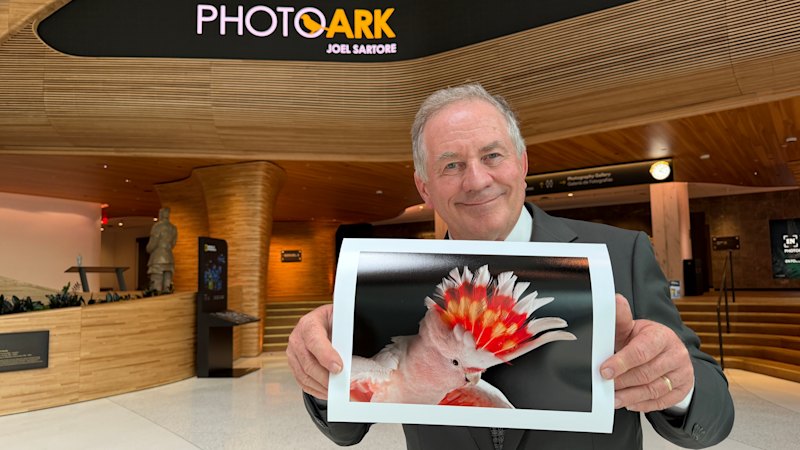
Fifteen years after National Geographic photographer Joel Sartore walked into a Sunshine Coast parrot sanctuary with a camera, he laid his eyes on the Brisbane 2032 Olympic Games emblem.Little did Sartore know, as he aimed his lens at a pink cockatoo called Cindy, that his photograph would one day help launch a global brand.The connection to the bird he snapped in the Glass House Mountains in 2011 was unmistakable from the moment he saw the Brisbane 2032 emblem last week.“When I saw it, I thought ‘I get it, I get it’ – it looks like fire, it looks like something that’s organic and wild,” Sartore says.“I just thought that it’s smart. I loved it – I just loved it. But, of course, I’m a little biased now.”The Brisbane 2032 Olympic emblem, inspired by Cindy.Brisbane 2032This masthead spoke to Sartore when he was in Washington DC, where his Photo Ark: Animals of Earth exhibit was showing at the National Geographic Museum of Exploration.The following day, Sartore was due to head to the Mexican border to document even more species, but not before he reflected on the inadvertent role he played in inspiring a new global brand.“It’s really incredible. First, the Animals of Earth exhibit here at the Geographic, which is wonderful, and now this. I’m very blessed and lucky, and I’m really curious how that came about,” he says.“I wish my folks were alive to see this – they’d think I’d made good.”Sartore was shown the Olympic emblem last week, after National Geographic was alerted of the role he played in its development.“Somebody asked me what I thought it looked like and I said it looks like a cockatoo that’s cresting,” he says.“I was ready to move on. But then they said ‘You know, that’s based on the cockatoo you shot in Australia years ago.’ I’m like, seriously, wow!” he says.Sartore clearly remembers the photo shoot at Parrots in Paradise – a side quest when he was on assignment for a National Geographic feature on koalas.While in Australia, Sartore took the opportunity to work on his Photo Ark project – a quest to document as many of Earth’s species as possible.It was then he met Parrots in Paradise founder Dail Martins.“I went there on a rainy day and she had nobody there,” Sartore says.“She was just so generous with her time, and she brought her birds out. I photographed all the ones I needed in this thing set up in her backyard under a tent cover, under a canvas.”Among those birds was Cindy – a gregarious pink cockatoo with a flair for modelling.“The way she was leaning in, she really liked [Malins] – a lot of people that handle parrots like that, they can talk to their birds and trigger that cresting of those feathers,” Sartore says.“Just a beautiful bird, everything about her.”“She really was a sweetheart,” Malins says of Cindy.Sadly, Cindy died last year. Malins guessed she was about 30 years old, but could not be certain.Dail Mailins’ mother and husband, Betty Mailins and Mark Skudder, pictured with Cindy.Dail MalinsWhat she did know was that Cindy entered their lives in 2000, as Parrots in Paradise evolved from an idea to reality.“There was a guy selling two birds and I was after an Alexandrine,” Malins says.“We arrived at his place, and there was two very small, pristine little cages: one perch, one food bowl and one water bowl at either end – nothing else, absolutely nothing.“Nothing to amuse the birds. Nothing to make them interested.“We bought the Alexandrine and as we drove away, I said to [husband] Mark, ‘We can’t leave it there – we’ve got to go and go back and get her’.“So we did. That’s how Cindy came to us. She was a sweetie.”Cindy at Parrots in Paradise.Dail MalinsA sociable bird too, Malins says.“She loved my husband. She loved showing off to people every time somebody came in,” she says.“She’d step up on their hands, flick out her wings and throw a crest out. She loved the people.”Malins says everyone at Parrots in Paradise was “absolutely blown away” by Cindy’s involvement in the Olympic emblem design process.“We get very excited when anything happens here,” she says.“To realise our little lovely Cindy that we’ve known so long is the poster girl for 2032 is really special.“She was lovely and everything about her was great.”Cindy was photographed as part of Sartore’s 30-plus-year Photo Ark project—a global quest to document every species in human care using plain studio backgrounds.“To date, we’ve photographed nearly 19,000 species this way using black and white backgrounds and studio lighting,” he says.“By using this technique, we give all animals an equal voice because there’s no size comparison. A mouse and an elephant are the same size in these pictures.”While hard to quantify Photo Ark’s success in raising awareness, Sartore says there have been some tangible, positive results for conservation – including here in Australia.He pointed to the impact of his photography of the red handfish, a Tasmanian species that has a higher population at a breeding centre in a Hobart university than in the wild.“When we named that our 18,000th species, the folks in Tasmania got a hold of us and said featuring that fish as a milestone species helped save their breeding efforts, because they didn’t know where their funding was going to come from next,” he said.“They heard from people all around the world that wanted to help support them – that’s a big win for us because it doesn’t happen near nearly often enough.”The project typically keeps Sartore away from his Nebraska home for half the year.“In terms of captive species, there’s probably 30-to-40,000, because things change a lot, especially at aquariums and rehabbers,” he says.“In terms of the numbers of animals in the wild, there’s about 1.5 million described now.“I like to say we’re just getting started.”Start the day with a summary of the day’s most important and interesting stories, analysis and insights. Sign up for our Morning Edition newsletter.
The winner is Cindy: The story behind Brisbane 2032’s emblem inspiration
Full Article
Original Source
Read the full article at Smh →KhanList aggregates and links to publicly available news content. We do not host full articles from third-party sources. Always verify important information with original sources.