
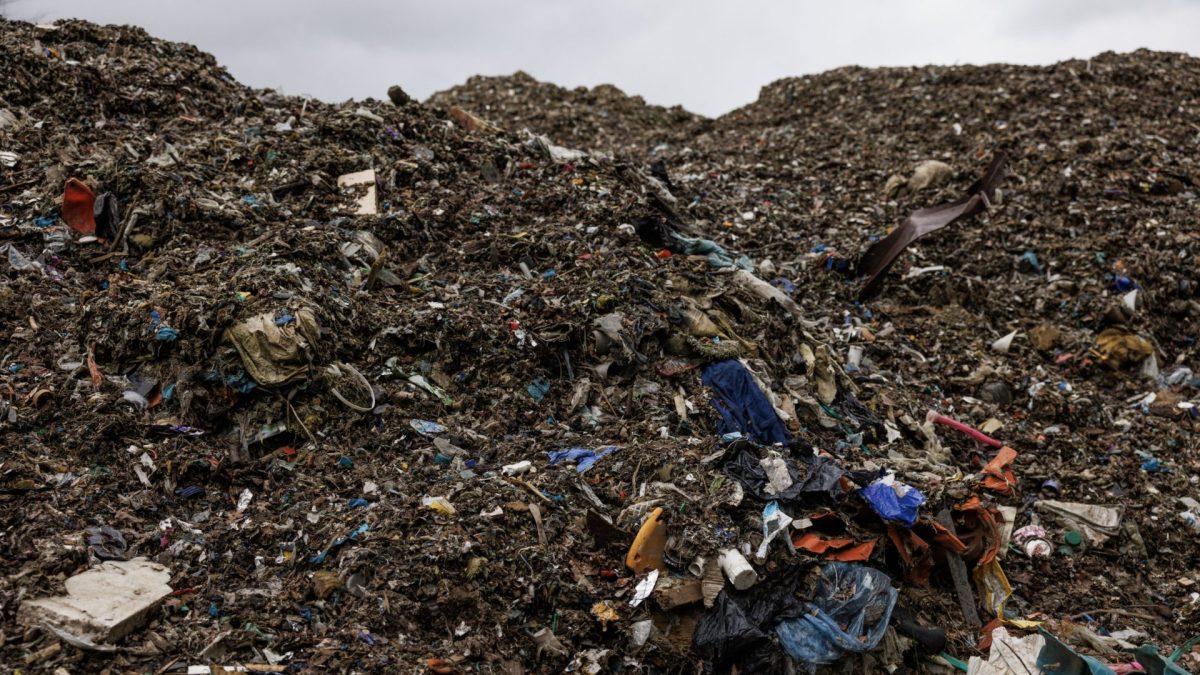
Deep inside an ancient woodland in Kent lies a vast clearing of barren land. Trees have stood at this site for centuries, but now lie dead across the floor. Until recently, this was the scene of one of the UK’s most notorious illegal waste dumps. Behind the trees, criminals created mountains of toxic waste that rose as high as 15 feet. The site has now been cleared as part of a £15m clean-up operation by the Environment Agency (EA), which has removed 39,500 tonnes of household, commercial and medical waste in the past year. It’s part of a crackdown on a growing organised crime industry that is estimated to be costing England’s economy £1bn each year. Half of this is borne by the public purse, either through clean-up costs or lost revenue from taxes. ‘We’re seeing more organised crime’ The term waste crime covers a range of offences, from small-scale fly-tipping to larger operations where criminals pose as legitimate businesses that collect waste for a fee, but then dump it illegally rather than paying to dispose of it properly. This type of crime is not new, but is becoming more organised, sophisticated and profitable. “The nature and the scale of waste crime has changed quite a lot in the last five years or so,” said Matt Higginson, an environment officer at the EA who has overseen the clean-up at the site in Kent, known as Hoad’s Wood. “We are seeing more organised crime getting involved in it so that provides a greater challenge to the Environment Agency,” he said. Almost 40,000 tonnes of waste were cleared from Hoad’s Wood, but it will never be the same (Photo: Dan Kitwood/Getty Images) Matthew Scott, police and crime commissioner for Kent, told the House of Lord’s environment and climate change committee last year there was “absolutely no doubt” that organised crime networks, including individuals involved in modern slavery and drug dealing, were involved in large-scale waste crime. “These are people who are well versed in organised crime, and I believe that they act quite freely because they do not fear consequences,” he said. Authorities struggling to get a grip For several years authorities have struggled to get a grip on this growing underground industry. Illegal dumping in Hoad’s Wood was first reported to the EA in 2020, but the clean-up did not start until five years later. There was a significant increase in the levels of waste at the site around 2023, at which point the EA and Kent Police launched a joint investigation. Three men were arrested in February last year, but no one has been charged as of yet and the investigation is ongoing. It took years of campaigning by locals and environmental groups to bring the issue to light. “It was a long time between the site being cleared and actually getting some response from the Secretary of State and the government bodies that were required to deal with this. For somebody to actually put their hands in their pocket and say ‘we will sort it out and get the site back to how it should be’,” said Ian Rickards, area manager at Kent Wildlife Trust, which was involved in the campaign. New government crackdown A number of high-profile waste crime incidents have pushed the issue up the agenda, including a site near Kidlington in Oxfordshire that hit the headlines last year. Shocking images of mountains of rubbish over 30 feet high caught the public’s attention, prompting a response from ministers. The EA has now been given an additional £45m over three years to hire more enforcement officers and pay for technology such as drones to identify problem sites. The Kindlington site by the River Cherwell helped prompt a government crackdown on waste crime (Photo: Carl Court/Getty Images) But the scale of the challenge is huge; the EA told Parliament in December that hundreds of new illegal waste sites are created each year. The watchdog currently has a list of 114 “high-priority waste sites”, 15 of which are as large or larger than Hoad’s Wood. While the £45m will pay for additional enforcement, there’s also the question of who will pay to clean up these sites. Technically, it’s a landowner’s job to pay for waste to be removed from their land. Hoad’s Wood is one of a small number of supersites that the EA is paying to clear up, alongside Kindlington. Environmental damage While Hoad’s Wood is now cleared of rubbish, the environmental damage will likely never be reversed. Rickards described the land before as “thick, dense woodland with birdsong and animal life” that was “quickly converted into toxic wasteland”. The site is an ancient woodland, meaning it has existed since at least 1600, however Rickards said there had likely been trees on the site since the last ice age. This kind of habitat cannot easily be recreated. A patch of barren land has been left behind following the Hoad’s Wood clean-up (Photo: Environment Agency) “That takes hundreds of years of development of subtle things like how the fungi and mycorrhiza develop through the soil. The vegetation and plants and invertebrates are part of the soil. They don’t turn up overnight,” he said. The EA is doing some things to restore the site, including leaving felled trees to rot and release their nutrients back into the ground. Rickard said an interesting new habitat could emerge in the coming years if the site is left to recover in this way, however, it will be different to what has been lost. “None of my generation or the next generation are ever going to see that pure, true ancient woodland developing in there,” Rickards said.
The wildlife sites drowning in toxic rubbish to make criminals rich – at our expense
Full Article
Original Source
Read the full article at Inews →KhanList aggregates and links to publicly available news content. We do not host full articles from third-party sources. Always verify important information with original sources.