
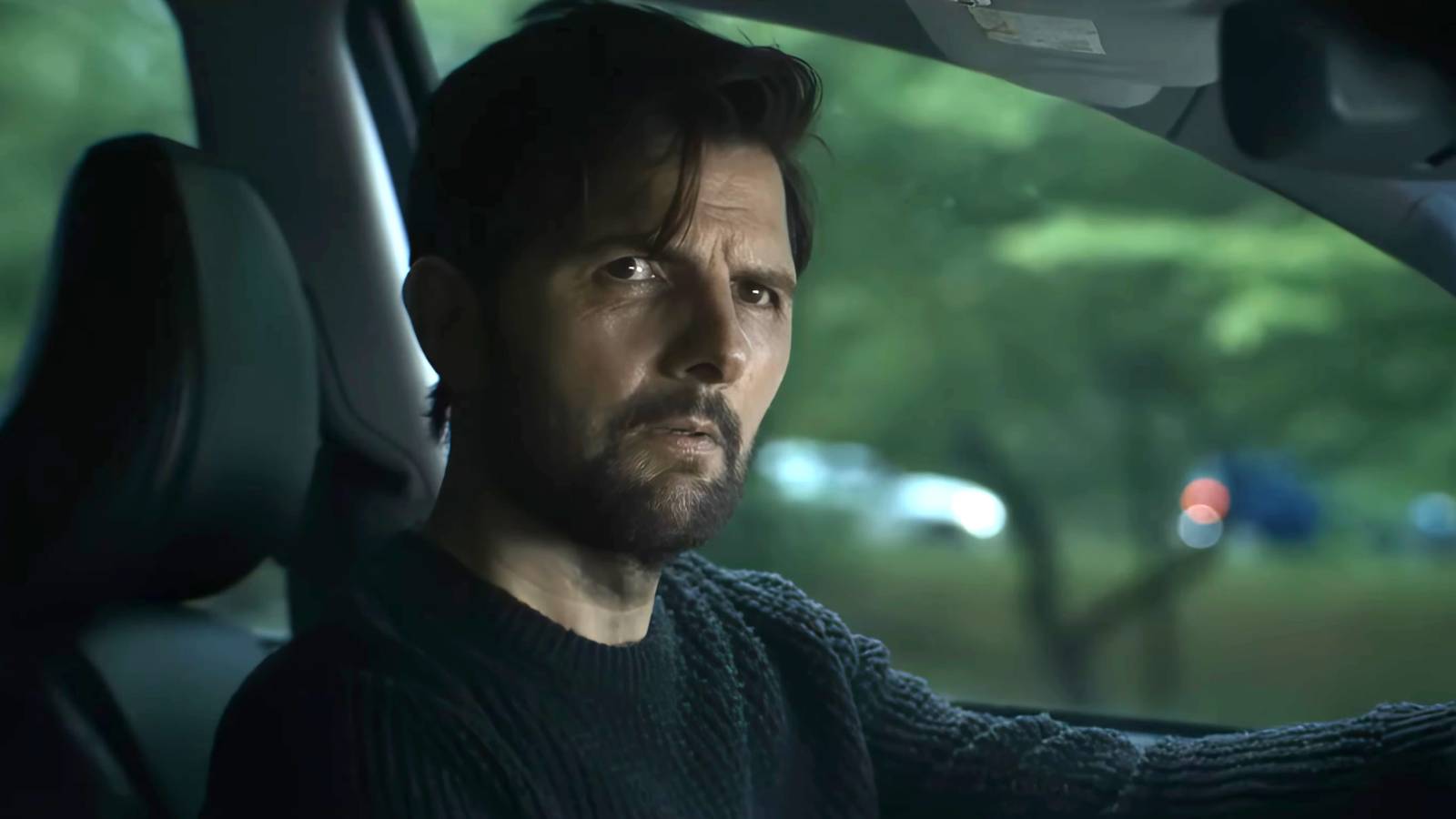
Published Aug 28, 2026, 2:20 PM EDT Sign in to your ScreenRant account Warning: Major SPOILERS lie ahead for The Whisper Man!Netflix's The Whisper Man is finally here, and the creative team behind the mystery thriller are breaking down its big ending. Based on Alex North's novel of the same name, the film centers on Adam Scott as Tom Kennedy, an author still coping with the death of his wife from a terminal illness who moves back to his hometown with his son, Jake. Shortly after arriving, Jake becomes the latest in a string of kidnappings in the area, which are presenting the same signs of the serial killer that his estranged father, Robert De Niro's Pete Willis, arrested decades prior. Across The Whisper Man's 114-minute runtime, Tom, Pete and Michelle Monaghan's Detective Amanda Beck track down every lead they can, including interviewing the original killer, Michael Keaton's Frank Carter, in prison, and Hamish Linklater's Norman Collins, a shady collector of true crime evidence. This ultimately leads them all to the conclusion that the culprit is none other than Owen Teague's Francis Carter, Jr., son of the original perpetrator carrying on his father's legacy. Ahead of the film's release, ScreenRant's Liam Crowley interviewed James Ashcroft and Alex North to discuss The Whisper Man. When asked about building to the ending's big reveal of Carter Jr. as the new killer that kidnapped Jake, the director began by acknowledging that it "comes back to that theme of fathers and sons," with Keaton and Teague's characters serving as the "mirror opposite" of both Tom and Pete's relationship, as well as Tom and Jake's, calling it the "dark side of the coin": James Ashcroft: I never saw this as so much a whodunnit; it's more of a "why" dunnit. And it's also, I think, very tragic as well. Owen, who plays the current Whisper Man, is ultimately a flawed character, yes — but he's the final victim in this. North went on to acknowledge that some readers have expressed their dissatisfaction with The Whisper Man novel's ending in the seven years since it was published, feeling it's "not fair," particularly with Frank killing his son in his prison cell in the closing moments. The author, however, explained that "it's not meant to be a happy ending," concurring with Ashcroft that it's "a tragic outcome" for Francis, and that the audience is "not meant to cheer at that moment." Before the credits start rolling, the Whisper Man ending delivers one final twist, in which Tom realizes that the Girl in the Blue Sweater Jake had discussed seeing throughout the film was actually that of his late mother, seemingly giving the film a paranormal element. When asked about this, North affirmed that it's "very much there in the book," however his writing aims to leave the truth as being more up to the readers: Alex North: You can take it as a supernatural explanation, or you can take it as a psychological defense mechanism that Jake is going through in terms of who that little girl represents and how she operates for him throughout the story. But she's my favorite character in it, so she was very important to me to have in the book because, otherwise, it's a very male story — which is fine, because it's a story about fathers and sons. But she was my favorite character to write, I think, along with Jake. Though North may not have had much involvement in the film's overall development, as he recently told ScreenRant, writing duo Ben Jacoby and Chase Palmer did largely stay accurate in their approach to adapting The Whisper Man. Most notably preserved is that of the aforementioned controversial ending, in which Frank strangles his son to death in his prison cell, fulfilling the theory that the reason his victims had shirts over their faces before their death was not Keaton's character avoiding their face, but instead imagining who he really wanted to murder. Even still, The Whisper Man came with a variety of changes to its narrative. For starters, Tom and Pete slowly begin rebuilding their relationship much earlier in the novel, with Jake not leaving the house of his own accord like in the film, but instead being violently removed after his grandfather is stabbed by Francis. This, in turn, takes Pete out from the rest of the investigation, whereas the film doesn't include this fatal interaction until its climax, with Francis fighting both De Niro and Scott's characters in their desperate final attempt to save Jake. Reel 1 · The Deep Cuts Robert De Niro Filmography Trivia “Are you talkin' to me?” ⚾Bang the DrumPre-Mean Streets lead 🎩UntouchablesCapone's silk skivvies 📖Cape FearTeeth ground down 🎬Bronx TaleBehind the camera 😬Jack ByrnesCircle of trust ROLL THE FILM → 01 Months before Mean Streets put him on the map, De Niro played a slow-witted, terminally ill Major League catcher named Bruce Pearson opposite Michael Moriarty in a 1973 baseball drama. The role earned him the National Society of Film Critics' Best Supporting Actor award. What was the film? AThe Natural BBang the Drum Slowly CEight Men Out DBull Durham ✓ Correct! Bang the Drum Slowly (1973). Released about five months before Mean Streets, John Hancock's adaptation of Mark Harris' novel features De Niro as Bruce Pearson, a backwoods catcher dying of Hodgkin's. He spent weeks at minor-league spring training in Georgia learning to chew tobacco and squat behind the plate. The role earned him the New York Film Critics Circle and National Society of Film Critics nods that primed him for Godfather II auditions a year later. ✗ Wrong dugout. The answer is Bang the Drum Slowly (1973). The Natural (1984) is the Robert Redford / Roy Hobbs picture — no De Niro. Eight Men Out (1988) is John Sayles' Black Sox film. Bull Durham (1988) is Costner / Sarandon. Bang the Drum Slowly is the dying-catcher drama that came out months before Mean Streets and made Hollywood take notice. NEXT → 02 For Brian De Palma's 1987 prohibition-era epic, De Niro famously gained around 30 pounds, shaved his hairline back, and insisted on wearing silk underwear made by the same Sulka shirtmakers Al Capone himself had used. He plays Capone for less than 20 minutes of screen time but dominates every frame. What's the film? AOnce Upon a Time in America BBugsy CThe Untouchables DMobsters ✓ Correct! The Untouchables (1987). De Niro replaced Bob Hoskins late in pre-production — Hoskins was paid $200,000 for not playing Capone, prompting his famous “If they ever have parts they don't want me for, please call again” quote. The Sulka silk underwear thing is real: De Niro tracked the firm down because Capone was a documented client. Sean Connery won Best Supporting Actor as Jim Malone, but it's De Niro's swaggering “baseball bat” speech that everyone remembers. ✗ Wrong rap sheet. The answer is The Untouchables (1987). Once Upon a Time in America (1984) is Sergio Leone's Noodles / Max epic — De Niro plays a fictional Jewish gangster, not Capone. Bugsy (1991) is Warren Beatty as Bugsy Siegel. Mobsters (1991) didn't feature De Niro. The Untouchables is the De Palma / Mamet picture with Capone, the baseball bat scene, and the silk Sulka underwear. NEXT → 03 In Scorsese's 1991 Southern-Gothic remake, De Niro plays a tattooed, scripture-quoting ex-con stalking the Bowden family. He reportedly paid a dentist around $5,000 to grind down his teeth for the part — and another $20,000 after filming to fix them. Who was the character? ASam Bowden BMax Cady CLewis Medlock DHannibal Lecter ✓ Correct! Max Cady. De Niro had body-builder Vince Wilfork-level abs at age 47 for the role, learned his Pentecostal cadence from real Southern preachers, and yes — ground down his teeth so Cady would look like he'd done 14 hard years in prison. Robert Mitchum had originated the Cady role in J. Lee Thompson's 1962 Cape Fear; both Mitchum and Gregory Peck cameo in Scorsese's version. De Niro was Oscar-nominated; he lost to Anthony Hopkins (Lecter, ironically). ✗ Wrong file. The answer is Max Cady. Sam Bowden is the lawyer Cady is stalking — played by Nick Nolte in '91 and Gregory Peck in '62. Lewis Medlock is Burt Reynolds in Deliverance. Hannibal Lecter is The Silence of the Lambs — the role Anthony Hopkins beat De Niro to Best Actor for that same year. Cape Fear is the one with the bible-quote tattoos and the ground-down teeth. NEXT → 04 In 1993 De Niro made his directorial debut with a coming-of-age story set in the 1960s Bronx, adapted by Chazz Palminteri from his own one-man play. De Niro played the working-class father Lorenzo Anello opposite Palminteri's mob boss Sonny. Name the film. AThe Good Shepherd BA Bronx Tale CSleepers DThis Boy's Life ✓ Correct! A Bronx Tale (1993). Palminteri famously turned down million-dollar studio offers because they all wanted to recast Sonny — he held out for a deal that kept him as both writer and lead. De Niro produced, directed and co-starred as bus-driver Lorenzo. He's only directed two features in his career: this and 2006's The Good Shepherd. A Bronx Tale was later adapted into a Broadway musical that De Niro and Jerry Zaks co-directed in 2016. ✗ Wrong block. The answer is A Bronx Tale (1993). The Good Shepherd (2006) is De Niro's other directorial outing, the slow-burn CIA history piece. Sleepers (1996) is Barry Levinson; De Niro plays a priest, doesn't direct. This Boy's Life (1993) is Michael Caton-Jones — De Niro stars as Dwight Hansen but doesn't direct. A Bronx Tale is the directorial debut, with Chazz Palminteri's Sonny. NEXT → 05 In 1990 De Niro played Leonard Lowe, a man emerging from a 30-year catatonic state under the care of a fictionalised Oliver Sacks (Robin Williams). De Niro spent weeks observing real encephalitis-lethargica patients at the Bronx Psychiatric Center and earned a Best Actor Oscar nomination. What's the film? AMad Dog and Glory BStanley & Iris CAwakenings DJacknife ✓ Correct! Awakenings (1990). Penny Marshall directed it from Steven Zaillian's adaptation of Sacks' 1973 memoir. Sacks himself was on set during shooting, and patients on the actual ward later said De Niro's tics, gait and post-encephalitic tremors were uncannily accurate — he'd watched videotapes Sacks had made in the 1960s. The film was nominated for Best Picture, Best Adapted Screenplay, and Best Actor for De Niro (he lost to Jeremy Irons for Reversal of Fortune). ✗ Wrong ward. The answer is Awakenings (1990). Mad Dog and Glory (1993) is the John McNaughton dark comedy with De Niro and Bill Murray. Stanley & Iris (1990) is the Jane Fonda romance about adult illiteracy — same year, very different film. Jacknife (1989) is the Vietnam-vet drama. Awakenings is the Oliver Sacks adaptation with Robin Williams — one of De Niro's most physically delicate performances. NEXT → 06 De Niro's character Sam “Ace” Rothstein in Scorsese's 1995 Casino — a meticulous, pastel-suited sportsbook genius running the fictional Tangiers — was a thinly fictionalised version of which real-life Vegas figure who actually ran the Stardust? ABugsy Siegel BFrank “Lefty” Rosenthal CMeyer Lansky DTony “The Ant” Spilotro ✓ Correct! Frank “Lefty” Rosenthal. Nicholas Pileggi (Goodfellas) wrote the source non-fiction book, and Rosenthal — the brilliant handicapper who really did run the Stardust, Fremont, Marina and Hacienda for the Chicago Outfit until a 1982 car bomb nearly killed him — consulted on the film. Joe Pesci's Nicky Santoro is the fictionalised Tony Spilotro, and Sharon Stone's Ginger McKenna is based on Rosenthal's wife Geri. De Niro reportedly studied hours of Rosenthal's late-1970s local-TV talk show. ✗ Wrong vault. The answer is Frank “Lefty” Rosenthal. Bugsy Siegel built the Flamingo in 1946 and was murdered in 1947 — he's Warren Beatty in Bugsy. Meyer Lansky was the mob's accountant, a behind-the-scenes figure. Tony “The Ant” Spilotro is Joe Pesci's Nicky Santoro, not De Niro's character. De Niro played Rosenthal — the Stardust handicapper whose 1982 car bomb survival opens the movie. NEXT → 07 In 2000 De Niro played the polygraph-wielding ex-CIA father-in-law Jack Byrnes opposite Ben Stiller's Greg Focker, kicking off a comedy trilogy that would gross over $1 billion globally. The first instalment was directed by Jay Roach (Austin Powers). Name it. AAnalyze This BMeet the Parents CWag the Dog DThe In-Laws ✓ Correct! Meet the Parents (2000). Universal had been chasing the project since the mid-1990s based on a 1992 Greg Glienna short film — Steven Spielberg was briefly attached to direct with Jim Carrey starring before Roach and Stiller landed the parts. The trilogy (with Meet the Fockers in 2004 and Little Fockers in 2010) leaned heavily on the contrast between De Niro's stone-faced gravitas and Stiller's flop-sweat. Combined worldwide gross: roughly $1.1 billion. ✗ Wrong family dinner. The answer is Meet the Parents (2000). Analyze This (1999) is De Niro's comedy with Billy Crystal — he plays a panic-attacked mob boss, not Jack Byrnes. Wag the Dog (1997) is the Levinson satire with Dustin Hoffman. The In-Laws (2003) is a Peter Falk remake De Niro isn't in. Meet the Parents is the polygraph / Focker / circle-of-trust one. NEXT → 08 De Niro's eighth Academy Award nomination — and his first Best Supporting Actor nod since Godfather Part II nearly 40 years earlier — came in 2013 for playing an OCD-prone, Eagles-obsessed Philadelphia father opposite Bradley Cooper and Jennifer Lawrence. Name the film. AAmerican Hustle BJoy CSilver Linings Playbook DThe Family ✓ Correct! Silver Linings Playbook (2012). Directed by David O. Russell, it earned Oscar nominations in all four acting categories — the first film to do so since Reds in 1981. De Niro reportedly cried on set during his “I love my son” monologue, telling Russell it had been so long since he'd had material like this. He lost Best Supporting Actor to Christoph Waltz for Django Unchained, but went on to make American Hustle and Joy with Russell. Killers of the Flower Moon (2023) earned him a ninth nom. ✗ Wrong year. The answer is Silver Linings Playbook (2012). American Hustle (2013) was Russell's next film and De Niro had a single-scene cameo as mafia boss Victor Tellegio — not a nomination. Joy (2015) again featured him in a small role. The Family (2013) is Luc Besson, no Oscar attention. Silver Linings is the Pat Sr. / Eagles superstition / handicapping role — his first Supporting nod since 1974. REVEAL MY RATING → Final Frame · The Verdict Your De Niro IQ 🎬 / 8 Tribeca regular — or just a casual cinephile? ⤴ ANOTHER TAKE With The Whisper Man's reviews indicating a very mixed response from critics, it's unclear whether the darker ending of North's novel, and the film itself, is part of what's putting reviewers off for the thriller. However, considering audiences often find themselves just as invested in the twists and turns of a mystery movie as they do the answers themselves, it will be interesting to see if they resonate with the film far better and help make it a viewership hit. Release Date August 28, 2026 Runtime 106 minutes Director James Ashcroft Writers Ben Jacoby, Chase Palmer, Alex North Producers Joe Russo, Anthony Russo, Michael Disco, Angela Russo-Otstot, Mike LaRocca Cast A widowed crime writer's 8-year-old son is abducted, leading him to seek help from his estranged father, a retired police detective. Together, they uncover links to a decades-old case involving a notorious serial killer known as The Whisper Man. Main Genre Thriller Executive Producer(s) Tim Connors, Malcolm Gray, Mike LaRocca, Elizabeth Niles, Marcus Viscidi Studio(s) Netflix
The Whisper Man's Controversial Ending & Book Accuracy Explained By Director & Author
Full Article
Original Source
Read the full article at Screenrant →KhanList aggregates and links to publicly available news content. We do not host full articles from third-party sources. Always verify important information with original sources.