
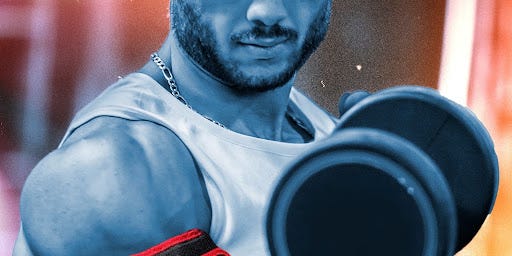
4 min readThis column first appeared in the Men’s Health email newsletter. The Optimized Man is a biweekly series from our editorial director as he tries out the latest, greatest, and weirdest health and wellness innovations so you don’t have to. Sign up here to get the next one.EVER HAD ONE of those days when you just don’t want to lift anything heavy?You’re not sick. You’re not injured. You just had a rest day—or two. You’re fired up on creatine or pre-workout or whatever. You made the effort to get to the gym. You’re wearing your new Metcons. You’re quietly jamming to your most embarrassing BEAST MODE playlist. You are, in every visible way, locked the eff in. But the thought of walking over to the big-boy end of the dumbbell rack and throwing around a bunch of heavy shit for the next half-hour?Nope. Not today.I’ve been feeling this way a lot lately—allergies, I guess?—and instead of relying on basic bodyweight training (snooze) or cable machines (the lines…), I’ve been using my blood-flow restriction (BFR) cuffs from Suji to keep the weight load low and the muscle-growth signal high. I first came across Suji back in 2020, after I shattered my collarbone and spent the better part of a year, post-surgery, rebuilding the 20 pounds of muscle I’d lost in my upper body. For months, I couldn’t lift anything heavier than a 10-pound dumbbell, which is humbling for any man and especially humbling for a man whose job entails encouraging other men to lift heavier dumbbells. My physical therapist introduced me to Suji’s cuffs, which look like the blood pressure cuffs that go around your arm during a doctor’s visit. You wrap one high on your upper arm or upper leg, depending on what you’re training, and the cuff fills with air until your limb feels, technically speaking, strangled.To be clear: You are not cutting off your circulation. Please, please, do not cut off your circulation. What BFR does is restrict blood from leaving the working muscle while still allowing some blood to flow in. Think of it as creating a temporary pressure cooker inside the limb. Oxygen drops. Fatigue builds faster. The muscle starts behaving as if the load is much heavier than it actually is, and your body begins recruiting the kind of muscle fibers it usually saves for harder work. That’s the whole BFR sales pitch, basically: Make stupid-light weights feel stupid hard. And the research backs up the idea that low-load BFR can produce muscle size gains that are at least in the neighborhood of what you’d get from traditional heavier lifting. For me, that means 20-pound curls instead of 40, and afterward, my biceps don’t seem to know the difference.Suji’s approach to BFR is especially interesting because it takes a lot of the guesswork out of a training method that should not be based on guesswork. The old-school version of BFR is wrapping a resistance band around your arm until it feels tight and then hoping you have not accidentally invented a tourniquet. (Do not do this.) The better version is using a cuff that can estimate what’s called your “limb occlusion pressure”—basically, how much pressure it would take to fully stop blood flow in that limb—and then train at a smaller percentage of that number.That matters because pressure is not one-size-fits-all. Your arm is not my arm. Your thigh is not my thigh. My left side, after the Great Collarbone Incident of 2020, was barely even my left side. Cuff width, limb size, blood pressure, and placement all change the pressure needed to get the right effect. Suji’s cuffs use personalized calibration to set and repeat a pressure that is meant to land in the productive zone: uncomfortable enough to create the desired training stress, but not so aggressive that your hand turns into a shriveled claw.And yes, uncomfortable is part of the deal. Not in a sharp or piercing way. More in the way it felt when you were a kid and held your breath for as long as possible, and your face turned purple, and your eyes watered, and your temples tightened and tightened until your body finally overruled your stupid little brain. It feels like that, except on your arm or leg. Then, the second you deflate the cuff and blood rushes back into the limb, the relief is immediate and, I might add, glorious. A breath of fresh air never felt so good. (Needless to say, talk to a doctor or PT before doing any of this, especially if you’re recovering from surgery or you’re managing cardio or BP issues.)I don’t use BFR all the time, and I still lift heavy when I can lift heavy. I still want progressive overload. I still want to feel, every now and then, like a person who can throw heavy shit around. But I love BFR for the days when heavy lifting feels like too much and doing nothing feels like a surrender. I love it for travel as a hedge against bad hotel gyms. I love it for the strange little bargain it offers: lower load, more burn, real work. (Men’s Health has an excellent guide to getting started.)The trick to optimization, I’m starting to think, isn’t always doing more. Sometimes it’s figuring out the least you can do while still giving your body a reason to change. And sometimes that least you can do involves a 20-pound dumbbell, an inflated cuff, and some really, really terrible music on your phone. Your body will take care of the rest.Richard Dorment is the editorial director of Men’s Health and Women’s Health.
The Weird Tool That Makes 20 Pounds Feel Like 40
Full Article
Original Source
Read the full article at Menshealth →KhanList aggregates and links to publicly available news content. We do not host full articles from third-party sources. Always verify important information with original sources.