
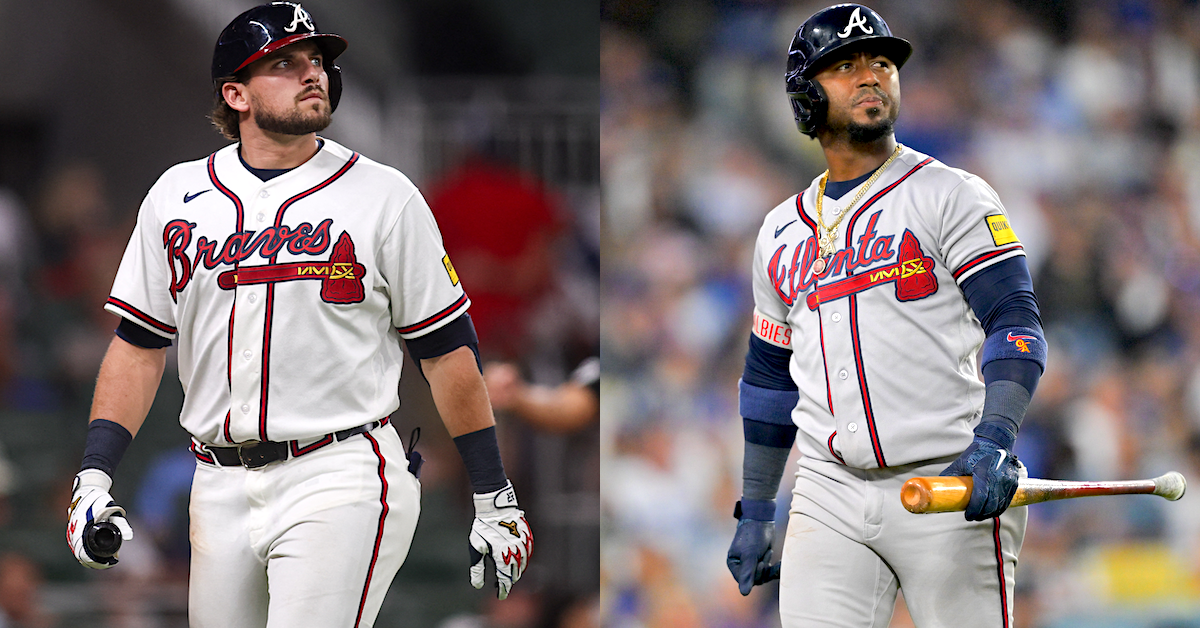
Brett Davis and Jayne Kamin-Oncea-Imagn Images Ozzie Albies, Austin Riley, and Freddie Freeman were vital contributors to the Braves when they won the 2021 World Series after getting as far as Game 7 of the National League Championship Series against the Dodgers the year before. Half a decade later, all three remain lineup staples — the first two in Atlanta, the third in Los Angeles — but as the postseason approaches, they rate as significant concerns for their respective teams. Though neither Albies nor Riley has turned 30 yet, both have not only had disappointing seasons, they appear to be multiple years into their decline phases, held in place by a combination of loyalty, track record, and long-term extensions. Freeman is 36 years old and a future Hall of Famer nearing the end of his 10th All-Star season, but while he would seem to be on firmer footing, he’s been dealing with a power outage that has coincided with a bout of patellar tendinitis in his right knee. He’s played through it at a time when the Dodgers have dealt with bigger injury concerns, though at least he’s got a first-round bye to help him recover for a few days. Earlier this week, I went around the diamond to identify the most notable vulnerabilities in the lineups of teams still contending for playoff spots in the American League — a companion of sorts to my annual pre-deadline Replacement Level Killers series, albeit among a more limited field. For the National League, that means the Brewers, Dodgers, Braves, Cubs, and Padres, all of whom have clinched spots (the last two of those on Thursday), plus the Phillies and Diamondbacks. Arizona trails Philadelphia by two games with three to play and has Playoff Odds of just 11.1% before accounting for the complicated and unresolved tiebreaker scenario involving those two teams. While full-season performances play a significant part in these selections, I’m more concerned with who’s worst now, with injuries and adjustments in mind. Each position has a headliner (or two, if it’s a job share), but at several positions, I’ve noted other teams with concerns, particularly injury-related ones. Catcher: J.T. Realmuto, Phillies A three-time All-Star and two-time Gold Glove winner, J.T. Realmuto once rated among the game’s top catchers, but he’s been in decline for years, and at age 35, his offensive performance has collapsed to the point that he landed on my Replacement Level Killers list in July. His .207/.286/.333 (70 wRC+) line represents career lows across the board, and while his 89.6 mph average exit velocity is in line with his recent seasons, his 5.4% barrel rate and 40.1% hard-hit rate are his lowest since 2016 and ’17, respectively. He’s struggled against lefties (.192/.293/.269, 58 wRC+) and has been particularly anemic at the plate in September (.113/.214/.177, 11 wRC+). Even those ugly small-sample splits make him look like Mike Piazza next to the roster’s other two catchers, as both Rafael Marchán and Garrett Stubbs have a sub-zero wRC+ (-24 and -1, respectively). Realmuto missed time due to back spasms in late April, and has had some notable bumps and bruises due to foul balls and hit-by-pitches as well, so it’s fair to wonder what aches and pains he’s currently playing through. First Base: Tim Tawa and Pavin Smith, Diamondbacks Ildemaro Vargas was sensational early in the season, opening with a 24-game hitting streak (27 games if you count the tail end of last season), but he quickly faded after a torrid April. Most of the Diamondbacks’ first base work since mid-June has been done by Tim Tawa, though Pavin Smith is back in the picture as well; the latter missed all of April and May due to left elbow inflammation, and was outrighted to Triple-A Reno during the All-Star break, but returned to both the 40-man roster and the majors less than two weeks ago. Tawa, a righty-swinging 27-year-old utilityman, has played at least three games at every position besides shortstop and catcher this year, but he’s hit just .233/.290/.392 (86 wRC+) while especially struggling in September (63 wRC+). Smith, a lefty-swinging 27-year-old, has been even less productive overall (.190/.274/.310, 63 wRC+), though he’s hitting .364/.417/.727 with two homers — including a two-run pinch-walk-off shot against the Yankees on September 19 — in 24 plate appearances since retuning. As for Freeman, after hitting .290/.375/.487 (138 wRC+) in the first half, he’s batting .295/.351/.350 (96 wRC+) in the second. He’s been able to keep the hit parade going — that’s why he’s likely to become the next member of the 3,000 hit club some day — but has homered just once since July 4. He’s also endured the two longest extra-base hit droughts of his career, an 18-gamer from July 28 to August 16 and his current 16-gamer, dating back to September 3; he’s hit .185/.229/.185 over the latter stretch. The Dodgers need him to get right, so it’s unclear why Dave Roberts is still writing his name in the lineup every day instead of letting him rest for October. Second Base: Ozzie Albies, Braves Albies has been the Braves’ regular second baseman since late 2017, save for some interruptions due to injuries. The now-29-year-old switch-hitter helped the team reach the playoffs in seven of his 10 seasons, though barring a big final few games, he’s bound for his third straight campaign with less than 1.5 WAR. He’s hitting .241/.297/.398 (89 wRC+) with 22 homers and 1.2 WAR. Where he was once a real force against left-handed pitching, his wRC+ against them is below 100 wRC+ for the second straight season (97 in 259 PA), while his 84 wRC+ against lefties (in 415 PA) is just two points above his career-worst mark, set two years ago. His quality of contact hasn’t been great; he’s sporting career lows in barrel rate (3.9%), xBA (.225) and xSLG (.343). As you’ll see as you read on, the Braves have other problems on their infield as well. Meanwhile, not only have the Phillies gone 9-12 this month while failing to sew up a playoff spot, on Thursday night Luis Arraez sprained his left ankle while running out of the baseline in an effort to avoid a tag at first base. His prognosis is unclear at this writing. In the grand scheme, the deadline acquisition of Arraez and the reshuffling of the infield that sent Bryson Stott to third base, Alec Bohm to first base, and Bryce Harper to right field has paid off, though Arraez has been the weakest link. He dipped from .324/.360/.440 (120 wRC+) to .278/.309/.369 (82 wRC+) on the offensive side, and from 9 FRV in 885.2 innings to 1 FRV in 389.2 innings on the defensive side. If the Phillies advance and he’s unable to go, interim manager Don Mattingly could undo the aforementioned position changes, but the more likely scenario would be to have Edmundo Sosa fill in. He’s hit just .246/.283/.415 (86 wRC+) and has only played 86.1 innings at the keystone this season, but historically, he has been an above-average defender at any infield spot. Third Base: Austin Riley, Braves Though he’s only 29 years old and has made two All-Star teams, Riley is now in his fourth straight season of decline in terms of both wRC+ and WAR, and unlike Albies, his offense has really crashed through the floor, as he’s hit .223/.294/.371 (84 wRC+) with 19 homers. While his bat speed remains exceptional, his swing choices have really suffered; he’s cut his overall swing rate from 51% to 48.7%, but his chase rate has jumped from 27.7% to 32.4%, and his 31.6% strikeout rate is his highest since his abbreviated 2019 rookie season. His quality of contact has declined, though it’s still pretty good, but with those extra strikeouts, his .214 xBA and .396 xSLG both represent career lows. As he’s signed through (gulp) 2032, the Braves have let him try to hit his way out of the slump; he’s played 156 games, and there’s no reason to think the team will change course. On the injury front, the Cubs Alex Bregman suffered multiple facial fractures on Sunday when he was hit by a Michael Busch foul ball while in the on-deck circle. Photos posted on social media showed his left eye swollen shut. The 32-year-old third baseman is in the midst of his best season since 2022, hitting .262/.352/.452 (124 wRC+) with 26 homers and 5.2 WAR. He has avoided an IL stint and reportedly has no vision or concussion-related issues. After lobbying manager Craig Counsell to return to the lineup on Wednesday, the plan is for him to play in the opener of Friday’s doubleheader against the Red Sox. Pedro Ramírez, a 22-year-old rookie utilityman who has hit .261/.319/.406 (100 wRC+) with good infield defense, has played third in his absence and will be on standby if Bregman experiences any setbacks. Shortstop: Trea Turner, Phillies Though he’s a three-time All-Star and two-time batting champion — the reigning NL champ, at that — Trea Turner has fallen apart this season. Outside of his cup-of-coffee campaign in 2015, he had never posted a wRC+ below 107 before, but he’s down to 82 this year, with his .239/.296/.377 line representing career worsts in each category even with a modest second-half rebound. He’s been getting eaten alive by sliders, sweepers, changeups, and cutters, with batting averages of .208 or lower and slugging percentages of .340 or lower against all of those offerings, and whiff rates above 35% against all but the cutters. His 34.4% chase rate is just a point off his career high, while his 88.4 mph average exit velo is a career low. On the other side of the ball, he’s dead last among shortstops with -17 DRS; his -9 FRV is only the majors’ third-lowest total, but it’s the lowest of any Phillies player who didn’t switch positions after Arraez’s arrival. If he were playing through an injury, that would at least provide some explanation for his sudden decline, but he’s gone to the post for 154 games, so it’s hard to believe he’s laboring through something significant. While I chose to spotlight Turner, I should point out that for the entire season, Braves shortstops have accumulated just 0.5 WAR, a little over half that of the Phillies shortstops (Turner and 41 plate appearances from Sosa). Lately, the job has been shared by Ha-Seong Kim and Mauricio Dubón. Dubón has split his time between five different positions and has hit a respectable .276/.321/.395 (98 wRC+); in 448.2 innings at shortstop, he has 2 FRV and 0 DRS. Kim, however, has struggled mightily, hitting an unsightly .113/.203/.121 (-3 wRC+) in 139 plate appearances. While he topped a 100 wRC+ annually from 2022–24 with the Padres, he has been an afterthought at the plate since tearing his right labrum in late 2024, undergoing season-ending surgery, and then producing an 83 wRC+ last year with the Rays — who let him go on waivers seven months after signing him to a two-year, $29 million deal — and Braves. A torn ligament in his right middle finger, suffered in January, cost him the first seven weeks of the season, and he went back on the IL for a month in early July due to further inflammation in the digit. The Braves have given him some runway to get right, but it wouldn’t be a surprise if that indulgence ends when the playoffs start. Left Field: Brandon Marsh and Bryan De La Cruz, Phillies Phillies left fielders have netted -0.7 WAR, the majors’ second-lowest mark, and even if one waves off the comically terrible small-sample “contribution” of Otto Kemp (-0.8 WAR by going 1-for-23 without a walk and with -3 FRV in 63 innings), the reality is that Brandon Marsh’s performance is driving this, regardless of his platoon partner/fill-in. Though he made the NL All-Star team for the first time on the strength of a .301/.339/.490 (122 wRC+) showing with 15 homers in the first half, he’s hit .185/.244/.263 with three homers and a 33 wRC+ since the break, the majors’ lowest among qualifiers. Overall, his 0.4 WAR is the eighth-lowest mark of any batting title qualifier; Cleveland’s Jo Adell (also 0.4) and Boston’s Jarren Duran (0.5) are the only others among the bottom 10 who have played regularly for still-contending teams. There’s no obvious reason for Marsh’s downturn. His bat-tracking data has been consistent from half to half, he’s reined in his tendency to chase, and his strikeout and walk rates have improved, but his average exit velocity has fallen from 89.8 to 88.5 mph, his barrel rate from 9.3% to 5.8%, and his hard-hit rate from 45.9% to 38%. Recently Mattingly suggested that pitchers adjusted to Marsh in the wake of his hot first half, and he hadn’t successfully countered: “I just think they made an adjustment to him,” Mattingly said. “And we got to make it back. We haven’t been able to do that, I’ll say in general. You know, Marsh is sitting back there at some point, and they’re probably not doing a ton of homework on him. They’re attacking, whatever. He gets aggressive. He starts being aggressive early. He’s doing damage. He’s getting his hits. All of a sudden he’s hitting .330 and he’s on the All-Star team. And it’s like, ‘Maybe we ought to do a little more work on this guy?’ You see adjustments all the time.” When Marsh went 2-for-4 with a three-run homer off the Brewers’ Dustin May on Tuesday, it was his first homer since August 1; he had collected just two extra-base hits (both doubles) over that 31-game span, and hadn’t had a multi-hit game since August 21. Over the past month, Mattingly has used 29-year-old Bryan De La Cruz more often than Sosa as Marsh’s platoon partner; he’s hit .296/.350/.437 (113 wRC+) in 80 plate appearances including his time in right field, which has been shored up by Harper. De La Cruz owns just a 90 wRC+ in 1,952 plate appearances for his career, so I wouldn’t expect that performance to be sustained. Center Field: Justin Crawford and Derek Hill, Phillies As if the Phillies didn’t have other problems, they haven’t gotten much out of their center field platoon. Rookie Justin Crawford has hit just .263/.310/.355 (81 wRC+) with three homers and 16 stolen bases, and that’s while only taking 64 plate appearances (with a 74 wRC+) against lefties. His defense hasn’t been great either (-8 DRS, -2 FRV). Righty Derek Hill has hit for a 109 wRC+ since being acquired from the White Sox on June 11, and a 99 wRC+ (.241/.291/.442) overall, with a 111 wRC+ against lefties but a 79 wRC+ against righties — and even that is 26 points ahead of his career mark, accumulated over 467 plate appearances. He’s been unusually clutch, ranking fifth on the team in WPA (1.00) but 12th in plate appearances (126). Small-sample caveats apply both there and with regards to his strong defense in center (7 DRS and 2 FRV in 269 innings). If he could hit righties, he’d be worthy of more playing time, but that’s just not the case. Injury-wise, Andy Pages lost a month of what has been a breakout season due to a fracture in his left hand. He was voted into the starting lineup of the NL All-Star team on the strength of a .270/.336/.471 (121 wRC+) first half, but his power tailed off from that point to August 21, when he was hit by a 100-mph heater from the Pirates’ Bubba Chandler; thanks to a higher BABIP, he hit .288/.361/.432 (122 wRC+) in the latter span, but his barrel and hard-hit rates dropped substantially. Hand injuries can cause lingering power outages; though Pages collected three hits in his second game back, his first six batted balls since returning have averaged just 82.7 mph in exit velo, with only one of them a hard-hit ball. Right Field: Sal Frelick and Luis Lara, Brewers After a breakout season in which he hit for a 114 wRC+ with 3.6 WAR in 2025, Sal Frelick’s performance has collapsed this season. The 26-year-old speedster has hit just .234/.299/.323 (74 wRC+) with four homers, seven steals, and -0.3 WAR. Just after landing on my Replacement Level Killers list for right fielders, he hit the IL due to a right (throwing) shoulder strain. He was subsequently diagnosed with a minor tear in his labrum and missed nearly six weeks, but he has opted to play through the injury for the remainder of the season instead of undergoing surgery. Unfortunately, all he’s done is act as a drag on the offense, hitting .224/.292/.293 (65 wRC+). Luis Lara, a switch-hitting 21-year-old rookie, has hit just .250/.314/.332 (82 wRC+) since debuting on July 7, and hasn’t been much help platoon-wise (59 wRC+ against lefties, 93 wRC+ against righties). He’s made 33 starts in left, while the lefty-swinging Jake Bauers has made 28 — but just one since September 3, as he’s mainly been playing first base. Bauers is in the midst of an age-30 breakout season (.268/.393/.491, 146 wRC+). Playing him regularly in right while letting the righty-swinging Andrew Vaughn play first base full-time would seem to make sense, though the reality is that Bauers’ glove is a liability (-4 DRS and -4 FRV in 198 innings in right, -5 DRS and -5 FRV in 809 innings at first base) at either spot, and Vaughn is rough at first, too. Designated Hitter: Who Knows Exactly, Padres Diamondbacks designated hitters have netted -1.8 WAR this year, the majors’ second-lowest mark, with the Padres the third-worst at -1.7 WAR. The Snakes have spread things around more, with seven players making between 11 and 33 starts at DH, led by Adrian Del Castillo, who was optioned to Reno a couple of weeks ago. The Padres have started righty Miguel Andujar at DH 56 times, and lefty Gavin Sheets 30 times; both are currently on the injured list but working towards returning in time for the playoffs. Andujar, who has hit .259/.303/.423 (101 wRC+) overall, with a 105 wRC+ as a DH, has been on the IL since July 20 due to a right wrist fracture. Sheets, who has hit .211/.313/.388 (100 wRC+) overall, has just a 59 wRC+ as a DH; he’s been on the IL since August 30 due to a left foot sprain and plantar plate tear. Andujar was able to squeeze in a nine-game rehab stint at Triple-A El Paso and is taking live batting practice at Petco Park. Sheets, who’s also taking live BP, didn’t have the luxury of a rehab stint, and won’t be able to do anything besides DH and pinch-hit if he is activated. In their absence, lately it’s been backup catcher Luis Campusano and reserve outfielder Austin Hays — both righties — in that role. Campusano has hit .268/.365/.440 (130 wRC+) overall, and with the Padres considering carrying three catchers, including 20-year-old rookie Ethan Salas, on the postseason roster, they could spare one for the DH pool. Hays has hit just .277/.296/.404 (91 wRC+) for the White Sox and Padres, but as an able-bodied defender, he may have the leg up on the roster spot. Of course, when it comes to designated hitters on playoff-bound teams, the real question everybody wants to know is how healthy Shohei Ohtani is. The four-time MVP was activated on Tuesday after a 15-day IL stint for left knee, right biceps, and neck issues that not only ended his season as a pitcher but contributed to a slump. In 61 plate appearances from August 19 through September 7, he hit a homerless .122/.295/.184 (50 wRC+) with a 34.4% strikeout rate. In that span, he barreled just one ball (3.6%) and had just a 39.3% hard-hit rate. In two games since he’s returned, he’s gone 3-for-9 with three strikeouts and a 101.6-mph average exit velocity, with all six of his batted balls at 98 mph or higher; he just missed a home run in the first inning against Nick Pivetta on Thursday. That has to come as a relief for the Dodgers, though all eyes will be on him for any sign of further aches and pains.
The Weakest Positions on the Remaining National League Contenders
Full Article
Original Source
Read the full article at Blogs →KhanList aggregates and links to publicly available news content. We do not host full articles from third-party sources. Always verify important information with original sources.