
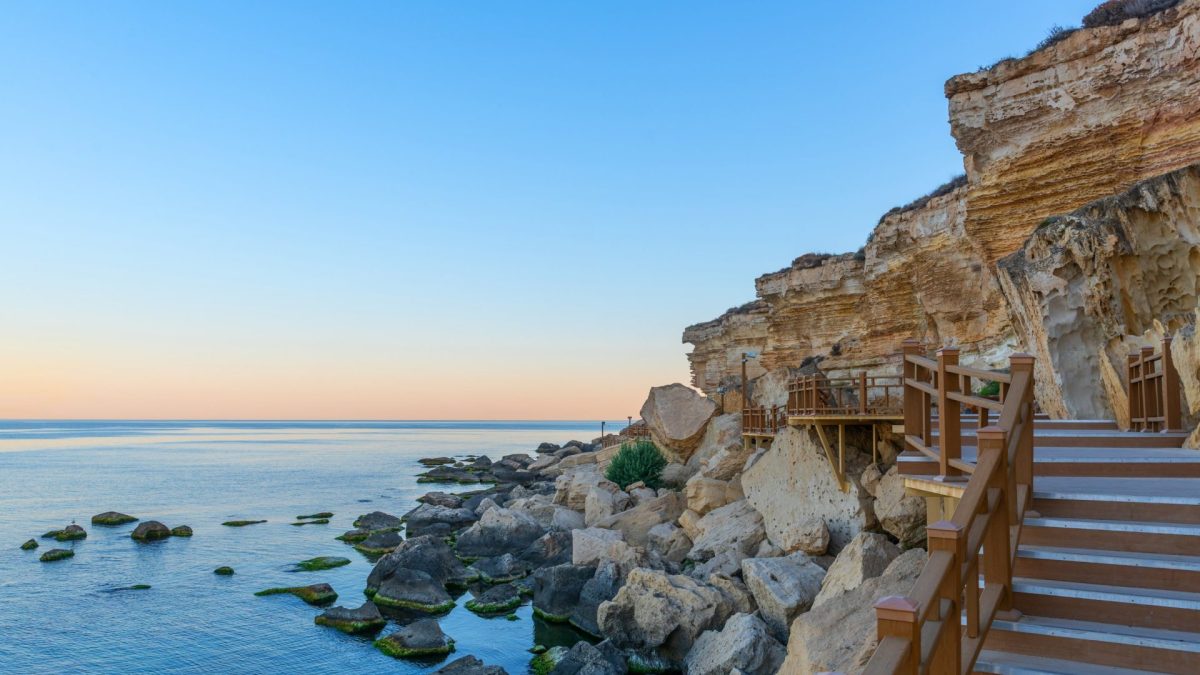
Sandy beaches and shimmering blue water is not what I had expected in the world’s largest landlocked country. Kazakhstan’s better-known landscapes, after all, are those of the Tian Shan mountains, where hikers trek to high-altitude glacial lakes, and the vast steppe, best explored on horseback. The south-western city of Aktau is a springboard for Mangystau’s salt plains, underground mosques and towering limestone pillars – but, sitting on the Caspian Sea, the port city itself soon caught my attention. The Caspian is the world’s largest inland body of water – slightly larger than Germany, albeit shrinking each year, and borders five countries. On my first evening in Aktau, I wandered the coastal promenade between limestone cliffs and the sea, stopping at panoramic platforms and coves along the way. Couples and families were sprawled on beach towels across the rocks, a group of teenage boys took turns performing somersaults into the water, older residents were settled into chairs with fishing rods and beers, and two young women were towelling off after a swim. Curious, I asked one of them, Aliyah, who worked in a nearby hotel, how the water was. “Splendid. These are the last few weeks before it gets too cold,” she told me. It was September, and while the water was still inviting enough for a quick dunk – 25°C, according to my watch – the first plunge made me gasp. By February, it will fall to around 5°C. Arailym, a tour guide with Red Maya Travel, told me how she and her friends head out for freediving sessions in the brackish water at weekends. “I can dive to 8m,” she told me with a grin.Later, I met Oleg Morozov, who runs a dive outfit at Briz yacht club. He showed me videos from his final dives of the season: shipwrecks resting beneath the surface and a dice snake hunting for sea urchins. The Caspian might not be a tropical-reef spectacle, but it has its own cast of characters, including gobies, mullet, pike-perch and garfish, as well as crayfish tucked among crevices. The city’s relationship with the sea is reflected on the dining table. At the Yellow Bazaar, I found pantry staples sitting alongside counters selling the day’s catch. Aktau Beach on the Caspian Sea (Photo: Avantika Chaturvedi) Fish features prominently in western Kazakh cooking, and Aktau has its own take on beshbarmak, the country’s national dish of meat, noodles and onion broth: fishbarmak, made with sturgeon, is best tried at Aidyn restaurant. At Te Quiero, a shack perched over the water, I lingered over a coffee, watching seagulls swoop over the water, while at the waterfront SeaView restaurant, my aglio e olio came with fresh Caspian shrimp and a generous amount of shredded aged qurt – a traditional, salty, and sour dried cheese made by straining fermented milk. Over a brunch with some women I’d met on my tour of Mangystau, I scoffed down several helpings of Sicilian-style vegetable rolls – delicate ribbons of aubergine and courgette wrapped around a succulent beef filling, rich and hearty without being too heavy. Aktau’s current tourism investment might be focused primarily on the coast, but the city’s origins are decidedly less sun and sand. Much of the region was once submerged beneath the ancient Tethys Ocean, whose retreat left Mangystau with its fossil-rich limestone landscapes. Te Quiero Coffee in Kazakhstan (Photo: Avantika Chaturvedi) Aktau is a product of the Soviet era, built from scratch in the 60s to support the oil and uranium industry. That industrial heritage is still visible in the oil rigs and nodding donkeys punctuating the outskirts, while broad boulevards and concrete apartment blocks retain the character of a planned Soviet city. I headed to the Melovoy Lighthouse – a working Soviet-era red-brick lighthouse perched on the roof of a residential apartment block, its distinctive silhouette visible from much of the coast. It is hardly a conventional tourist attraction: there is no ticket booth or visitor entrance. I had to rely on the kindness of a local resident, who keyed me into the lift and sent me up to the 10th floor. It made for a lovely vantage point over the city, especially as the sun dipped into the Caspian, washing the sky in shades of gold and burnt orange. Prawn pasta at Seaview Restaurant (Photo: Avantika Chaturvedi) Returning to the waterfront, I found myself thinking about how little it resembled the Kazakhstan I’d imagined before visiting. I hadn’t expected to spend my evenings watching the sun drop over an inland sea, or to find a local beach culture thriving on the edge of one ofCentral Asia’s most arid regions. The Caspian may not be the first place that comes to mind when planning a summer by the water, but that is precisely what makes Aktau worth the detour next year. How to get there Pegasus, Azerbaijan Airlines and others fly to Aktau from the UK with one stopover. Where to stay Rixos Water World Aktau is a luxury resort about 20km from the city, with beach access, multiple pools, a spa, restaurants and an adjoining waterpark, doubles from £345. Holiday Inn Aktau – Seaside offers sea views and a city location, doubles from £80.
The vast Silk Road beach destination you’re not thinking of, but should be
Full Article
Original Source
Read the full article at Inews →KhanList aggregates and links to publicly available news content. We do not host full articles from third-party sources. Always verify important information with original sources.