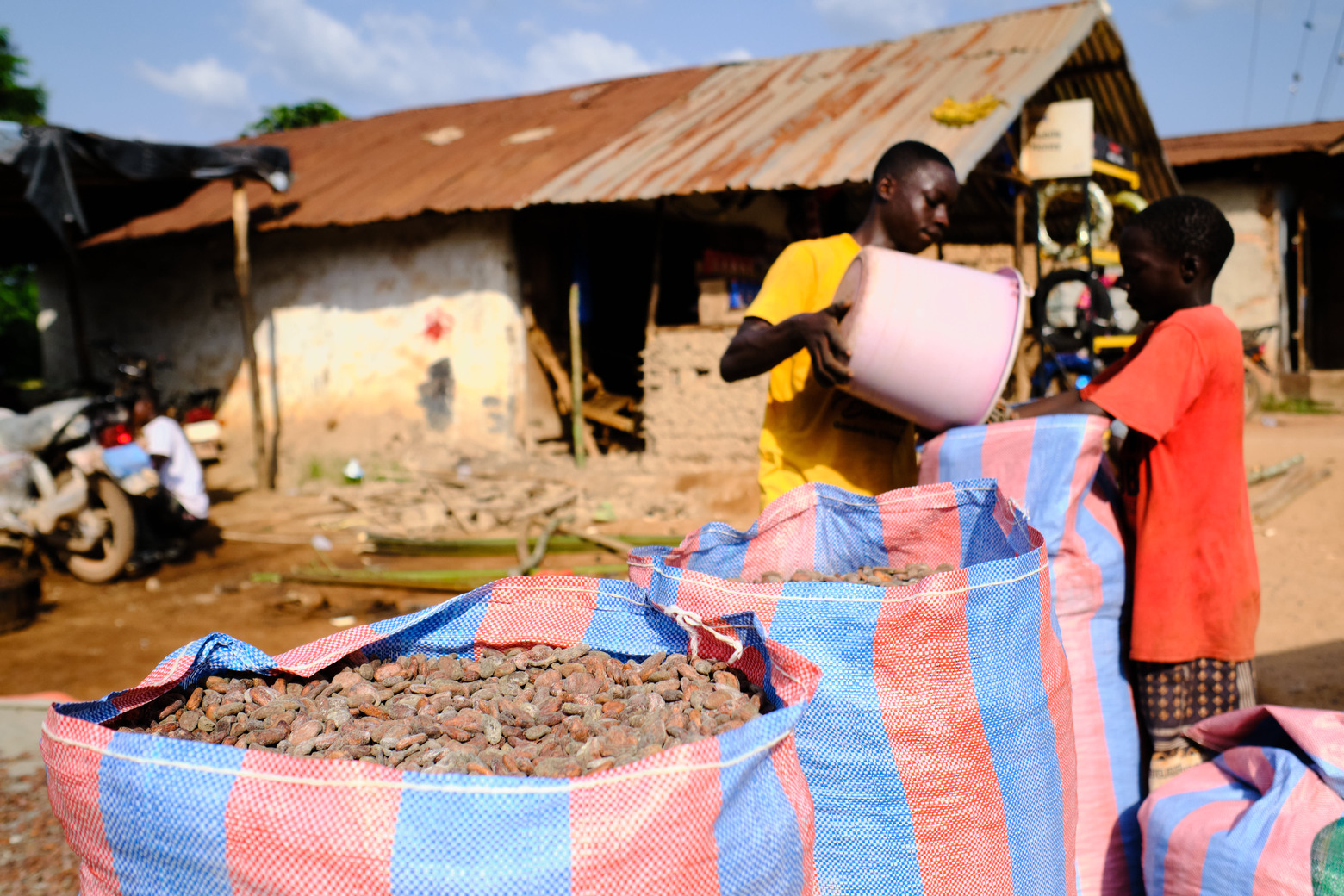
Liberia’s remote southeast, home to some of West Africa’s last remaining rainforests, is facing a deforestation crisis driven by cacao farming.Tens of thousands of workers from neighboring Côte d’Ivoire have migrated across the border in recent years, driven by land shortages and a price boom.This “cocoa rush” destroyed more forest in Liberia’s Grand Gedeh county last year than in any county on record since 2002. (GRAND GEDEH, Liberia) – Off in the woods beyond the ekki trees, a sharp crack cuts through the buzzing of insects. “It’s a tree falling,” says George Bowey, a baby-faced community eco-guard who works here in the proposed Kwa National Park, a thick tropical rainforest in southeastern Liberia. There are different ways to grow cacao. In one method, saplings are intercropped with other tree species so they form a diverse ecosystem. Or there’s another method, where plantation land is cleared by pouring gasoline on the base of native trees and setting their roots on fire so they wither and die. This is the method that migrant cacao workers from nearby Côte d’Ivoire have brought into Kwa. The Wild Chimpanzee Foundation’s George Bowey walks past a burned tree in the proposed Kwa National Park. Photo by Ashoka Mukpo for Mongabay. The sound of more trees falling echoes in the distance as Bowey picks his way through the bush. The other eco-guards and forest rangers here at Kwa call him “Gentle George.” With his upbeat personality, it’s not hard to see why. He bounds up a damp hillside, listing off some of the species found inside Kwa. “We got western chimpanzees, forest elephants, pygmy hippos, giant pangolins, white- and black-belly pangolins, we got a lot of animals in here, like leopards, golden cats, we got Diana monkeys, western black and white colobus, we got three types of crocodiles,” he says. Eventually he reaches his destination. The cool overgrowth suddenly gives way to a blast of heat and raw sunlight. In front is a wide clearing, full of dry and leafless trees that stretch up toward the sky. Others rot on the ground like the skeletal fingers of a giant’s corpse. The waist-high saplings that poke out from the grasses next to them announce what this is. It’s a massive cacao plantation. Around 250 acres in all, Bowey says, or about 100 hectares. Kwa isn’t formally a national park yet, but it’s in the process of becoming one, and in the meantime commercial agriculture is prohibited inside its 1,720 square kilometers (664 square miles). It’s one of the few protected habitats for chimpanzees and other wildlife in southeastern Liberia, and forest rangers patrol it regularly along with the help of eco-guards like Bowey who work for the Wild Chimpanzee Foundation. “At the end of 2023, we started seeing cocoa going closer to the park, but to enter the park it was last year,” Bowey says. Much of the land around Kwa has already been cleared for cacao by people who live nearby. Now plantations like this are creeping inside its boundaries. “They’ve given all the forest to Burkinabés, but some people still want to get access to more forests,” Bowey says. “In the name of getting money they’ve decided to get into the park.” Cacao saplings underneath burned trees in the proposed Kwa National Park. Photo by Ashoka Mukpo for Mongabay. The two-hour walk back to the ranger camp weaves past other new plantations, which Bowey marks with a portable GPS tracker. There’s still a canopy over some of them, for now, but the burns on the trees confirm that they’re dying. Bowey says he used to see chimpanzees and forest elephant tracks here. Since the plantations sprung up they’ve fled, moving deeper into the recesses of Kwa. He grew up in one of the communities near here, and he knows some of the people sending workers inside the forest. When he visits to warn them against it, they tell him they need to make money. He understands where they’re coming from. But not enough to justify the destruction he’s seeing. “I really don’t have sympathy for them,” he says, glaring at a fallen tree. “It should be understood for my community people, those of us who are around the landscape, that we should not be bringing people in here.” Recording illegal cacao farms with GPS in the proposed Kwa National Park. Photo by Ashoka Mukpo for Mongabay. Cocoa fever The Upper Guinean Forest was once a vast belt of jungle and deep woods that covered nearly 400,000 km2 (154,000 mi2) from Sierra Leone to Togo. This immense rainforest sustained kingdoms, fueled trade, and harbored endemic wildlife. Over the last century and a half, most of it has vanished. French and British colonial enterprises logged the forest ruthlessly, and after independence countries like Côte d’Ivoire and Ghana built enormous cocoa industries by destroying much of what remained. (Throughout this story, we use “cacao” for the tree and raw beans, and “cocoa” for the commodity and processed products.) A young cacao tree in Grand Gedeh, Liberia. Photo by Ashoka Mukpo for Mongabay. More than half of what survived this period is here in Liberia. On a map of primary forest cover, the country’s remote southeast still appears as an island of green surrounded by a sea of commercial agriculture and deforestation in West Africa. Grand Gedeh county is one of southeast Liberia’s most densely forested regions. About the size of Lebanon, up until a few years ago it could take days to reach by car from the capital city, Monrovia. As of 2020, 99% of Grand Gedeh was covered by natural forests. Many of those forests are now disappearing. Grand Gedeh is in the grip of what people are calling “cocoa fever.” In the last few years, tens of thousands of migrant workers from Côte d’Ivoire have crossed into this part of Liberia on the invitation of landowners who are eager to profit from their experience in the cocoa industry. On one side of the border that separates Liberia from Côte d’Ivoire, deforestation is driving these workers into a hunt for new land. On the other, they’re contributing to a new wave of it. Côte d’Ivoire is the world’s biggest exporter of cacao beans. But many of its plantations are decades old and losing soil nutrients. With most of the country’s forests long gone, there’s almost nowhere left to establish new plantations. Liberians in this region, on the other hand, are land-rich but cash-poor. Migrant workers offer to turn their forests into cacao plantations, and split the earnings once they start to harvest. It’s a deal that many people around here are more than happy to make. Since 2020, forest loss in Grand Gedeh has skyrocketed. Data from Global Forest Watch show that in 2024 and 2025 alone, an area of primary forest more than four times the size of Manhattan was destroyed. Last year, Grand Gedeh lost more forest than any Liberian county has in any year on record since 2002. “primary forest loss”. Photo by Ashoka Mukpo for Mongabay. The cause of this destruction is cocoa. And Grand Gedeh’s booming industry is now on a collision course with the European Union, Liberia’s biggest export market for cocoa, where a strict ban on commodities linked to deforestation is set to come into force at the end of 2026. How the bloc deals with southeastern Liberia’s cocoa rush will be a test of how serious it is about enforcing that ban. Handcuffs in the jungle Surrounded by chest-high grasses on a swampy trail, Yei Neagor stops walking and presses a finger to her lips. The seven-person ranger patrol behind her hunches down and veers off the trail into the brush. They emerge into a clearing, where two young men see them and bolt toward the forest, disappearing into the shadows. “Why y’all running for?” she yells as the rest of the patrol fans out into the clearing, surrounding a small wooden shelter where supplies and dirty clothing lie in piles next to makeshift cots. The men have been living rough, camping here while they work to set up an illegal cacao farm nearby. FDA rangers arrest a migrant cacao worker at a camp in Grand Gedeh, Liberia. Photo by Ashoka Mukpo for Mongabay. The two men are gone before the rangers can pursue them, but their friend isn’t so lucky. Caught without shoes or a shirt, he’s detained before he can escape. Smoke from a cookfire billows through the palm-thatched shelter. In French, the rangers demand his ID. He provides a card issued by the Liberian immigration authorities. The wide-eyed, trembling boy is from neighboring Côte d’Ivoire. The rangers are from Liberia’s Forestry Development Authority, the agency responsible for managing the country’s forests. In this area, cacao farming is prohibited. The boy’s card includes the name of his immigration sponsor. It’s a Liberian businessman who’s known to the rangers. This isn’t the first time they’ve arrested workers linked to him around here. “We arrested 14 people, from this same person,” Neagor says. “They went to jail and spent one month there, and the court told them that they should never come back.” The card also shows his age — he’s a month shy of his 18th birthday. Still shirtless, he starts to cry. Neagor and the others aren’t fazed. He knows he’s not supposed to be here, they say. “If we leave these people, three years from now it will be like Gbarzon,” Neagor says. “You will come here and not see one leaf except for cocoa leaf.” FDA rangers escort arrested migrant cacao worker out of the forest in Grand Gedeh, Liberia. Photo by Ashoka Mukpo for Mongabay. ‘Generations will judge us tomorrow’ In Zwedru, Grand Gedeh’s sleepy, hill-ringed capital, Neagor sits on the stoop of the FDA’s regional headquarters in her pressed green uniform. She’s been in charge of the station for six months. Neagor says she wanted to be a forester from a young age, when she’d visit her grandmother’s house “to be around the habitat.” Here in Grand Gedeh, she’s watching it disappear. “The worst of it in this county is in Gbarzon district,” she says. “I will be honest to tell you that about 70% of the forest there is gone.” Liberia Forestry Development Authority’s Yei Neagor. Photo by Ashoka Mukpo for Mongabay. Gbarzon is one of three administrative districts in Grand Gedeh. All of them border Côte d’Ivoire. She says cacao workers began arriving from there around 2017, but in the last three years their numbers have shot up. According to an unpublished report by Liberia’s Refugee Repatriation and Resettlement Commission, the current number of migrants in Grand Gedeh could be as high as 80,000 — a huge figure, given the county’s census-recorded population of just over 200,000. That would mean nearly one in every three people here is a migrant. “Some of them will say it is very easy and common to get forests in Liberia,” Neagor says. In 2024, the global price of cocoa quadrupled after bad weather and crop disease damaged yields in West Africa. Speculation by hedge funds helped fuel the wild fluctuation in prices, which have since dropped. But the spike sent entrepreneurs scrambling to find land and convinced people here that there’s big money to be made in cocoa. For the most part, land in southeastern Liberia is communally owned, and there are laws regulating the ability of private individuals to lease it out for commercial agriculture. In practice, those laws aren’t being followed. “Sometimes they say from here to this tree belongs to me, make your farm. But there’s no document to back up that you are the forest owner,” says Ashai Wulu Gaye, the chairman of a community forest in Grand Gedeh. FDA rangers on patrol in Grand Gedeh, Liberia. Photo by Ashoka Mukpo for Mongabay. Town chiefs and other influential people have been rushing into deals with migrant workers, who are often called “Burkinabés” because of their ethnic roots in Burkina Faso, here and across Liberia’s southeast. There are rumors — and evidence — that many of these deals are backed by politicians and other powerful figures. Last year, an investigation by the Liberian environmental news outlet The Daylight exposed an illegal land transaction between government officials in Grand Gedeh and a cocoa entrepreneur from Côte d’Ivoire. Silas Siakor, a long-time environmentalist and community rights advocate, says there’s often more than meets the eye in towns caught up in the cocoa rush. “My experience with these situations is that there is always a line from that local guy who’s making the case about his livelihood being in jeopardy that comes up to some bigshot somewhere up the chain,” he says. “They are not alone. People use those very legitimate cases to front for very bad situations.” Neagor and her office have a narrow enforcement mandate. Their operations are mostly confined to forests where the FDA has a written agreement with local communities; and even then, their hands are tied in ways that imply political interference. They arrest workers in those forests, but not the Liberians who sent them there. And she’s been instructed not to destroy any mature cacao trees — even when they were planted illegally in protected areas like Kwa. “We sit and fold our hands and watch the forest going,” she says. “Generations will judge us tomorrow.” Handshake deals On the outskirts of the town of Zleh in Gbarzon district, two young men swing machetes at weeds in a plantation. Green pods hang from some of the cacao trees above them. The men work faster than seems possible in the beating sun. “You have to be courageous, because the work is very hard,” says Mohammed, a worker in rubber boots and a black tank top. A migrant worker in a cacao farm in Grand Gedeh, Liberia. Photo by Ashoka Mukpo for Mongabay. He’s been here for four years, with one six-month break to visit his family back in Burkina Faso. “In Côte d’Ivoire there are no forests, that’s why I came to Liberia,” he says. Mohammed has a lot of company. Zleh’s town chief says there are around 650 workers like him in this area. Of the community’s 17,000 acres (6,900 hectares) of customary forest land, 14,000 acres (nearly 5,700 hectares) have been dedicated to cacao. Dead trees and cacao saplings ring the town, which is about a two-hour drive north of Kwa. “The first people entered [Liberia] and didn’t have any problem,” Mohammed says, in French. “Once you are getting your own you will call your brothers to come and join you.” Their trajectory here mirrors that of earlier eras in Côte d’Ivoire. Labor from Burkina Faso has been integral to the cocoa industry there since the colonial era. Burkinabés like Mohammed make up 60% of the immigrant population in Côte d’Ivoire, and a third of them work in the cocoa sector. Many have sharecropping agreements with communities there that are similar to the ones they’re making here in Zleh. It hasn’t been an entirely smooth history. There have been outbursts of xenophobia against Burkinabés in Côte d’Ivoire, including a spate of organized attacks during the civil wars of the early 2000s. Tensions over land were a core dynamic fueling those conflicts. Both groups here in Zleh say they’re happy to be working together. But there are rules for the newcomers. They’re expected to stay away from local women and avoid damaging food crops, for example. “When they come, we give them all the narrative and explain to them what you’re not supposed to do and what you’re supposed to do,” says Benson Genayn, Zleh’s town chief. “Then they too will tell us their dislikes.” Mohammed, a migrant cacao worker from Burkina Faso. Photo by Ashoka Mukpo for Mongabay. The trees here are just starting to produce pods, and Genayn explains that the profits will be split between the town, the workers, and overhead costs. “We will share those bags into three,” he says. “One for you the farmer, one for the farm itself, and one for those that working on the farm.” None of this is written down anywhere. Liberians are mostly new to the cocoa industry, and for now they are completely reliant on the expertise of workers like Mohammed. The workers, on the other hand, have no formal contract proving they’re even entitled to any payment. “From what I’ve heard, the government in Liberia is concerned about this as a security issue, because there’s already been conflicts between local chiefs and these young farm workers,” said one analyst who’s worked on cocoa policy in Liberia and requested anonymity. “People are starting to fight, and it’s obviously over money.” Land is always a heated subject in Liberia, and cocoa is raising the temperature. Workers are being sent into forests where ownership is murky, leading to bitter disputes. Families are taking each other to court. Some workers have been caught in the middle. Last year, four were killed in nearby Nimba county. Mohammed says he isn’t worried about any of this. It’s peaceful here in Zleh town, and he won’t stick around forever anyway. He wants to make enough money to marry and live close to his aging family. “We will work hard, get our own, then make our plan to go home,” he says. A migrant worker in a cacao farm in Grand Gedeh, Liberia. Photo by Ashoka Mukpo for Mongabay. ‘I need something to live’ Neagor’s office only has about a dozen rangers, and they’ve been focusing on forests where commercial cacao farming is banned under the terms of co-management agreements the FDA has with local communities. Konobo, a district that neighbors Gbarzon, has a 120,000-acre (48,600-hectare) FDA-registered community forest. Prince Tarley is a youth leader in Boundary, one of the towns inside that forest. He says he saw what cocoa was doing for other communities in Grand Gedeh and wanted a piece for himself. Along with other Boundary residents, he recruited migrant workers to carve plantations out of the forest surrounding the town. “It transformed people’s lives,” he says. “For example, I can show you houses that have been built upon these Burkinabés arrival. Before, you couldn’t see zinc houses.” James Tarley, youth secretary of Boundary Town in Grand Gedeh, Liberia. Photo by Ashoka Mukpo for Mongabay. Tarley points to the zinc-covered roof on one of the nearby mud-brick houses. The migrants — or their backers across the border — typically pay an “appreciation” fee to their hosts as part of the deal. Part of that payment was spent on home improvements here in Boundary. Now, rain won’t leak in and soak the owner’s belongings. Another man from the town says he spent his share helping his son attend school in Spain. Commercial agriculture has never been a big part of economic life in Grand Gedeh. Historically, most people in this region were bushmeat hunters or smallholder farmers. The deal they are getting now from the Burkinabé workers is a good one, the men say. With no up-front costs to bear, they’ll get a steady income they won’t have to lift a finger to earn. “I don’t have the hands to do it,” says one of Tarley’s neighbors. “Maybe financially I don’t have the ability to sponsor myself to go and plant cocoa. Some of [the workers] have sponsors from their area that can send money for them to buy rice and foodstuffs.” The men in Boundary acknowledge that their deals with the workers violate the community forest’s rules. Some say they’d now prefer to cancel their agreement with the FDA rather than follow those rules. “It is not legal, I agree. But I live on the land,” says Tarley. “If you say I shouldn’t do cocoa, what do you expect me to do? I need something to live.” Neagor doesn’t have patience for this argument. A few days earlier, her team carried out a surprise pre-dawn raid on a farm near Boundary, barreling into the forest on motorcycles and firing a gun in the air before arresting 21 workers, the men here say. Arrested migrant workers at a police station in Zwedru. Photo by Ashoka Mukpo for Mongabay. They are still angry about the raid. To get the workers out of jail cost them $1,500 — a big sum in rural Liberia — and 11 packed up and left for home after they were released. Neagor is used to this kind of tension. The FDA’s enforcement operations are often unpopular even among other parts of the government here, but she shrugs at the backlash. “We don’t need the whole county to support us to do our work,” she says. In the long run, the FDA’s law enforcement won’t pose the biggest threat to Tarley’s dreams of an economic boom anyway. The law they need to worry about isn’t even Liberian — it’s one that was passed thousands of miles away, in Brussels. Buyer beware Down the road from Zleh, in a town on the main highway, piles of cacao beans dry on tarps in the sun. Teenagers rake through them, stuffing giant handfuls into burlap sacks that they haul into a concrete storehouse. This is the cocoa’s first stop on its way into the global supply chain. Traders sorting through cocoa beans in Grand Gedeh, Liberia. Photo by Ashoka Mukpo for Mongabay. Lincoln Daslah is the secretary of a cocoa-buying collective and a middleman between producers in Grand Gedeh and exporters in Monrovia. He takes a 30% cut of what he sells down the line. “Since I joined cocoa my life has really improved,” he says. The price volatility of the past few years has given him a crash course in global markets. But they’ve been good years nonetheless. “Business is increasing on a daily basis,” he says, as more beans are poured onto the tarp. That might not be the case a year from now. The European Union is the world’s biggest importer of cocoa beans. It’s Liberia’s top customer, and trade has been ticking up. In 2024, the bloc imported more than 17,000 metric tons of Liberian cocoa — a 30% increase in just two years. The EU’s Deforestation Regulation (EUDR), one of Europe’s flagship environmental laws, could derail this trade. The regulation prohibits companies from bringing commodities like beef, rubber, soy, and cocoa into the bloc’s markets unless they can prove it wasn’t produced on land deforested after Dec. 31, 2020. Adopted by the European Parliament in 2023, after two year-long delays the EUDR is expected to come into force at the end of this year. Grand Gedeh’s cocoa looks a lot like what the law is meant to stop. But few here know what it is, let alone its implications. Daslah has never even heard of the EUDR. By next year, it could wreck his business. “If cocoa from Liberia was produced on land cleared after that EUDR cutoff date, it would fail on deforestation grounds,” says Owen Gibbons, senior manager for public affairs and advocacy at the Rainforest Alliance. Lincoln Daslah, a cocoa trader in Grand Gedeh, Liberia. Photo by Ashoka Mukpo for Mongabay. Cacao is farmed deep in the forest. In Grand Gedeh, some plantations can only be reached by foot or motorcycle after hours down winding trails. The EU’s new rules require companies that supply its chocolate industry to know exactly where these plantations are and when they started production. That means someone has to visit them and punch their coordinates into a GPS tracker. It’s a massive undertaking, and much of the burden is falling on exporting countries that don’t want to lose access to the EU market. Côte d’Ivoire and Ghana have both spent years working to put these systems in place. Liberia has barely started. “Liberia is at a very early stage on all these fronts,” Gibbons says. “There is no national traceability infrastructure comparable to what exists in Côte d’Ivoire or Ghana.” Liberian policymakers are aware they have a problem on their hands. In May, the acting minister of agriculture, David Akoi, bashed the EUDR in a Senate hearing, calling it a “new colonial rule.” Officials have warned the country’s farmers are staring at a crisis, and a belated effort to set up a tracing system is underway. But it’s unlikely to be ready in time to meet the looming Dec. 30 deadline. That means companies trading export commodities here will soon find themselves at risk of heavy fines from EU member states. With no way to tell exactly where the cocoa they’re buying is coming from, they might decide the easiest solution is to just not buy any at all. The cacao drying in front of Daslah’s storehouse was almost certainly produced on land deforested after the EUDR’s 2020 cutoff date. Even if Liberia does manage to pull together a tracing system, it would be banned from the EU market. Policymakers in Brussels say that’s what it will take to protect forests like the ones here in Grand Gedeh. “I understand the frustration of farmers in Liberia that just started production in that sense and aren’t ready,” says Delara Burkhardt, a German member of the European Parliament who’s pushing to end the EUDR’s implementation delays. “I think still in the long term we have to make sure that sustainable practices are supported, and clear-cutting forests is something that breaches the law.” Delara Burkhardt, member of the European Parliament in Strasbourg France. Image by Juan Maza for Mongabay. Daslah says he doesn’t understand why the EU would want to hurt his business. He knows the forest is vanishing. Where he owns land, around 85% of the forest is already gone, he estimates. But patches of it are still standing, and anyway — there’s always Kwa. “To stop the cocoa plantation business altogether, that means we are going back to zero, the same place we came from yesterday,” he says. Catch and release After a sweltering four hours in the bush, Neagor’s team piles back into their pickup truck. They lift the boy they arrested, still in handcuffs, into the bed beside them. The other workers were long gone deep into the forest, but the FDA had made its presence felt. The boy sits sullenly in the back, flanked by his captors, as the truck passes thick tangles of fern and palm on the isolated road. Eventually they reach an immigration checkpoint at a crossroads. An immigration officer saunters up to the vehicle, clad in his brown uniform. He greets the rangers and asks what they’re doing in the area. Neagor explains the operation and says the boy in the back is a worker they arrested on one of the illegal plantations. The officer asks her to brief his commander, who sits in the shade next to an austere two-room concrete office. FDA rangers with detained migrant worker in Grand Gedeh, Liberia. Photo by Ashoka Mukpo for Mongabay. The meeting takes a long time. At the end of it, she comes to retrieve the boy. She’s agreed to leave him here instead of taking him to Zwedru to be processed at the police station. Later, she says the commander objected to the raid. “He said that because the people were farming right behind the checkpoint, that means it’s a place where people are supposed to farm,” she says. The officer knew about the plantation and the workers inside the forest. They had his approval — that they were breaking the law hadn’t factored in. “He knows. But some of them do it out of money,” Neagor says, trailing off. Unwilling to fight the battle over jurisdiction — or unable to win it — Neagor gets back into the truck, leaving the boy’s fate in the hands of the immigration officers. The rangers speed off down the narrow road to Zwedru. On both sides the forest canopy hangs above them, glowing in the afternoon sun. George Bowey in an illegal cacao farm in the proposed Kwa National Park. Photo by Ashoka Mukpo for Mongabay. James Giahyue contributed to this report from Monrovia and Grand Gedeh, Liberia. Banner image: Packaging cocoa beans in Grand Gedeh, Liberia. Photo by Ashoka Mukpo for Mongabay. Citations: N’Guessan Diby, L. (2024). Towards a sustainable soil health management in the West African cocoa production system. Soil Science Cases. doi:10.1079/soilsciencecases.2024.0001 Traoré, N., & Torvikey, G. D. (2022). Migrants in the plantation economy in Cote d’Ivoire: A historical perspective. IMISCOE Research Series, 189-208. doi:10.1007/978-3-030-97322-3_10 FEEDBACK: Use this form to send a message to the author of this post. If you want to post a public comment, you can do that at the bottom of the page. Credits Topics
The vanishing forests on Liberia’s cocoa frontier
Full Article
Original Source
Read the full article at News →KhanList aggregates and links to publicly available news content. We do not host full articles from third-party sources. Always verify important information with original sources.