
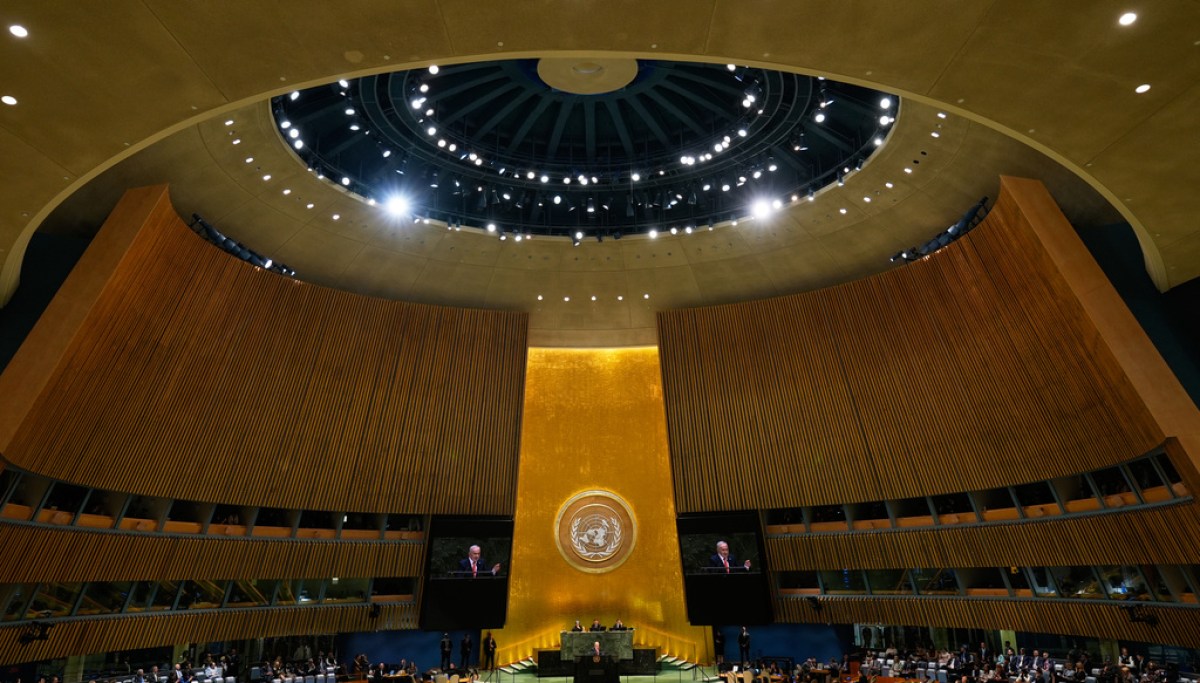
Thirty years ago, U.N. Secretary-General Boutros Boutros-Ghali offered an ambitious vision of the institution he led. The Cold War was over. Globalization was drawing countries together even as fragmentation threatened to pull them apart. The United Nations, he argued, could help build a more cooperative international order.He was remarkably confident. Nations would be bound closer together, and the credibility of the U.N. would deepen “year by year.”Thirty years later, another parade of world leaders gathered in New York. This year’s General Assembly theme is “Restoring Trust”, part of its promise of “A United Nations That Delivers for All.” Secretary-General Antonio Guterres offered a darker assessment: Geopolitical divisions have deepened, and trust has eroded. That may be the most realistic thing said at the U.N. all week.The question after eight decades is whether gathering most of the world’s leaders in the same city every September is making the world appreciably better at solving its problems. Russia and the West remain divided over Ukraine. Wars consume the Middle East, where ancient religious, ethnic, and territorial disputes continue to fuel modern conflicts with global implications. Large parts of Africa remain trapped in civil war, religious violence, and persistent poverty. Great powers repeatedly collide in the Security Council. In important ways, we are further apart.The record has exposed a basic weakness in an institution built around sovereign equality: Giving every country a voice does not mean every government is equally qualified to exercise every institutional responsibility.Small countries deserve a voice alongside powerful ones. That should not change. But representation is not the same as qualification. Yet the U.N. repeatedly places governments with troubling records in positions where they help judge the conduct of others.Look at the Human Rights Council. Its 2026 membership includes China and Cuba, along with Burundi, Ethiopia, Iraq, Pakistan, Qatar, and Vietnam. They deserve representation at the U.N. Whether that qualifies governments to sit in judgment of the human-rights conduct of others is another question.Israel provides the clearest example of distorted priorities. The U.N. has legitimate grounds to scrutinize Israeli conduct. But Israel occupies a permanent agenda position in the Human Rights Council under Item 7, a distinction no other country receives.Israeli Prime Minister Benjamin Netanyahu speaks during the 81st session of the U.N. General Assembly at the U.N. headquarters, Thursday, Sept. 24, 2026. (AP Photo/Seth Wenig) Why has an institution created to address human rights everywhere institutionalized special scrutiny of one country, while governments with severe human rights records sit on the council?The same problem reaches into the bureaucracy. The “paramount consideration” in hiring should be efficiency, competence, and integrity, according to the U.N. Charter. Yet geography, national claims on positions, and diplomatic convention have become woven into how the institution operates.An American traditionally heads political and peacebuilding affairs. A Chinese official oversees economic and social affairs. A Briton traditionally gets humanitarian affairs, a French official peacekeeping, and a Russian counterterrorism.Read that last one again.Russia effectively retains an informal claim on the U.N.’s counterterrorism leadership. Nothing in the charter requires this arrangement.What convention created, convention can end.The system has also produced a vast international bureaucracy. More than 40,000 resolutions, decisions, and presidential statements have accumulated since 1946.The institution has become exceptionally good at perpetuating process. Conferences produce declarations. Declarations create mandates. Mandates require offices, reports, committees, and staff. Activity becomes easier to measure than results.Washington’s own behavior has hardly clarified matters. The United States carries roughly $4 billion in arrears to regular and peacekeeping budgets while pledging billions to U.N. humanitarian agencies. U.S. Ambassador to the U.N. Mike Waltz pushes cuts while President Donald Trump chairs a Board of Peace designed partly to work around the U.N.Half in, half out. Call it what it is: a mood, not a policy.Consider Iran. On Sept. 17, Russia and China vetoed a U.S. resolution extending the mandate of the panel monitoring U.N. sanctions on Iran. Eleven Security Council members supported it.The same pattern appeared April 7 when Russia and China vetoed a resolution encouraging states to coordinate protection of merchant shipping in the Strait of Hormuz. Again, 11 members supported it.There is the U.N. problem in miniature. Eleven of 15 Security Council members can agree, and the institution still cannot act because two permanent members decide their interests lie elsewhere.The dysfunction runs below the Security Council. On April 8, the Economic and Social Council elected Iran by acclamation to the Committee for Program and Coordination and seated China, Cuba, Nicaragua, Saudi Arabia, and Sudan on the committee that decides which nongovernmental organizations receive U.N. access. No recorded vote was taken. Dan Negrea, the U.S representative to the U.N. Economic and Social Council, announced that the U.S. “disassociates from consensus,” objected to the seating of Cuba and Nicaragua, and called Iran “unfit to serve.”He was right, but he did not go far enough. Washington should have objected to the whole slate. Beijing, Havana, and Managua jail their critics, and Khartoum’s army is fighting a civil war that has displaced millions. None of them belongs on a committee that decides which civil society groups get a voice at the U.N.Britain, France, Canada, and Australia did not object. That silence is the dysfunction. Once the worst actors hold the committee seats, a lone American objection is the only thing that stops them.Then there is the money.The 2026 regular budget abolished about 2,900 positions. That is real reform. But it prompts an obvious question: Why did it require a financial crisis to discover that thousands of positions could be eliminated?Selection of the next secretary-general is therefore a test. Washington should demand genuine competition for senior positions, an end to obsolete mandates, and cuts to headquarters management with the same seriousness applied elsewhere.That leaves Washington with the question it has avoided all year.In or out?Leaving carries serious costs. The U.S. would surrender its Security Council veto and a forum in which Washington can force Russia, China, and others to defend their positions publicly.Some U.N. capabilities are also useful. Buy what works.For now, stay in. But stay in with a plan.A five-year program should target obsolete mandates, an oversized bureaucracy, protected senior positions, questionable committee assignments, and programs that cannot demonstrate results. Set benchmarks, publish progress, and invite allies that still see value in the institution to join the effort.Then make the consequence clear. If meaningful reforms are not implemented within five years, the U.S. should be prepared to withdraw. Withdrawal should not be an annual threat whenever Washington loses a vote. It should be the stated consequence of giving an institution a reasonable opportunity to reform and watching it choose not to do so.Boutros-Ghali’s 1996 vision reflected the optimism of the post-Cold War moment. Perhaps institutions really could substitute rules and cooperation for traditional power politics. We have now run the experiment for three decades. Another General Assembly has brought nearly every government on earth to New York. And the world is not drawing together.TRUMP AND XI SIZE EACH OTHER UPThe U.N.’s problem is no longer a shortage of ambition. It is the distance between ambition and results. Enough is enough. Accepting dysfunction year after year is not a policy.Thirty years ago, the U.N. asked the world to invest in its promise. Washington should now give it five years to demonstrate that promise can still be redeemed.
The US should no longer accept the UN’s dysfunction
Full Article
Original Source
Read the full article at Washingtonexaminer →KhanList aggregates and links to publicly available news content. We do not host full articles from third-party sources. Always verify important information with original sources.