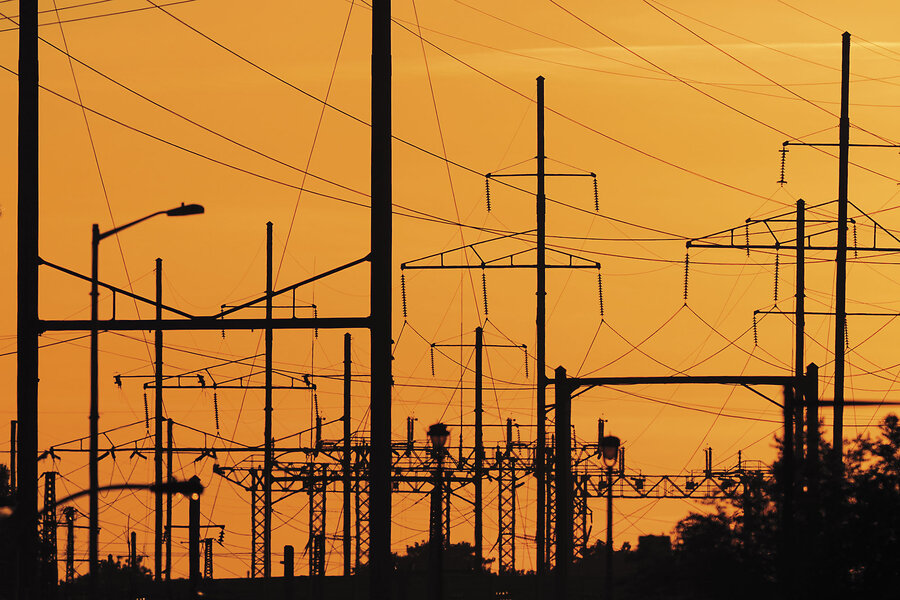
In many ways, America’s bureaucracy-laden electric grid has been like an old farm wagon – slow-moving, showing its age, and still operating under the assumption that electric demand grows slowly and consistently. Now, industry and government want to hook that wagon up to a Ferrari.The artificial intelligence industry is building power-hungry data centers across the country in a race to keep ahead of surging AI demand. At the same time, non-AI sectors, such as electric vehicles and new construction, are also dialing up demand. That dynamic is shaking the electric power industry to its core.Yet the biggest obstacle to meeting that demand is not more electricity generation. It’s modernizing the regulatory and infrastructure choke points that are slowing the construction of new power plants and keeping already available energy from reaching the people who need it most. Why We Wrote This Efforts to modernize the aging electric grid, amid surging demand for power, are running up against challenges, including bureaucratic delays. How big is the challenge, and what are the obstacles?Upgrading the electric grid is a major challenge. The United States last year installed 53 gigawatts of new electric power capacity, the biggest annual increase since 2002, according to the U.S. Energy Information Administration. This year, that number could reach a record 86 GW. Still, such increases might not be enough to meet the surging demand, and obstacles remain.Many Americans don’t want power plants built or electric lines strung near their homes. And building a traditional power plant is costly. So electric power companies and regulators are cautious, hesitating to construct plants unless future demand is guaranteed.The AI industry, by contrast, turns on a dime. And while it’s booming now, there’s no guarantee that the boom won’t turn into a bust if the industry consolidates into one or two winners. Perhaps the biggest challenge of all is bureaucratic delay in modernizing the grid, which can cause planned energy projects to be canceled altogether.What’s being done to add capacity?Power plants are being built rapidly. In some cases, AI companies are building their own plants to power data centers, bypassing the grid entirely. To get local approval, they’ve also signed pledges that their projects won’t raise local utility bills. SOURCE: U.S. Department of Homeland Security, U.S. Energy Information Administration, Edison Electric Institute | Jacob Turcotte/Staff The Trump administration is moving to ease environmental and other regulations so that power plants can be built more quickly. For the first 11 months of 2025, the nation installed some 4.2 GW of gas-fired generating capacity, more than double the capacity from the same period a year earlier, according to the Federal Energy Regulatory Commission. That is enough electric capacity to power millions of homes.Another potential winner is nuclear power in the form of small and midsize plants that can be built more quickly than traditional big power plants. “Nuclear is having this amazing wave of investment,” Evelyn Wang, an engineering professor at the Massachusetts Institute of Technology and former director at the federal government’s Advanced Research Projects Agency-Energy, said at a Houston energy conference in March.But the biggest winner might be green energy, despite the administration’s attempts to slow or kill such projects. Many companies have embraced solar and wind power installations because they are quick and relatively easy to put up. In that same 11-month period last year, the nation added 10 times more solar than natural gas capacity, and wind was double the natural gas total. The demand for power is such that wind and solar are shifting from serving as alternative sources of energy to being part of the nation’s energy core.Industry analysts say it’s still early days, and it’s not yet clear which of the competing technologies will emerge as winners.Isn’t green energy fickle, dependent on the sun and wind? Yes, solar and wind are intermittent energy sources. But power companies are getting around that by deploying battery storage to capture that power when it’s produced and feed it onto the grid when it’s needed. In states like Texas and California, the speed of battery deployment “is truly extraordinary,” says Sally Benson, a Stanford University professor who served as chief energy-transitionstrategist at the White House Office of Science and Technology Policy during the Biden presidency. Since 2019, California’s battery storage capacity has exploded by some 2,000%. On many nights, from about 6 p.m. to 10 p.m., the state’s No. 1 source of electricity is stored energy from lithium-ion batteries, she says.When will capacity catch up to demand?Delays connecting new power plants to the grid are hampering progress. At the end of last year, planned facilities totaling more than 2,060 GW of power and storage had hookup applications pending. The queue is long, and the approval process is slowing.Because of that delay, most of those plants won’t get built, concluded the Lawrence Berkeley National Laboratory in a recent report. Of power developers’ applications filed between 2000 and 2019 to connect projects to the grid, only 13% of the proposed new capacity had reached commercial operations by the end of 2024. Since the beginning of the 2000s, the average wait time for approval has doubled to more than four years.A related problem: insufficient transmission lines to carry the energy from where it’s produced to where it’s needed. Various estimates suggest that in the next four years, the nation will have to expand transmission systems by 60%, the Department of Energy reports. By 2050, the nation might need triple today’s capacity.“The grid is old, and it needs to be fixed,” says Roger Diwan, a vice president for S&P Global Energy. “And there is a little bit of pain in doing that. [But] the fact that we have large customers who are merging, who want [more energy] faster, but also are capable of providing the capital for it, is very important. And in a way, it will solve a lot of the problems.”
The US needs more electricity. Can the grid deliver?
Full Article
Original Source
Read the full article at Csmonitor →KhanList aggregates and links to publicly available news content. We do not host full articles from third-party sources. Always verify important information with original sources.